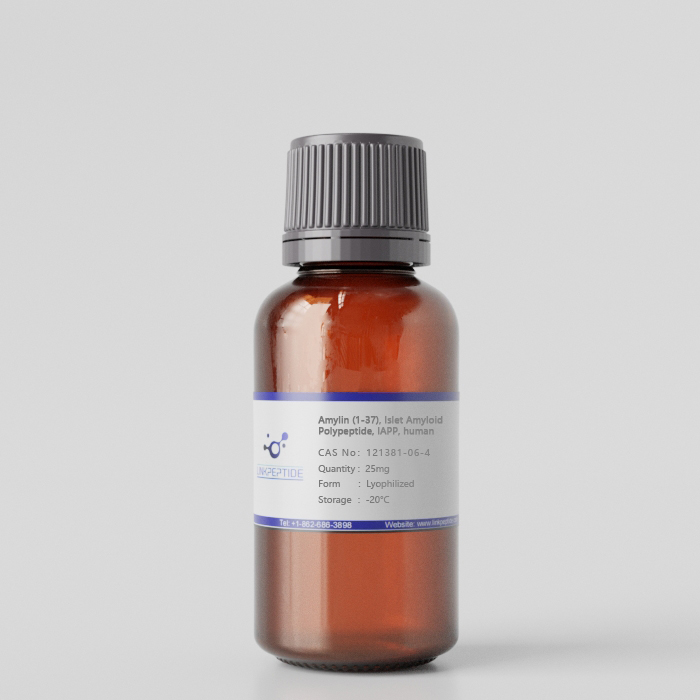
Product Name: Amylin (1-37), Islet Amyloid Polypeptide, IAPP, human
Sequence One Letter Code: KCNTATCATQRLANFLVHSSNNFGAILSSTNVGSNTY (Disulfide bridge: 2-7)
Sequence Three Letter Code: H-Lys-Cys-Asn-Thr-Ala-Thr-Cys-Ala-Thr-Gln-Arg-Leu-Ala-Asn-Phe-Leu-Val-His-Ser-Ser-Asn-Asn-Phe-Gly-Ala-Ile-Leu-Ser-Ser-Thr-Asn-Val-Gly-Ser-Asn-Thr-Tyr-OH (Disulfide bridge: 2-7)
Cas No: 121381-06-4
Chemical Formula:C165H260N50O56S2
Molecular Weight: 3904.5
Purity: 95%
Form: Lyophilized
Storage Conditions: - 20 °C
Research Area: Diabetes and Metabolic Syndrome
Source / Species: human
Conjugation: Unconjugated
Code Nacres: NA.26
Application: Amylin (1–37), also known as human Islet Amyloid Polypeptide (IAPP), is a synthetic form of the endogenous 37–amino acid hormone co-secreted with insulin by pancreatic β-cells. Amylin regulates postprandial glucose homeostasis by slowing gastric emptying, suppressing glucagon secretion, and promoting satiety. In addition to its physiological role, human IAPP is the principal component of amyloid deposits observed in pancreatic islets of patients with type 2 diabetes mellitus. Due to its intrinsic aggregation propensity, it is extensively used to study amyloid formation, peptide misfolding, and β-cell toxicity mechanisms. This peptide serves as a valuable tool in metabolic and diabetes research, supporting investigations into hormone co-secretion dynamics, amyloidogenesis, and molecular pathways contributing to islet dysfunction and disease progression.
Current Research: Amylin (1–37), or human Islet Amyloid Polypeptide (hIAPP), occupies a dual position in contemporary metabolic research: it is both a physiological regulator of postprandial glucose homeostasis and a central molecular driver of islet amyloid formation in type 2 diabetes mellitus (T2DM). As a 37–amino acid peptide co-secreted with insulin from pancreatic β-cells in response to nutrient stimulation, amylin modulates glucose flux through coordinated endocrine and gastrointestinal mechanisms. At the same time, its intrinsic aggregation propensity underlies β-cell proteotoxic stress, making it one of the most intensively studied amyloidogenic peptides in metabolic disease. Physiological Role in Glucose Regulation Under normal conditions, amylin is secreted in parallel with insulin at an approximate molar ratio of 1:100. It acts via amylin receptors—heterodimeric complexes composed of the calcitonin receptor (CTR) and receptor activity-modifying proteins (RAMPs)—to regulate postprandial glucose excursions. Current research continues to clarify three primary mechanisms: Delayed gastric emptying, which moderates the rate of glucose absorption. Suppression of postprandial glucagon secretion, reducing hepatic glucose output. Central satiety signaling, mediated through the area postrema and other brainstem nuclei. Recent metabolic studies emphasize amylin’s integration with GLP-1 and insulin signaling networks, highlighting synergistic actions in appetite regulation and energy balance. The growing interest in dual amylin/GLP-1 receptor agonists for obesity and T2DM therapy has renewed attention to the native hormone’s receptor pharmacology and downstream signaling bias. Structural Determinants of Amyloidogenesis Human IAPP is among the most aggregation-prone endocrine peptides. The amyloidogenic core region (residues 20–29) plays a decisive role in β-sheet formation and fibrillogenesis. Unlike rodent IAPP, which contains proline substitutions that disrupt β-sheet assembly, human IAPP readily forms oligomers and fibrils under physiological conditions. Current biophysical research focuses on the early oligomeric intermediates, which are believed to be the principal cytotoxic species rather than mature fibrils. Advanced techniques such as cryo-electron microscopy, solid-state NMR, and high-resolution fluorescence spectroscopy are being used to resolve fibril polymorphism and structural heterogeneity. These efforts aim to correlate aggregate conformation with membrane disruption capacity and β-cell toxicity. Synthetic Amylin (1–37) is therefore widely employed in controlled aggregation assays to examine: Nucleation kinetics and seeding mechanisms Cross-seeding interactions with other amyloidogenic proteins Effects of pH, ionic strength, and lipid membranes on fibril formation Small-molecule or peptide-based aggregation inhibitors Mechanisms of β-Cell Toxicity A major focus of current diabetes research is understanding how IAPP aggregation contributes to progressive β-cell dysfunction. Oligomeric IAPP species interact with cellular membranes, promoting pore formation, calcium dysregulation, mitochondrial impairment, and activation of ER stress pathways. This culminates in oxidative stress and apoptosis. Recent studies further implicate inflammatory signaling pathways, including NLRP3 inflammasome activation and cytokine release, linking amyloid deposition to islet inflammation. Investigations using synthetic human IAPP in β-cell lines and isolated islets allow mechanistic dissection of these stress responses under reproducible experimental conditions. Hormone Co-Secretion and Islet Microenvironment Another evolving research direction examines how insulin and amylin co-packaging in secretory granules influences aggregation dynamics. Zinc ions, insulin hexamer formation, and granule pH are thought to modulate IAPP solubility prior to secretion. Disruption of this tightly regulated environment in insulin-resistant states may increase extracellular aggregation propensity. In vitro systems using Amylin (1–37) support studies on peptide–peptide interactions, granule-mimetic conditions, and extracellular matrix influences on amyloid deposition. These models help clarify how metabolic stress accelerates amyloidogenesis in T2DM progression. Translational and Therapeutic Context While native human IAPP is amyloidogenic, engineered analogs such as pramlintide incorporate proline substitutions that reduce aggregation while preserving receptor activity. Ongoing therapeutic development seeks to optimize amylin receptor agonism for metabolic benefit without amyloid liability. Parallel efforts aim to identify inhibitors of IAPP aggregation as potential disease-modifying strategies. Synthetic Amylin (1–37) remains essential in benchmarking aggregation kinetics, validating inhibitor screening platforms, and modeling islet amyloid deposition in vitro and in animal systems.
Get a Quote
 LinkPeptide