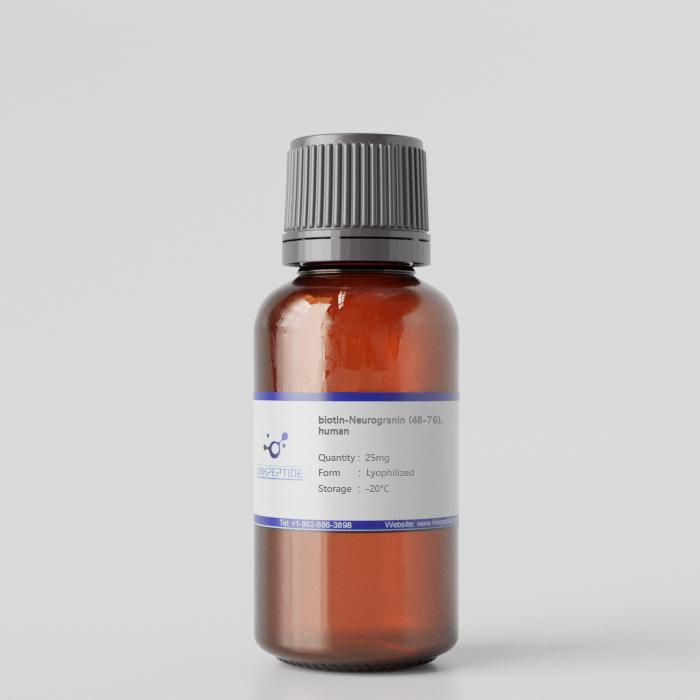
Product Name: biotin-Neurogranin (48-76), mouse
Sequence One Letter Code: Biotin-SGECGRKGPGPGGPGGAGGARGGAGGGPS-OH
Sequence Three Letter Code: biotin-Ser-Gly-Glu-Cys-Gly-Arg-Lys-Gly-Pro-Gly-Pro-Gly-Gly-Pro-Gly-Gly-Ala-Gly-Gly-Ala-Arg-Gly-Gly-Ala-Gly-Gly-Gly-Pro-Ser-OH
Chemical Formula:C101H162N38O36S2
Molecular Weight: 2548.9
Purity: 95%
Form: Lyophilized
Storage Conditions: - 20 °C
Research Area: Neurological Disease Research
Source / Species: mouse
Conjugation: Conjugated
Conjugation Type: Biotins
Code Nacres: NA.26
Application: Biotin-Neurogranin (48–76), mouse is an N-terminally biotinylated synthetic peptide corresponding to residues 48–76 of murine neurogranin, a postsynaptic protein enriched in neuronal dendritic cytoplasm. Neurogranin regulates calcium–calmodulin–dependent signaling pathways that are essential for synaptic plasticity, learning, and memory formation. The 48–76 fragment represents a major neurogranin-derived peptide detected in brain tissue and cerebrospinal fluid, with altered levels associated with Alzheimer’s disease and synaptic dysfunction. Biotin conjugation enables affinity capture, ELISA development, and sensitive detection in biomarker and protein–protein interaction studies. This peptide supports investigations into synaptic signaling mechanisms, neurodegenerative disease progression, and quantitative biomarker assay development in neurological research.
Current Research: Biotin-Neurogranin (48–76), mouse is an N-terminally biotinylated synthetic peptide corresponding to residues 48–76 of murine neurogranin (Ng), a neuron-specific postsynaptic protein highly enriched in dendritic spines. Neurogranin is a key regulator of calcium–calmodulin (CaM) signaling, functioning as a CaM-binding protein that modulates intracellular Ca²⁺ dynamics and downstream kinase activation. Through its interaction with calmodulin in a calcium-sensitive manner, neurogranin contributes to synaptic plasticity mechanisms that underlie learning and memory consolidation. The 48–76 fragment encompasses a biologically significant region of neurogranin that includes elements of the calmodulin-binding domain. Proteolytic processing of full-length neurogranin in the brain generates stable peptide fragments, among which the 48–76 sequence has emerged as a prominent species detectable in brain tissue and cerebrospinal fluid (CSF). In recent years, neurogranin-derived peptides—particularly mid-region fragments such as 48–76—have gained substantial attention as biomarkers of synaptic degeneration. Elevated CSF neurogranin levels correlate strongly with synaptic loss and cognitive decline in Alzheimer’s disease (AD), and are now widely investigated in the context of early-stage neurodegeneration and disease progression monitoring. Current research positions neurogranin as a synaptic integrity marker rather than a general neuronal injury marker. Unlike tau or neurofilament light chain, which reflect broader neuroaxonal damage, neurogranin levels more specifically mirror postsynaptic dysfunction. Quantitative studies show that increased CSF neurogranin concentrations are associated with amyloid-β pathology and predict accelerated cognitive deterioration in prodromal AD cohorts. This has made neurogranin fragments, including 48–76, central to biomarker panel development for differentiating AD from other neurodegenerative conditions. The N-terminal biotin conjugation of Biotin-Neurogranin (48–76) significantly expands its research utility. Biotinylation allows high-affinity capture via streptavidin-coated surfaces, enabling its application in ELISA calibration, competitive binding assays, and assay validation workflows. In biomarker assay development, synthetic biotinylated fragments serve as standards or spike-in controls for quantifying endogenous neurogranin-derived peptides in CSF or plasma samples. This is particularly relevant for ultrasensitive platforms such as Simoa, electrochemiluminescence assays, and mass spectrometry-based quantification methods. Beyond biomarker quantification, the peptide supports mechanistic studies of neurogranin–calmodulin interactions. Because residues 48–76 include key determinants of CaM binding, the fragment can be used in affinity pull-down experiments to characterize calcium-dependent binding kinetics, competitive inhibition, or structural mapping of interaction interfaces. In vitro systems frequently employ biotin-tagged peptides to immobilize the fragment on sensor chips for surface plasmon resonance (SPR) or biolayer interferometry (BLI), facilitating quantitative analysis of protein–protein interactions under controlled calcium concentrations. In neurodegenerative disease research, Biotin-Neurogranin (48–76) is also used to investigate proteolytic pathways that generate extracellular neurogranin fragments. Enzymes implicated in synaptic remodeling or degeneration—such as calpains and other activity-dependent proteases—are studied using defined peptide substrates to evaluate cleavage specificity and kinetics. These investigations contribute to understanding how synaptic stress and amyloid-related toxicity may enhance neurogranin fragmentation and release. Additionally, this peptide supports translational studies focused on therapeutic response monitoring. As disease-modifying treatments for Alzheimer’s disease and other dementias advance, synaptic biomarkers are increasingly evaluated as pharmacodynamic indicators. Changes in neurogranin fragment levels may provide early evidence of synaptic stabilization or continued degeneration, making standardized synthetic fragments essential for assay harmonization across laboratories. Overall, Biotin-Neurogranin (48–76), mouse represents a versatile research tool bridging molecular neuroscience and clinical biomarker development. It enables precise investigation of calcium–calmodulin–dependent synaptic signaling, facilitates quantitative detection of neurogranin fragments in neurodegenerative disease studies, and supports high-sensitivity assay development through biotin–streptavidin affinity systems. As synaptic dysfunction remains a central feature of Alzheimer’s disease and related disorders, defined neurogranin peptides such as 48–76 continue to play an important role in advancing mechanistic and translational neurological research.
Get a Quote
 LinkPeptide

![[Lys(Me2)20]-Histone H4 (8-30)-WGK(Biotin)](https://www.linkpeptide.com/wp-content/uploads/2026/06/LysMe220-Histone-H4-8-30-WGKBiotin.jpg "[Lys(Me2)20]-Histone H4 (8-30)-WGK(Biotin)")
![Ser(OGlcNAc)]400-KWK-Tau (388-411)-KK(Biotin)-NH2](https://www.linkpeptide.com/wp-content/uploads/2026/06/SerOGlcNAc400-KWK-Tau-388-411-KKBiotin-NH2.jpg "Ser(OGlcNAc)]400-KWK-Tau (388-411)-KK(Biotin)-NH2")
![[Lys(Me3)27]-Histone H3 (23-34)-GGK(Biotin)](https://www.linkpeptide.com/wp-content/uploads/2026/05/LysMe327-Histone-H3-23-34-GGKBiotin.jpg "[Lys(Me3)27]-Histone H3 (23-34)-GGK(Biotin)")