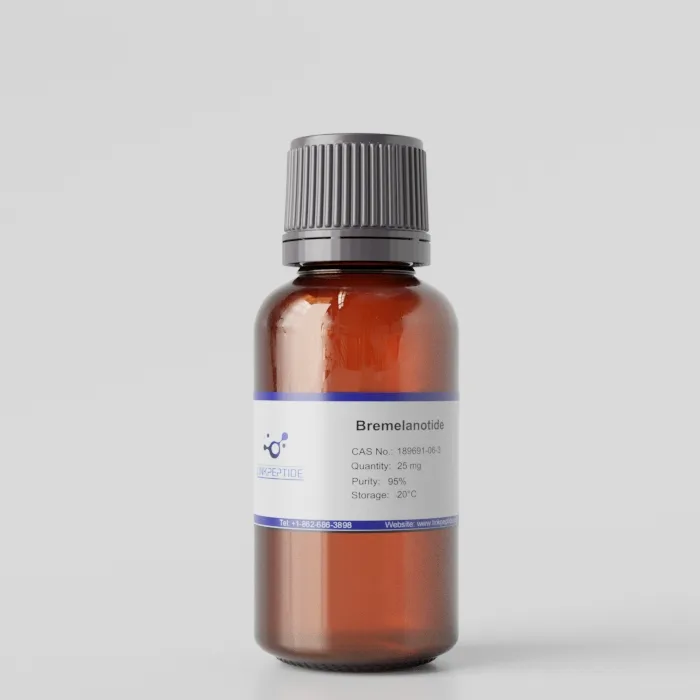
Product Name: Bremelanotide
Form: Free base
CAS No: 189691-06-3
Molar Mass: 1025.16
Chemical Formula: C50H68N14O10
Synonyms: PT 141, Vyleesi
Storage: Store at -20℃
Sequence: XDHFRWK
Target: Melanocortin (MC) Receptors
Application:
Bremelanotide (CAS: 189691-06-3) is a peptide drug that functions as a melanocortin receptor agonist, specifically targeting the melanocortin-4 receptor (MC4R). It exerts its effects by activating MC4R, which regulates appetite and sexual arousal. Bremelanotide has gained attention for its use in the treatment of female sexual dysfunction, including hypoactive sexual desire disorder (HSDD). By stimulating sexual arousal pathways in the brain, bremelanotide has shown promise in enhancing libido and sexual satisfaction in women. In the field of pharmaceutical chemistry, bremelanotide's mechanism of action on the central nervous system makes it an intriguing candidate for further research into therapies for sexual disorders and related conditions. Its potential applications extend to organic chemistry, where its peptide structure may serve as a template for the development of novel drug candidates targeting MC4R and other melanocortin receptors. Furthermore, bremelanotide's role in sexual health underscores its significance in improving quality of life and addressing unmet medical needs in this domain.
Current Research:
Bremelanotide is a synthetic peptide that acts as a melanocortin receptor agonist, specifically targeting the MC4R (melanocortin-4 receptor) in the brain. It is primarily used for the treatment of hypoactive sexual desire disorder (HSDD) in premenopausal women. HSDD is characterized by a lack of sexual desire that causes personal distress, and bremelanotide works by stimulating the melanocortin system, which is involved in sexual arousal and desire. This drug provides a novel, non-hormonal approach to managing sexual dysfunction, offering an alternative to traditional treatments like estrogen or testosterone therapy.
Mechanism of Action
Bremelanotide exerts its effects by activating melanocortin receptors, particularly MC4R, in the central nervous system. These receptors play a role in various physiological processes, including sexual behavior, appetite regulation, and energy homeostasis. When bremelanotide binds to these receptors, it stimulates areas of the brain associated with sexual desire and arousal. Specifically, the activation of MC4R can increase dopamine and other neurotransmitter levels in brain regions responsible for sexual motivation. Unlike traditional treatments for sexual dysfunction, bremelanotide does not affect hormones directly but instead targets the neural pathways involved in sexual desire.
Indications and Uses
Bremelanotide is indicated for the treatment of hypoactive sexual desire disorder (HSDD) in premenopausal women. It is typically used when other treatments have been ineffective or are not appropriate. The drug is administered via subcutaneous injection, typically self-administered in the thigh or abdomen 45 minutes before sexual activity. Bremelanotide is not intended for continuous daily use, but rather as an on-demand treatment to help improve sexual desire and reduce distress associated with low libido. It provides an option for women who experience sexual dysfunction and is distinct from other treatments that may require long-term use or have hormonal side effects.
Efficacy and Clinical Benefits
Clinical studies have demonstrated that bremelanotide significantly improves sexual desire and satisfaction in women with HSDD. In controlled trials, women who used bremelanotide experienced an increase in the number of sexually satisfying events and reported improvements in sexual desire. The drug's on-demand nature allows for more flexibility compared to daily medications, making it an appealing option for many women. Additionally, bremelanotide does not have the same hormonal side effects as other treatments, such as estrogen or testosterone therapy, and can be used in a wider range of patients, including those with contraindications to hormonal treatments.
Safety and Tolerability
Bremelanotide is generally well tolerated, though it can cause side effects. The most common adverse reactions include nausea, which occurs in a significant number of patients following administration. Other side effects may include headache, flushing, and injection site reactions such as pain or redness. These side effects are typically transient and resolve after a short period. In rare cases, bremelanotide can cause more severe reactions such as increased blood pressure or darker skin pigmentation, although these effects are not common. As with any drug, it is essential to monitor patients for adverse effects, especially in the initial stages of treatment.
Advantages and Limitations
The primary advantage of bremelanotide is its non-hormonal mechanism of action, which can benefit women who are unable or unwilling to use hormonal treatments for sexual dysfunction. It is an on-demand treatment, allowing for flexibility in its use, which is particularly advantageous for patients who do not require continuous daily therapy. However, bremelanotide’s efficacy may vary among individuals, and it does not address underlying causes of sexual dysfunction, such as psychological factors, that may contribute to HSDD. Additionally, side effects like nausea can be a limiting factor for some patients.
Future Directions
Ongoing research is focused on exploring the use of bremelanotide in other conditions related to sexual dysfunction, including those affecting men or postmenopausal women. Studies are also investigating potential improvements in drug delivery methods, such as oral formulations, to make it even more convenient for patients. Furthermore, future clinical trials may assess bremelanotide’s effectiveness in combination with other treatments for sexual dysfunction, potentially providing more comprehensive therapeutic options.
Reference:
Dhillon, S., & Keam, S. J. (2019). Bremelanotide: first approval. Drugs, 79(14), 1599-1606.
Get a Quote
 LinkPeptide