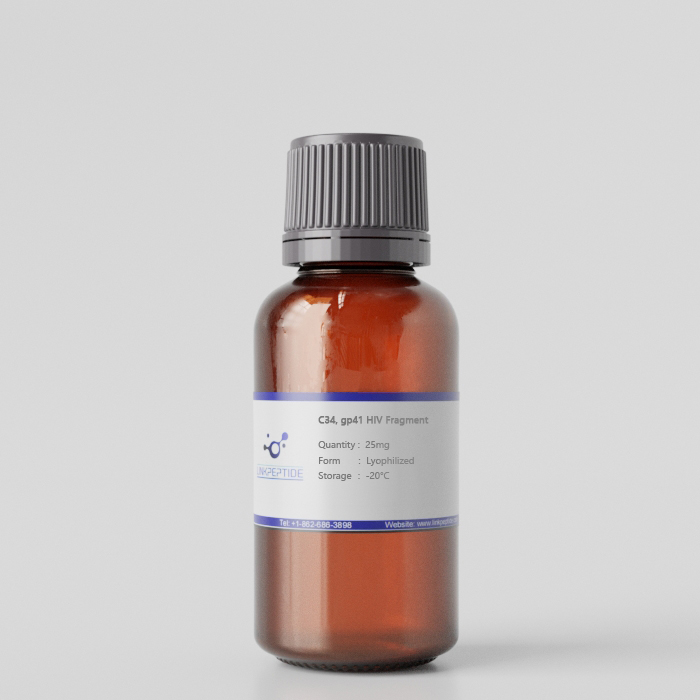
Product Name: C34, gp41 HIV Fragment
Sequence One Letter Code: WMEWDREINNYTSLIHSLIEESQNQQEKNEQELL
Sequence Three Letter Code: H-Trp-Met-Glu-Trp-Asp-Arg-Glu-Ile-Asn-Asn-Tyr-Thr-Ser-Leu-Ile-His-Ser-Leu-Ile-Glu-Glu-Ser-Gln-Asn-Gln-Gln-Glu-Lys-Asn-Glu-Gln-Glu-Leu-Leu-OH
Chemical Formula:C184H280N50O64S1
Molecular Weight: 4248.8
Purity: 95%
Form: Lyophilized
Storage Conditions: - 20 °C
Research Area: Antiviral
Source / Species: HIV
Conjugation: Unconjugated
Code Nacres: NA.26
Application: C34 Peptide is derived from the C-terminal heptad repeat 2 (HR2) region of the HIV-1 gp41 envelope glycoprotein, a structural domain essential for viral membrane fusion during HIV entry into host cells. The peptide binds specifically to the complementary HR1 region of gp41, preventing the formation of the six-helix bundle that drives viral and cellular membrane fusion. By blocking this critical step in the viral entry process, C34 functions as a potent inhibitor of HIV-1 fusion and entry. Due to its well-defined mechanism, the C34 peptide is widely used in studies of viral fusion mechanisms, HIV envelope protein structure–function relationships, and antiviral drug discovery, and serves as a valuable research tool for exploring therapeutic strategies targeting HIV membrane fusion.
Current Research: Human immunodeficiency virus type 1 (HIV-1) enters host cells through a highly coordinated membrane fusion process mediated by the viral envelope glycoproteins gp120 and gp41. This fusion event enables the viral membrane to merge with the host cell membrane, allowing the viral genome to enter the cell and initiate infection. Because membrane fusion is essential for viral entry, components of the gp41 fusion machinery have become major targets for mechanistic studies and antiviral drug development. The C34 peptide is a synthetic peptide derived from the C-terminal heptad repeat 2 (HR2) region of the HIV-1 gp41 envelope glycoprotein. By mimicking a critical segment of the viral fusion protein, the peptide can interfere with the structural rearrangements required for viral entry. Due to its defined inhibitory mechanism, C34 has become an important research reagent for investigating viral fusion mechanisms, envelope protein structure, and entry inhibitor development. HIV-1 Envelope Glycoprotein and Membrane Fusion The HIV-1 envelope glycoprotein complex consists of two subunits: gp120, which mediates receptor binding, and gp41, which drives membrane fusion. During viral entry, gp120 first binds to the CD4 receptor on host cells, followed by interaction with a co-receptor such as CCR5 or CXCR4. These interactions trigger conformational changes that expose the fusion machinery within gp41. Gp41 contains two highly conserved regions known as heptad repeat 1 (HR1) and heptad repeat 2 (HR2). These regions undergo a major structural rearrangement during the fusion process. The HR1 and HR2 segments fold together to form a six-helix bundle, a stable structure that brings the viral and host membranes into close proximity. Formation of this six-helix bundle is the key step that drives membrane fusion, allowing the viral envelope to merge with the host cell membrane. Mechanism of Action of the C34 Peptide The C34 peptide corresponds to a sequence from the HR2 region of gp41. Because it mimics a natural segment of the viral fusion protein, the peptide can interact with the HR1 region of gp41 during the fusion process. When C34 binds to HR1, it prevents the normal HR1–HR2 interaction required to assemble the six-helix bundle. As a result, the conformational changes necessary for membrane fusion cannot occur. By blocking formation of this fusion structure, the peptide effectively inhibits HIV-1 entry into host cells. This mechanism makes C34 a powerful experimental tool for studying the molecular events that occur during viral membrane fusion. Studying gp41 Structure–Function Relationships The gp41 protein undergoes dramatic structural transitions during HIV entry, making it a key focus of structural and biophysical studies. The C34 peptide has been widely used in research exploring gp41 folding, conformational dynamics, and fusion intermediate states. Because the peptide specifically interacts with the HR1 region, it helps researchers examine how the HR1–HR2 interface contributes to six-helix bundle formation. Experiments using C34 have contributed to detailed structural models of the gp41 fusion core and have clarified how viral envelope proteins coordinate membrane fusion. These insights are important for understanding how HIV infects host cells and how fusion inhibitors disrupt this process. Applications in Viral Fusion Research The C34 peptide is widely applied in laboratory studies focused on the mechanisms of viral entry and membrane fusion. Typical experimental applications include: Biochemical assays analyzing HR1–HR2 interactions Structural studies of gp41 fusion intermediates Cell-based assays measuring inhibition of HIV membrane fusion Comparative studies examining fusion mechanisms among viral strains Because the peptide targets a conserved region of gp41, it can also be used to investigate how sequence variations influence viral fusion efficiency. Role in Antiviral Drug Discovery Membrane fusion inhibitors represent an important class of antiviral strategies targeting the early stages of HIV infection. Peptides derived from gp41 heptad repeat regions have played a significant role in the development of fusion inhibitor therapeutics. C34 serves as a valuable model inhibitor for studying how peptide-based molecules can block gp41-mediated fusion. Researchers use the peptide in screening assays and mechanistic studies aimed at identifying compounds that disrupt the fusion machinery. These studies help guide the design of next-generation antiviral agents targeting HIV entry. Supporting Research on HIV Entry Mechanisms Understanding how HIV fuses with host cell membranes remains critical for advancing antiviral strategies and improving knowledge of viral infection pathways. Synthetic peptides derived from viral fusion proteins provide powerful tools for dissecting these complex molecular events. The C34 peptide, derived from the HR2 region of gp41, specifically interferes with six-helix bundle formation and blocks viral membrane fusion. Through its application in structural analysis, biochemical assays, and antiviral research, C34 continues to support investigations into HIV entry mechanisms, viral envelope protein function, and therapeutic strategies targeting membrane fusion.
Get a Quote


 LinkPeptide