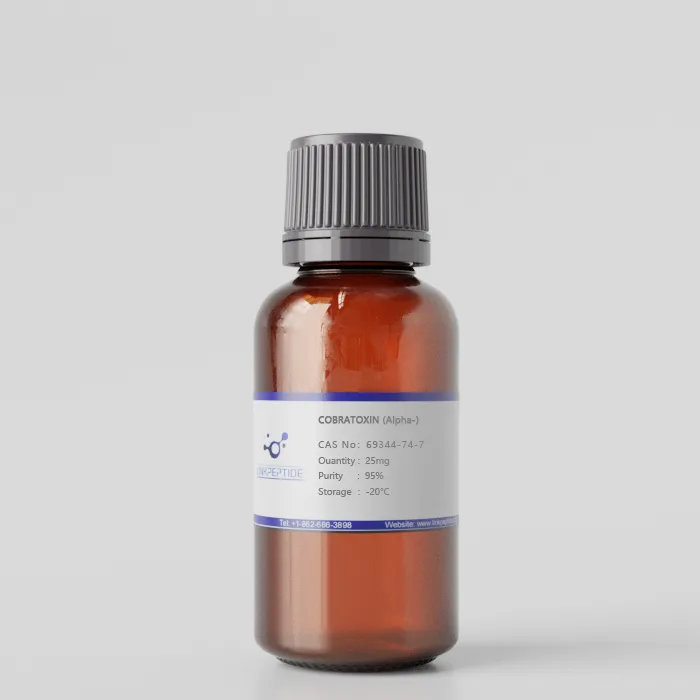
Product Name:COBRATOXIN (Alpha-)
Synonyms:NAJA NAJA KAOUTHIA TOXIN;NEUROTOXIN 3;NEUROTOXIN III;MONOCELLATE COBRATOXIN;ALPHA-COBRATOXIN;ALPHA-COBROTOXIN;COBRATOXIN;LONG NEUROTOXIN 1
CAS No:69344-74-7
Purity:95%
Molar Mass:7820.91
Chemical Formula:C332H520N98O101S10
Storage:Store at -20 degrees Celsius
Sequence:IRCFITPDIT SKDCPNGHVC YTKTWCDAFC SIRGKRVDLG CAATCPTVKT GVDIQCCSTD NCNPFPTRKR P
Target:nAChRs
Application:
Alpha-Cobratoxin is a potent neurotoxin derived from the venom of the Thai cobra (Naja kaouthia). This toxin specifically targets nicotinic acetylcholine receptors (nAChRs) at the neuromuscular junction, where it binds with high affinity and blocks the action of acetylcholine, effectively preventing the transmission of nerve impulses to muscles. The resulting inhibition leads to paralysis, making Alpha-Cobratoxin a valuable tool in neurobiological research. It is widely used to study the structure and function of nAChRs, explore the mechanisms of neurotoxicity, and investigate potential therapeutic interventions for neuromuscular diseases. Its specificity and potency provide critical insights into receptor-ligand interactions.
Current Research:
Alpha-Cobratoxin, a neurotoxic peptide derived from the venom of the cobra (Naja spp.), is a member of the three-finger toxin (3FTx) family. This 71-amino acid peptide exhibits high specificity for nicotinic acetylcholine receptors (nAChRs) at the neuromuscular junction, making it a critical tool in neurophysiology and pharmacology.
Mechanism of Action
Alpha-Cobratoxin binds irreversibly to the alpha-subunit of nAChRs, effectively blocking the binding of acetylcholine. This inhibition prevents receptor activation, halting synaptic transmission and causing neuromuscular paralysis. Its high affinity for nAChRs ensures potent and prolonged effects, which have made it a model molecule for studying receptor dynamics and neuromuscular function.
Applications in Research
Neurobiology Studies: Alpha-Cobratoxin is extensively used to investigate the structure and function of nAChRs. By selectively inhibiting these receptors, it allows researchers to dissect the role of cholinergic signaling in synaptic transmission and neuronal excitability.
Therapeutic Development: The toxin serves as a reference molecule for developing drugs targeting nAChRs, particularly in the treatment of disorders like myasthenia gravis, epilepsy, and neurodegenerative diseases.
Structural Insights: Its well-characterized interaction with nAChRs has contributed to our understanding of receptor-ligand binding mechanisms, aiding in the design of receptor-specific drugs and inhibitors.
Structural Features
Alpha-Cobratoxin adopts a compact structure stabilized by multiple disulfide bridges, typical of three-finger toxins. This stability enhances its binding affinity and specificity, ensuring its effectiveness as a research tool.
Conclusion
Alpha-Cobratoxin remains a cornerstone in neurotoxin research, providing valuable insights into nicotinic acetylcholine receptor biology. Its precision in targeting these receptors has facilitated advancements in understanding synaptic transmission, receptor pharmacology, and therapeutic development. This peptide continues to play a significant role in unraveling the complexities of neuromuscular physiology and cholinergic signaling.
Reference:
Get a Quote
 LinkPeptide

![[Nphe1]Nociceptin(1-13)NH2](https://www.linkpeptide.com/wp-content/uploads/2024/10/Nphe1Nociceptin1-13NH2-jpg-3.webp "[Nphe1]Nociceptin(1-13)NH2")
![SCYLLATOXIN [Tyr2]-](https://www.linkpeptide.com/wp-content/uploads/2024/10/SCYLLATOXIN-Tyr2-jpg-2.webp "SCYLLATOXIN [Tyr2]-")