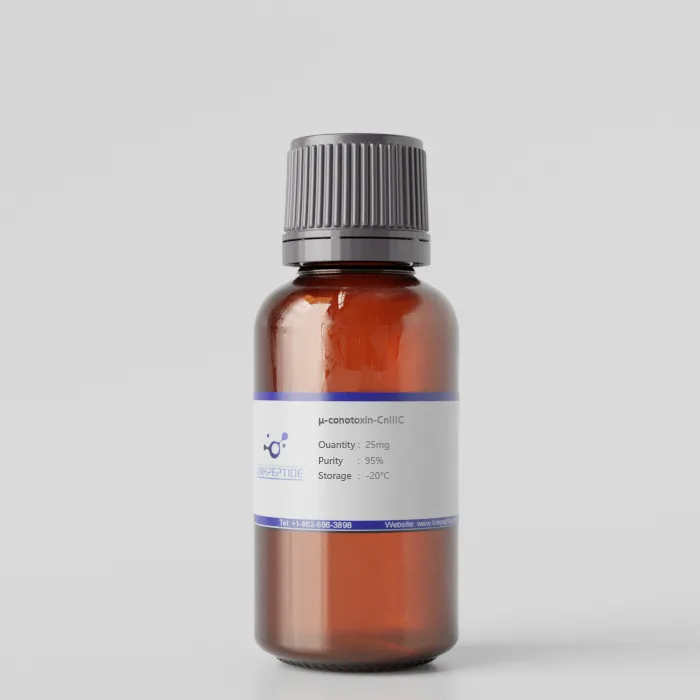
Product Name:µ-conotoxin-CnIIIC
Synonyms:Mu-Conotoxin CnIIIC
Purity:95%
Molar Mass:2376
Chemical Formula:C92H139N35O28S6
Storage:Store at -20 degrees Celsius
Sequence:ZGCCNGPKGCSSKWCRDHARCC
Target:NaV channels, α3/β2 nAChR
Application:
µ-Conotoxin CnIIIC is a peptide toxin derived from the venom of the Conus consors cone snail. It is a potent and selective blocker of voltage-gated sodium channels, specifically targeting both skeletal muscle (Nav1.4) and neuronal (Nav1.7) sodium channels. This unique dual targeting makes µ-conotoxin CnIIIC a valuable tool for studying the role of these channels in pain signaling, neuromuscular transmission, and excitability of neurons. Researchers use this peptide to investigate potential treatments for chronic pain and neurological disorders associated with abnormal sodium channel activity. Its high specificity also offers insight into sodium channel pharmacology and neurotoxin interactions.
Current Research:
μ-Conotoxin CnIIIC is a 22-amino-acid peptide isolated from the venom of the marine cone snail Conus consors. It functions as a potent and selective blocker of voltage-gated sodium channels, particularly the Naᵥ1.4 subtype found predominantly in skeletal muscle. This specificity makes it a valuable tool for studying sodium channel physiology and potential therapeutic applications.
Structural Characteristics
The peptide's structure includes three disulfide bridges, which are crucial for its stability and bioactivity. These disulfide bonds contribute to the peptide's ability to effectively occlude the sodium channel pore, thereby inhibiting ion conductance.
Mechanism of Action
μ-Conotoxin CnIIIC binds to site I on the α-subunit of voltage-gated sodium channels, physically blocking the channel pore. This action prevents sodium ion influx, thereby inhibiting action potential propagation in muscle cells. The peptide exhibits high specificity for the Naᵥ1.4 channel, with an inhibition constant (IC₅₀) of approximately 1.4 nM, making it a valuable tool for distinguishing between neuronal and muscle sodium channel subtypes.
Pharmacological Effects
In preclinical studies, μ-Conotoxin CnIIIC has demonstrated significant biological activity:
Analgesic Properties: By inhibiting sodium channels involved in pain transmission, μ-Conotoxin CnIIIC has shown potential as a pain-relieving agent.
Anesthetic Effects: The blockade of sodium channels can lead to localized anesthesia, suggesting applications in surgical procedures.
Muscle Relaxation: Inhibition of Naᵥ1.4 channels results in reduced muscle excitability, indicating potential use as a muscle relaxant.
Research Applications
Due to its specificity, μ-Conotoxin CnIIIC is extensively used in neurophysiological studies to:
Investigate Sodium Channel Function: By selectively inhibiting Naᵥ1.4 channels, researchers can study the role of these channels in muscle physiology and related pathologies.
Develop Therapeutic Agents: Understanding the interaction between μ-Conotoxin CnIIIC and sodium channels aids in the design of novel therapeutics targeting channelopathies.
Clinical Implications
The ability of μ-Conotoxin CnIIIC to selectively block muscle-specific sodium channels positions it as a potential therapeutic candidate for conditions involving hyperexcitability of skeletal muscles, such as certain myotonias. However, its application is currently limited to research settings, and further studies are necessary to explore its therapeutic potential.
Conclusion
μ-Conotoxin CnIIIC serves as a powerful tool in the study of voltage-gated sodium channels, offering insights into their function and paving the way for potential therapeutic developments targeting muscle-related disorders.
Reference:
Get a Quote
 LinkPeptide

![LEIUROTOXIN I [R7]-](https://www.linkpeptide.com/wp-content/uploads/2024/10/LEIUROTOXIN-I-R7-jpg-2.webp "LEIUROTOXIN I [R7]-")
![SCYLLATOXIN [Tyr2]-](https://www.linkpeptide.com/wp-content/uploads/2024/10/SCYLLATOXIN-Tyr2-jpg-2.webp "SCYLLATOXIN [Tyr2]-")