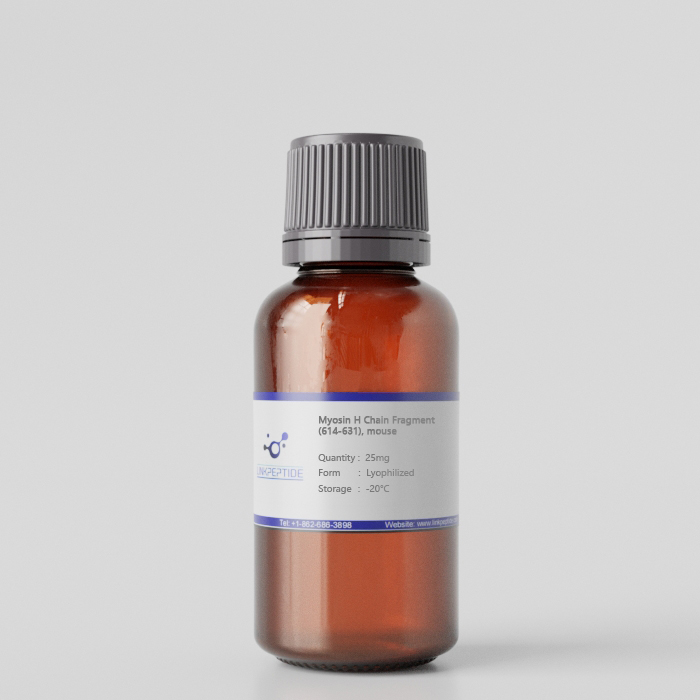
Product Name:DAPK Substrate Peptide
CAS No:386769-53-5
Purity:95%
Molar Mass:1578.8
Chemical Formula:C70H115N25O17
Storage:Store at -20 degrees Celsius
Sequence:KKRPQRRYSNVF
Target:DAPK
Application:
DAPK Substrate Peptide is a synthetic peptide designed as a specific substrate for Death-Associated Protein Kinase (DAPK), a serine/threonine kinase involved in various cellular processes, including apoptosis, autophagy, and cytoskeletal dynamics. The peptide sequence is optimized to be phosphorylated by DAPK, allowing researchers to study the kinase's activity in vitro. DAPK plays a crucial role in regulating cell death and is implicated in cancer, neurodegenerative diseases, and other pathological conditions. By using DAPK Substrate Peptide in biochemical assays, researchers can investigate the enzyme's function, understand its role in disease mechanisms, and explore potential therapeutic strategies targeting DAPK signaling pathways.
Current Research:
DAPK Substrate Peptide is a synthetic peptide designed for assessing the enzymatic activity of Death-Associated Protein Kinase (DAPK), a serine/threonine kinase involved in regulating apoptosis, autophagy, and cytoskeletal dynamics. DAPK is a critical component in cell death signaling pathways, and its activity is implicated in cancer, neurodegeneration, and immune responses.
Structure and Features
Sequence: The peptide typically contains a phosphorylation site corresponding to DAPK’s consensus sequence (e.g., RXX(S/T)).
Phosphorylation Site: A serine or threonine residue acts as the target for DAPK-mediated phosphorylation, allowing quantitative measurement of its activity.
Detection: Phosphorylation can be monitored using radioactive assays, phosphorylation-specific antibodies, or fluorescence-based methods.
Mechanism of Action
DAPK phosphorylates its substrate peptides on serine or threonine residues, enabling in vitro studies of the kinase's catalytic activity. This interaction mimics physiological substrates, providing insights into DAPK’s function and regulation under controlled experimental conditions.
Research Applications
Kinase Activity Assays:
The substrate peptide is used to measure DAPK activity in biochemical assays.
Allows the study of DAPK’s catalytic properties, including substrate specificity and kinetic parameters.
Signal Transduction Research:
Helps elucidate DAPK’s role in pathways regulating apoptosis, autophagy, and cellular stress responses.
Used to study upstream regulators and downstream effectors of DAPK activity.
Drug Discovery:
Aids in screening for DAPK inhibitors or modulators as potential therapeutics for cancer and other diseases involving aberrant apoptosis.
Disease Models:
Facilitates research on DAPK-related pathologies such as tumor suppression, ischemia-reperfusion injury, and neurodegenerative disorders.
Handling and Storage
Form: Typically supplied as a lyophilized powder.
Storage: Store at -20°C in a desiccated environment to maintain stability.
Reconstitution: Reconstitute in sterile water or an appropriate buffer compatible with the experimental setup.
Conclusion
The DAPK Substrate Peptide is a vital tool in studying the enzymatic activity and regulatory mechanisms of Death-Associated Protein Kinase. Its use in kinase assays, signal transduction research, and drug discovery contributes to understanding DAPK’s role in cell death and survival, advancing therapeutic development in cancer and neurodegenerative diseases.
Reference:
Get a Quote
 LinkPeptide

![Tyrosine Kinase Peptide 1 [KVEKIGEGTYGVVYK]](https://www.linkpeptide.com/wp-content/uploads/2026/06/Tyrosine-Kinase-Peptide-1-KVEKIGEGTYGVVYK.jpg "Tyrosine Kinase Peptide 1 [KVEKIGEGTYGVVYK]")
![SAMS Peptide [HMRSAMSGLHLVKRR-NH2]](https://www.linkpeptide.com/wp-content/uploads/2026/06/SAMS-Peptide-HMRSAMSGLHLVKRR-NH2.jpg "SAMS Peptide [HMRSAMSGLHLVKRR-NH2]")
![Crosstide [GRPRTSSFAEG]](https://www.linkpeptide.com/wp-content/uploads/2026/06/Crosstide-GRPRTSSFAEG.jpg "Crosstide [GRPRTSSFAEG]")