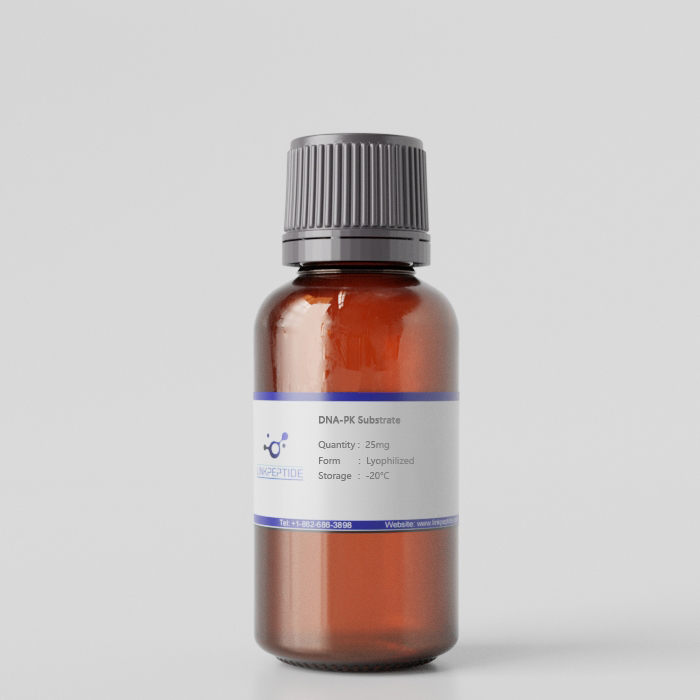
Product Name: DNA-PK Substrate
Sequence One Letter Code: EPPLSQEAFADLWKK
Sequence Three Letter Code: H-Glu-Pro-Pro-Leu-Ser-Gln-Glu-Ala-Phe-Ala-Asp-Leu-Trp-Lys-Lys-OH
Chemical Formula:C82H123N19O24
Molecular Weight: 1759.1
Purity: 95%
Form: Lyophilized
Storage Conditions: - 20 °C
Research Area: peptide substrate
Source / Species: human
Conjugation: Unconjugated
Code Nacres: NA.26
Application: DNA-PK Substrate is a synthetic peptide corresponding to residues 11–24 of human p53 and is engineered for selective phosphorylation by DNA-dependent protein kinase (DNA-PK). Substitution of threonine 18 and serine 20 with alanine enhances specificity for DNA-PK–mediated phosphorylation. DNA-PK plays a central role in nonhomologous end joining during repair of DNA double-strand breaks. This substrate is widely applied in kinase assays to measure DNA-PK activity, characterize regulatory mechanisms, and evaluate inhibitors targeting DNA damage response pathways in genome stability and oncology research.
Current Research: DNA-PK Substrate is a synthetic peptide derived from residues 11–24 of human p53, engineered for selective phosphorylation by DNA-dependent protein kinase (DNA-PK). To enhance specificity, the native Thr18 and Ser20 residues are substituted with alanine, minimizing off-target phosphorylation by other kinases and promoting preferential modification at the intended DNA-PK target site. This peptide serves as a well-defined tool for quantitative measurement of DNA-PK catalytic activity in biochemical and cell-based assays. Biological Context DNA-PK is a serine/threonine kinase belonging to the phosphatidylinositol 3-kinase–related kinase (PIKK) family. It plays a central role in the nonhomologous end joining (NHEJ) pathway, the primary mechanism for repairing DNA double-strand breaks (DSBs) in mammalian cells. The active DNA-PK holoenzyme consists of: DNA-PKcs (catalytic subunit) The Ku70/Ku80 heterodimer, which binds DNA ends and recruits DNA-PKcs Upon binding to DNA breaks, DNA-PK undergoes activation and phosphorylates substrates involved in DNA repair coordination, chromatin remodeling, and checkpoint signaling. Substrate Design and Specificity The peptide sequence corresponds to a region of p53 known to be phosphorylated in response to DNA damage. Strategic substitution of Thr18 and Ser20 with alanine: Reduces background phosphorylation by other kinases Enhances assay selectivity for DNA-PK Improves interpretability in mixed kinase systems Phosphorylation typically occurs at a serine residue within a DNA-PK consensus context. Research Applications 1. DNA-PK Activity Assays The substrate is widely used in radiometric, antibody-based, or mass spectrometry–based kinase assays to quantify DNA-PK activity in: Purified enzyme preparations Nuclear extracts DNA damage–induced cellular lysates 2. Kinetic Characterization It supports determination of kinetic parameters (Km, Vmax) under controlled in vitro conditions. 3. Inhibitor Screening The peptide is suitable for evaluating selective DNA-PK inhibitors used in cancer research. Reduced phosphorylation levels allow calculation of IC₅₀ values and assessment of inhibitor potency. 4. DNA Damage Response Studies DNA-PK is central to genome stability and is implicated in radiation resistance and tumor progression. The substrate enables mechanistic studies of DNA repair regulation and kinase signaling dynamics. Advantages Derived from a biologically relevant p53 sequence Engineered for enhanced DNA-PK specificity Compatible with multiple detection platforms Suitable for mechanistic and pharmacological studies Applicable to oncology and genome stability research Experimental Considerations DNA-PK activity assays typically require the presence of double-stranded DNA to stimulate kinase activation. Mg²⁺ and ATP concentrations should be optimized for catalytic efficiency. Inclusion of selective DNA-PK inhibitors can confirm assay specificity, particularly in complex lysate systems.
Get a Quote
 LinkPeptide

![SAMS Peptide [HMRSAMSGLHLVKRR-NH2]](https://www.linkpeptide.com/wp-content/uploads/2026/06/SAMS-Peptide-HMRSAMSGLHLVKRR-NH2.jpg "SAMS Peptide [HMRSAMSGLHLVKRR-NH2]")
![Syntide-2 [PLARTLSVAGLPGKK]](https://www.linkpeptide.com/wp-content/uploads/2026/05/Syntide-2-PLARTLSVAGLPGKK.jpg "Syntide-2 [PLARTLSVAGLPGKK]")