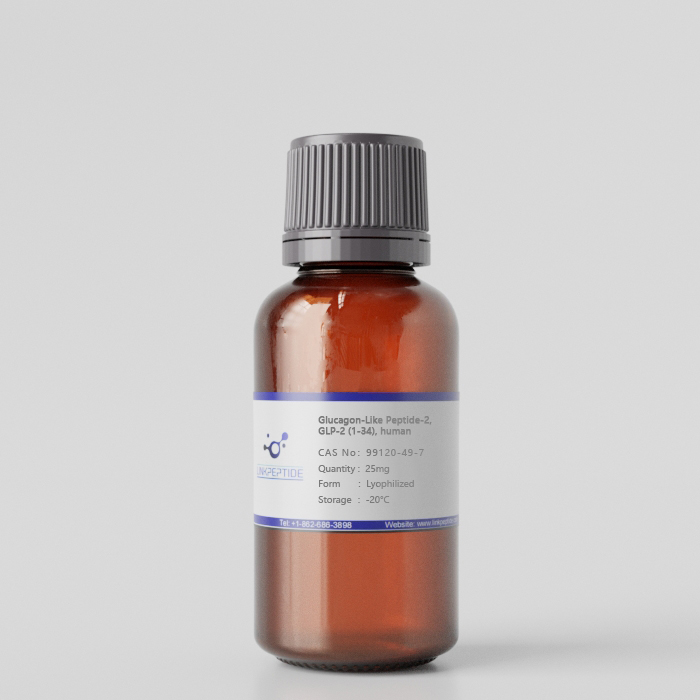
Product Name: Glucagon-Like Peptide-2, GLP-2 (1-34), human
Sequence One Letter Code: HADGSFSDEMNTILDNLAARDFINWLIQTKITDR
Sequence Three Letter Code: H-His-Ala-Asp-Gly-Ser-Phe-Ser-Asp-Glu-Met-Asn-Thr-Ile-Leu-Asp-Asn-Leu-Ala-Ala-Arg-Asp-Phe-Ile-Asn-Trp-Leu-Ile-Gln-Thr-Lys-Ile-Thr-Asp-Arg-OH
Cas No: 99120-49-7
Chemical Formula:C171H266N48O56S
Molecular Weight: 3922.4
Purity: 95%
Form: Lyophilized
Storage Conditions: - 20 °C
Research Area: Diabetes and Metabolic Syndrome
SMILES: CC[C@H](C)[C@@H](C(=O)N[C@@H]([C@@H](C)O)C(=O)N[C@@H](CC(=O)O)C(=O)N[C@@H](CCCNC(=N)N)C(=O)O)NC(=O)[C@H](CCCCN)NC(=O)[C@H]([C@@H](C)O)NC(=O)[C@H](CCC(=O)N)NC(=O)[C@H]([C@@H](C)CC)NC(=O)[C@H](CC(C)C)NC(=O)[C@H](CC1=CNC2=CC=CC=C21)NC(=O)[C@H](CC(=O)N)NC(=O)[C@H]([C@@H](C)CC)NC(=O)[C@H](CC3=CC=CC=C3)NC(=O)[C@H](CC(=O)O)NC(=O)[C@H](CCCNC(=N)N)NC(=O)[C@H](C)NC(=O)[C@H](C)NC(=O)[C@H](CC(C)C)NC(=O)[C@H](CC(=O)N)NC(=O)[C@H](CC(=O)O)NC(=O)[C@H](CC(C)C)NC(=O)[C@H]([C@@H](C)CC)NC(=O)[C@H]([C@@H](C)O)NC(=O)[C@H](CC(=O)N)NC(=O)[C@H](CCSC)NC(=O)[C@H](CCC(=O)O)NC(=O)[C@H](CC(=O)O)NC(=O)[C@H](CO)NC(=O)[C@H](CC4=CC=CC=C4)NC(=O)[C@H](CO)NC(=O)CNC(=O)[C@H](CC(=O)O)NC(=O)[C@H](C)NC(=O)[C@H](CC5=CNC=N5)N.C(=O)(C(F)(F)F)O
IUPAC: (4S)-5-[[(2S)-1-[[(2S)-4-amino-1-[[(2S,3R)-1-[[(2S,3S)-1-[[(2S)-1-[[(2S)-1-[[(2S)-4-amino-1-[[(2S)-1-[[(2S)-1-[[(2S)-1-[[(2S)-1-[[(2S)-1-[[(2S)-1-[[(2S,3S)-1-[[(2S)-4-amino-1-[[(2S)-1-[[(2S)-1-[[(2S,3S)-1-[[(2S)-5-amino-1-[[(2S,3R)-1-[[(2S)-6-amino-1-[[(2S,3S)-1-[[(2S,3R)-1-[[(2S)-1-[[(1S)-4-carbamimidamido-1-carboxybutyl]amino]-3-carboxy-1-oxopropan-2-yl]amino]-3-hydroxy-1-oxobutan-2-yl]amino]-3-methyl-1-oxopentan-2-yl]amino]-1-oxohexan-2-yl]amino]-3-hydroxy-1-oxobutan-2-yl]amino]-1,5-dioxopentan-2-yl]amino]-3-methyl-1-oxopentan-2-yl]amino]-4-methyl-1-oxopentan-2-yl]amino]-3-(1H-indol-3-yl)-1-oxopropan-2-yl]amino]-1,4-dioxobutan-2-yl]amino]-3-methyl-1-oxopentan-2-yl]amino]-1-oxo-3-phenylpropan-2-yl]amino]-3-carboxy-1-oxopropan-2-yl]amino]-5-carbamimidamido-1-oxopentan-2-yl]amino]-1-oxopropan-2-yl]amino]-1-oxopropan-2-yl]amino]-4-methyl-1-oxopentan-2-yl]amino]-1,4-dioxobutan-2-yl]amino]-3-carboxy-1-oxopropan-2-yl]amino]-4-methyl-1-oxopentan-2-yl]amino]-3-methyl-1-oxopentan-2-yl]amino]-3-hydroxy-1-oxobutan-2-yl]amino]-1,4-dioxobutan-2-yl]amino]-4-methylsulfanyl-1-oxobutan-2-yl]amino]-4-[[(2S)-2-[[(2S)-2-[[(2S)-2-[[(2S)-2-[[2-[[(2S)-2-[[(2S)-2-[[(2S)-2-amino-3-(1H-imidazol-4-yl)propanoyl]amino]propanoyl]amino]-3-carboxypropanoyl]amino]acetyl]amino]-3-hydroxypropanoyl]amino]-3-phenylpropanoyl]amino]-3-hydroxypropanoyl]amino]-3-carboxypropanoyl]amino]-5-oxopentanoic acid;2,2,2-trifluoroacetic acid
INCHIKEY: HBLLHMZIBQOWPT-BKBWCUKCSA-N
INCHI:
InChI=1S/C171H266N48O56S.C2HF3O2/c1-22-80(11)130(162(267)196-99(47-49-119(174)225)146(251)217-134(87(18)222)166(271)195-97(44-34-35-52-172)145(250)213-133(83(14)25-4)165(270)219-135(88(19)223)167(272)211-116(70-129(240)241)154(259)197-102(169(274)275)46-37-54-184-171(180)181)214-157(262)105(58-79(9)10)200-150(255)108(61-92-71-185-96-43-33-32-42-94(92)96)203-152(257)110(64-121(176)227)210-163(268)131(81(12)23-2)215-158(263)107(60-91-40-30-27-31-41-91)201-155(260)114(68-127(236)237)206-142(247)98(45-36-53-183-170(178)179)192-138(243)85(16)188-137(242)84(15)190-147(252)103(56-77(5)6)199-151(256)109(63-120(175)226)205-156(261)115(69-128(238)239)207-148(253)104(57-78(7)8)209-164(269)132(82(13)24-3)216-168(273)136(89(20)224)218-159(264)111(65-122(177)228)204-144(249)101(51-55-276-21)194-143(248)100(48-50-124(230)231)193-153(258)113(67-126(234)235)208-161(266)118(75-221)212-149(254)106(59-90-38-28-26-29-39-90)202-160(265)117(74-220)191-123(229)73-186-141(246)112(66-125(232)233)198-139(244)86(17)189-140(245)95(173)62-93-72-182-76-187-93;3-2(4,5)1(6)7/h26-33,38-43,71-72,76-89,95,97-118,130-136,185,220-224H,22-25,34-37,44-70,73-75,172-173H2,1-21H3,(H2,174,225)(H2,175,226)(H2,176,227)(H2,177,228)(H,182,187)(H,186,246)(H,188,242)(H,189,245)(H,190,252)(H,191,229)(H,192,243)(H,193,258)(H,194,248)(H,195,271)(H,196,267)(H,197,259)(H,198,244)(H,199,256)(H,200,255)(H,201,260)(H,202,265)(H,203,257)(H,204,249)(H,205,261)(H,206,247)(H,207,253)(H,208,266)(H,209,269)(H,210,268)(H,211,272)(H,212,254)(H,213,250)(H,214,262)(H,215,263)(H,216,273)(H,217,251)(H,218,264)(H,219,270)(H,230,231)(H,232,233)(H,234,235)(H,236,237)(H,238,239)(H,240,241)(H,274,275)(H4,178,179,183)(H4,180,181,184);(H,6,7)/t80-,81-,82-,83-,84-,85-,86-,87+,88+,89+,95-,97-,98-,99-,100-,101-,102-,103-,104-,105-,106-,107-,108-,109-,110-,111-,112-,113-,114-,115-,116-,117-,118-,130-,131-,132-,133-,134-,135-,136-;/m0./s1
Source / Species: human
Conjugation: Unconjugated
Code Nacres: NA.26
Application: Human GLP-2 (1–34) is a biologically active gut hormone derived from proglucagon processing and plays an important role in regulating intestinal growth and function. Acting through the GLP-2 receptor, a G protein–coupled receptor in the glucagon–secretin family, GLP-2 stimulates proliferation of intestinal crypt cells while inhibiting epithelial apoptosis. Through these mechanisms, the peptide promotes expansion of the intestinal mucosal surface and enhances nutrient absorption. GLP-2 also reduces intestinal permeability and modulates gastrointestinal motility and gastric acid secretion. Because of its trophic effects on intestinal tissue, the peptide is widely used in studies of gut physiology and mucosal repair. It supports research on intestinal adaptation, metabolic regulation, and therapeutic strategies targeting gastrointestinal and metabolic disorders.
Current Research: Human glucagon-like peptide-2 (GLP-2) is an important gut-derived hormone that plays a central role in maintaining intestinal structure and function. The biologically active form, GLP-2 (1–34), is generated through post-translational processing of the proglucagon precursor in intestinal enteroendocrine L-cells. Since its discovery, GLP-2 has attracted significant interest because of its ability to regulate intestinal growth, promote mucosal repair, and enhance nutrient absorption. As a result, synthetic GLP-2 (1–34) peptides are widely used in biomedical research focused on gastrointestinal physiology, metabolic regulation, and therapeutic strategies for intestinal disorders. Origin and Structure of GLP-2 GLP-2 is produced from the proglucagon gene, which also gives rise to several other peptide hormones, including glucagon, GLP-1, and glicentin. In the intestine, prohormone convertases process the precursor protein to generate GLP-2 as a 34-amino-acid peptide hormone. The biologically active GLP-2 (1–34) sequence represents the full-length endogenous peptide responsible for activating GLP-2 signaling pathways. This peptide interacts with the GLP-2 receptor (GLP-2R), a member of the class B G protein–coupled receptor (GPCR) family, which also includes receptors for glucagon, secretin, and vasoactive intestinal peptide. GLP-2 receptors are primarily expressed in the gastrointestinal tract, particularly in intestinal epithelial and subepithelial cells that regulate mucosal growth and intestinal barrier function. Activation of the GLP-2 Receptor When GLP-2 binds to GLP-2R, it activates intracellular signaling pathways associated with GPCR-mediated responses. These pathways influence multiple aspects of intestinal physiology, including epithelial cell survival, tissue remodeling, and metabolic regulation. Importantly, GLP-2 does not act directly on intestinal epithelial cells in most cases. Instead, receptor activation often stimulates intermediate signaling networks involving growth factors and paracrine mediators, which ultimately promote mucosal growth and maintenance. Through these signaling pathways, GLP-2 plays a crucial role in maintaining the structural integrity and functional capacity of the intestinal lining. Stimulation of Intestinal Growth One of the most distinctive biological effects of GLP-2 is its trophic influence on intestinal tissue. The peptide promotes expansion of the intestinal mucosa by stimulating proliferation of epithelial crypt cells, which are responsible for generating new intestinal epithelial cells. At the same time, GLP-2 helps maintain mucosal integrity by inhibiting apoptosis of epithelial cells. This balance between increased cell proliferation and reduced cell death leads to enlargement of the intestinal surface area. The resulting structural changes include: Increased crypt depth and villus height Enhanced intestinal absorptive capacity Improved nutrient uptake efficiency These effects are particularly important during conditions that require intestinal adaptation, such as after surgical resection or during recovery from intestinal injury. Regulation of Intestinal Barrier Function Beyond stimulating mucosal growth, GLP-2 also contributes to maintenance of intestinal barrier integrity. The peptide has been shown to reduce intestinal permeability, helping protect the body from harmful luminal contents such as pathogens and toxins. This protective function is associated with improved epithelial tight junction integrity and enhanced repair of damaged mucosal surfaces. As a result, GLP-2 signaling plays an important role in preserving gut barrier function under both normal and stress conditions. Effects on Gastrointestinal Motility and Secretion GLP-2 also influences several aspects of gastrointestinal physiology beyond epithelial growth. Studies have shown that the peptide can: Modulate gastrointestinal motility, slowing intestinal transit in certain contexts Reduce gastric acid secretion, contributing to improved nutrient digestion and absorption Support coordination between digestive processes and nutrient uptake These regulatory functions help optimize the digestive environment for efficient nutrient processing and absorption. Applications in Gastrointestinal Research Because of its multiple physiological effects, GLP-2 (1–34) is widely used in experimental studies of gut biology and metabolic regulation. Researchers frequently use the peptide to investigate mechanisms related to intestinal adaptation and epithelial regeneration. Common research applications include: Studies of intestinal mucosal growth and repair Investigations of nutrient absorption and digestive physiology Analysis of intestinal barrier function and permeability Research on hormonal regulation of gastrointestinal signaling pathways These studies help clarify how endocrine signaling coordinates intestinal structure and function. Relevance to Therapeutic Research The trophic and protective effects of GLP-2 have attracted significant attention in the development of therapies targeting gastrointestinal disorders. Conditions involving intestinal damage, impaired nutrient absorption, or mucosal injury may benefit from strategies that enhance GLP-2 signaling. Research using GLP-2 peptides supports efforts to better understand how the hormone regulates tissue regeneration and intestinal homeostasis. Insights from these studies may contribute to the development of treatments aimed at improving intestinal function in various clinical settings. Supporting Studies of Intestinal Adaptation and Metabolism The Human GLP-2 (1–34) peptide provides a valuable model for investigating how gut-derived hormones regulate intestinal growth and metabolic physiology. By activating the GLP-2 receptor and stimulating pathways that promote epithelial proliferation and barrier integrity, this peptide enables controlled study of the mechanisms that maintain intestinal health. As research continues to explore the connections between gut hormones, metabolism, and tissue regeneration, GLP-2 (1–34) remains an important tool for advancing our understanding of intestinal adaptation, gastrointestinal signaling, and metabolic regulation.
Get a Quote

 LinkPeptide