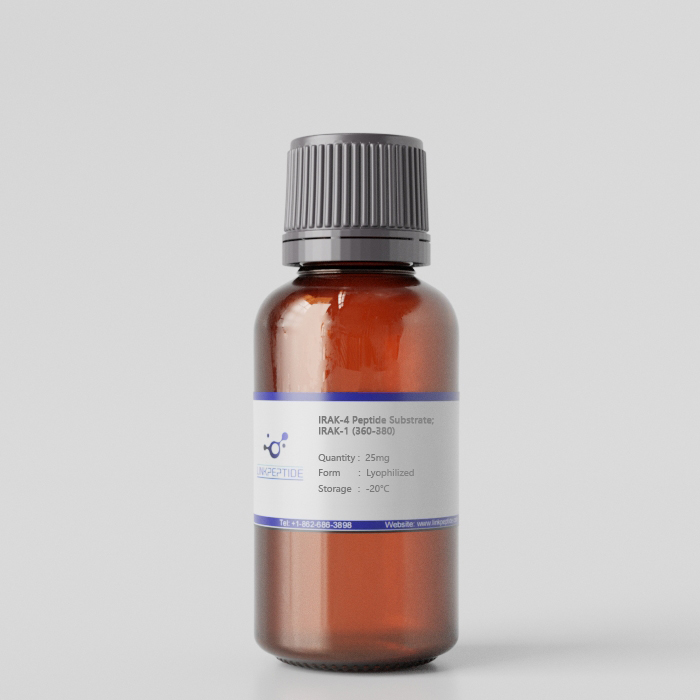
Product Name: IRAK-4 Peptide Substrate; IRAK-1 (360-380)
Sequence One Letter Code: KKARFSRFAGSSPSQSSMVAR
Sequence Three Letter Code: H-Lys-Lys-Ala-Arg-Phe-Ser-Arg-Phe-Ala-Gly-Ser-Ser-Pro-Ser-Gln-Ser-Ser-Met-Val-Ala-Arg-OH
Chemical Formula:C97H161N33O29S1
Molecular Weight: 2285.7
Purity: 95%
Form: Lyophilized
Storage Conditions: - 20 °C
Research Area: peptide substrate
Source / Species: Human, monkey
Conjugation: Unconjugated
Code Nacres: NA.26
Application: IRAK-4 Peptide Substrate is a synthetic sequence derived from amino acids 360–380 of IRAK-1, encompassing Ser-376, a primary phosphorylation site. IRAK-4 phosphorylates IRAK-1 as a critical step in interleukin-1 receptor (IL-1R) and Toll-like receptor (TLR) signaling cascades. This peptide is widely employed in kinase assays to measure IRAK-4 activity, define substrate specificity, and assess ATP-dependent phosphorylation kinetics. It is also suitable for screening inhibitors targeting innate immune signaling pathways. As a defined biochemical substrate, it supports mechanistic studies of inflammatory signaling, cytokine-driven immune activation, and therapeutic development aimed at modulating autoimmune and inflammatory disorders.
Current Research: The interleukin-1 receptor–associated kinase 4 (IRAK-4) plays a central role in innate immune signaling downstream of interleukin-1 receptors (IL-1R) and Toll-like receptors (TLRs). These pathways detect microbial components and inflammatory cytokines, initiating signaling cascades that activate transcription factors such as NF-κB and AP-1, which subsequently drive the expression of pro-inflammatory cytokines and immune mediators. A key step in this process is the phosphorylation of IRAK-1 by IRAK-4, which promotes assembly of signaling complexes and propagation of downstream immune responses. The IRAK-4 Peptide Substrate, derived from residues 360–380 of IRAK-1 and containing Ser-376, provides a defined biochemical tool for studying this phosphorylation event and for evaluating IRAK-4 kinase activity in controlled experimental systems. One major application of this peptide in current research is in in vitro kinase assays designed to quantify IRAK-4 catalytic activity. Because Ser-376 within IRAK-1 represents a primary phosphorylation site targeted by IRAK-4, the synthetic peptide serves as a simplified substrate that replicates the essential recognition motif. In kinase assays, purified IRAK-4 transfers a phosphate group from ATP to the peptide substrate, allowing researchers to measure enzymatic activity through radiometric detection, phospho-specific assays, fluorescence-based methods, or mass spectrometry. These assays are widely used to characterize ATP-dependent phosphorylation kinetics, including parameters such as enzyme turnover rate, substrate affinity, and catalytic efficiency. The peptide substrate is also valuable for investigating substrate specificity and structural determinants of IRAK-4 activity. Kinases recognize specific amino acid sequences surrounding phosphorylation sites, and understanding these recognition patterns is critical for mapping signaling networks. By modifying residues within the synthetic peptide or comparing phosphorylation efficiency across related sequences, researchers can determine how IRAK-4 recognizes its substrates. These studies help clarify the molecular basis of signaling specificity within the MyD88-dependent TLR and IL-1R signaling pathways. Another major research focus involves the use of IRAK-4 peptide substrates in drug discovery and inhibitor screening. Dysregulated TLR and IL-1 signaling has been implicated in numerous autoimmune and inflammatory diseases, including rheumatoid arthritis, systemic lupus erythematosus, and certain inflammatory skin disorders. Because IRAK-4 functions as an upstream kinase that amplifies inflammatory signaling, it has become an attractive target for therapeutic intervention. High-throughput kinase assays using defined peptide substrates such as the IRAK-4 peptide are commonly employed to evaluate candidate compounds that inhibit IRAK-4 activity. These assays allow rapid screening of chemical libraries to identify molecules capable of suppressing kinase activity and modulating inflammatory signaling. Recent research has also examined the structural and regulatory mechanisms governing IRAK-4 activation. Structural studies of IRAK-4 have revealed conformational changes associated with kinase activation and interactions with adaptor proteins such as MyD88. Using synthetic peptide substrates in biochemical assays allows investigators to compare the activity of wild-type IRAK-4 with that of mutant variants or regulatory complexes. Such experiments provide insights into how kinase activation is controlled within the broader signaling framework of innate immunity. The peptide is additionally useful in studies exploring the dynamics of inflammatory signaling networks. Activation of TLR and IL-1R pathways leads to a cascade of phosphorylation events that ultimately regulate cytokine production and immune cell activation. By measuring IRAK-4 activity using defined substrates, researchers can evaluate how different stimuli, cofactors, or regulatory proteins influence signaling intensity. These investigations contribute to a deeper understanding of how immune responses are initiated and controlled at the molecular level. Furthermore, the IRAK-4 peptide substrate supports research into cytokine-driven immune activation and inflammatory disease mechanisms. Because IRAK-4 acts early in the signaling cascade, changes in its activity can significantly alter downstream inflammatory responses. Monitoring phosphorylation of the peptide substrate allows researchers to quantify the effects of genetic mutations, signaling modulators, or pharmacological inhibitors on IRAK-4 function. In summary, the IRAK-4 Peptide Substrate derived from IRAK-1 residues 360–380 is an important biochemical tool for studying innate immune signaling. By providing a defined phosphorylation target for IRAK-4, it enables accurate measurement of kinase activity, investigation of substrate recognition mechanisms, and screening of inhibitors targeting inflammatory pathways. Through these applications, the peptide contributes to advancing research on cytokine signaling, immune regulation, and the development of therapies for autoimmune and inflammatory diseases.
Get a Quote
 LinkPeptide

![SAMS Peptide [HMRSAMSGLHLVKRR-NH2]](https://www.linkpeptide.com/wp-content/uploads/2026/06/SAMS-Peptide-HMRSAMSGLHLVKRR-NH2.jpg "SAMS Peptide [HMRSAMSGLHLVKRR-NH2]")
![CK1 Peptide Substrate [pS7] [KRRRAL-pS-VASLPGL]](https://www.linkpeptide.com/wp-content/uploads/2026/06/CK1-Peptide-Substrate-pS7-KRRRAL-pS-VASLPGL.jpg "CK1 Peptide Substrate [pS7] [KRRRAL-pS-VASLPGL]")