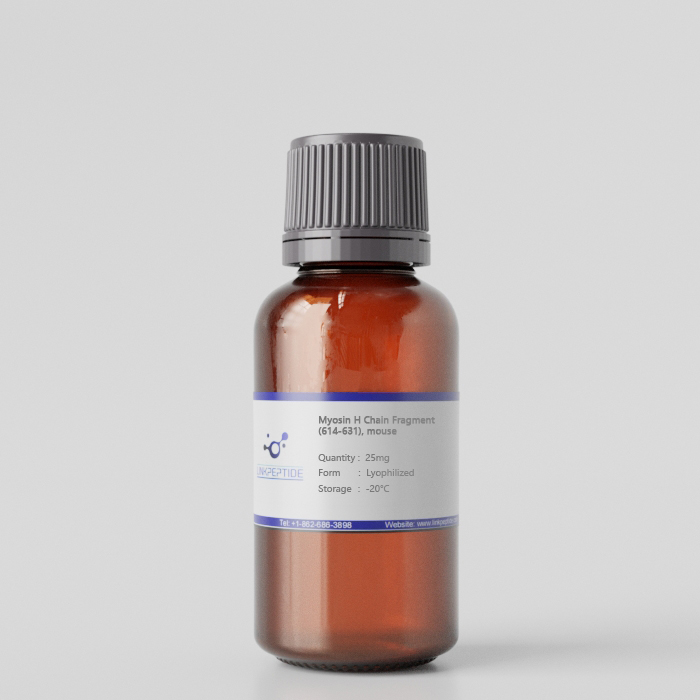
Product Name: MBP (4-14), bovine, MBP (3-13), mouse
Sequence One Letter Code: QKRPSQRSKYL
Sequence Three Letter Code: H-Gln-Lys-Arg-Pro-Ser-Gln-Arg-Ser-Lys-Tyr-Leu-OH
Cas No: 126768-94-3
Chemical Formula:C60H103N21O17
Molecular Weight: 1390.7
Purity: ≥ 95%
Form: Lyophilized
Storage Conditions: - 20 °C
SMILES: CC(C)CC(C(=O)O)NC(=O)C(CC1=CC=C(C=C1)O)NC(=O)C(CCCCN)NC(=O)C(CO)NC(=O)C(CCCN=C(N)N)NC(=O)C(CCC(=O)N)NC(=O)C(CO)NC(=O)C2CCCN2C(=O)C(CCCN=C(N)N)NC(=O)C(CCCCN)NC(=O)C(CCC(=O)N)N
IUPAC: 2-[[2-[[6-amino-2-[[2-[[2-[[5-amino-2-[[2-[[1-[2-[[6-amino-2-[(2,5-diamino-5-oxopentanoyl)amino]hexanoyl]amino]-5-(diaminomethylideneamino)pentanoyl]pyrrolidine-2-carbonyl]amino]-3-hydroxypropanoyl]amino]-5-oxopentanoyl]amino]-5-(diaminomethylideneamino)pentanoyl]amino]-3-hydroxypropanoyl]amino]hexanoyl]amino]-3-(4-hydroxyphenyl)propanoyl]amino]-4-methylpentanoic acid
INCHIKEY: KISWVXRQTGLFGD-UHFFFAOYSA-N
INCHI:
InChI=1S/C60H103N21O17/c1-32(2)28-42(58(97)98)78-53(92)41(29-33-15-17-34(84)18-16-33)77-50(89)37(11-4-6-24-62)74-54(93)43(30-82)79-51(90)38(12-7-25-70-59(66)67)73-52(91)39(20-22-47(65)86)75-55(94)44(31-83)80-56(95)45-14-9-27-81(45)57(96)40(13-8-26-71-60(68)69)76-49(88)36(10-3-5-23-61)72-48(87)35(63)19-21-46(64)85/h15-18,32,35-45,82-84H,3-14,19-31,61-63H2,1-2H3,(H2,64,85)(H2,65,86)(H,72,87)(H,73,91)(H,74,93)(H,75,94)(H,76,88)(H,77,89)(H,78,92)(H,79,90)(H,80,95)(H,97,98)(H4,66,67,70)(H4,68,69,71)
Source / Species: bovine, mouse
Conjugation: Unconjugated
Code Nacres: NA.26
Application: MBP (3–13) is a synthetic peptide corresponding to the immunogenic N-terminal region of myelin basic protein, a major autoantigen associated with multiple sclerosis and central nervous system demyelination. MBP fragments can induce immune reactivity and are valuable tools for studying T-cell activation, autoimmune responses, neuroinflammation, and demyelinating disease mechanisms. This sequence also functions as a substrate for protein kinase C, supporting research on phosphorylation-mediated signaling pathways. MBP (3–13) is widely used in studies of CNS autoimmunity, immune regulation, multiple sclerosis models, and kinase-related signal transduction.
Get a Quote
 LinkPeptide

![CK1 Peptide Substrate [pS7] [KRRRAL-pS-VASLPGL]](https://www.linkpeptide.com/wp-content/uploads/2026/06/CK1-Peptide-Substrate-pS7-KRRRAL-pS-VASLPGL.jpg "CK1 Peptide Substrate [pS7] [KRRRAL-pS-VASLPGL]")