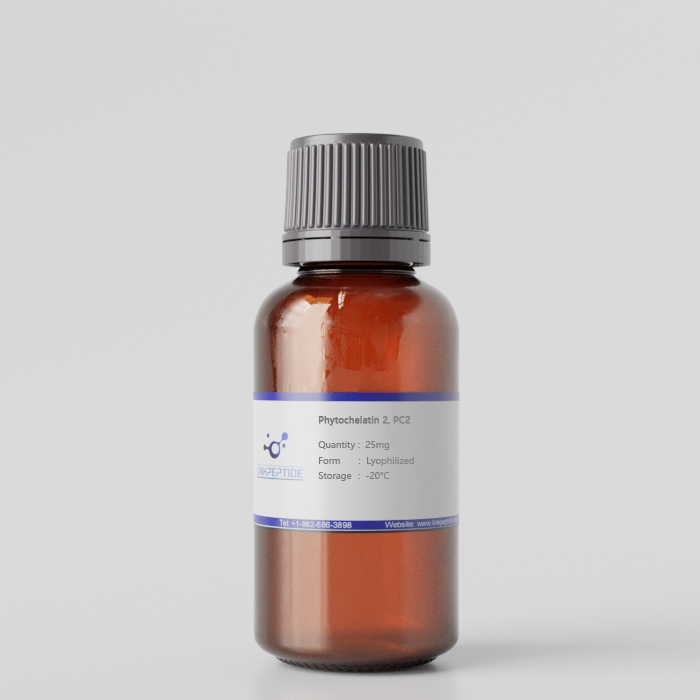
Product Name: Phytochelatin 2, PC2
Sequence One Letter Code: (γE-C)2-G
Sequence Three Letter Code: H-γ-Glu-Cys-γ-Glu-Cys-Gly-OH
Chemical Formula:C18H29N5O10S2
Molecular Weight: 539.6
Purity: 95%
Form: Lyophilized
Storage Conditions: - 20 °C
Research Area: Peptide Series
Source / Species: Plants
Conjugation: Unconjugated
Code Nacres: NA.26
Application: Phytochelatin 2 (PC2) is a glutathione-derived oligopeptide composed of two repeating γ-glutamyl-cysteine units followed by a terminal glycine, forming a thiol-rich metal-binding structure. In plants, PC2 is enzymatically synthesized in response to heavy metal exposure and functions as a primary intracellular chelator. Its cysteine thiol groups coordinate toxic metal ions such as cadmium, lead, and mercury, facilitating sequestration into vacuoles and mitigating oxidative damage. Synthetic PC2 provides a defined model compound for studying metal–thiolate coordination chemistry, detoxification pathways, and stress adaptation mechanisms. It is widely applied in plant physiology, environmental toxicology, and bioinorganic research to investigate metal tolerance, redox balance, and peptide-mediated sequestration processes under controlled experimental conditions.
Current Research: Phytochelatin 2 (PC2) Phytochelatin 2 (PC2) is a glutathione-derived oligopeptide with the general structure (γ-Glu–Cys)₂–Gly. It consists of two repeating γ-glutamyl–cysteine units linked to a terminal glycine, forming a thiol-rich scaffold optimized for heavy metal binding. In higher plants, phytochelatins are synthesized enzymatically from glutathione in response to metal stress and serve as primary intracellular chelators that neutralize toxic metal ions. As a defined synthetic analog of the endogenous molecule, PC2 provides a precise experimental tool for studying metal detoxification, coordination chemistry, and redox-regulated stress responses. Biosynthesis and Regulatory Context Phytochelatins are produced by phytochelatin synthase (PCS), a metal-activated enzyme that catalyzes transpeptidation reactions using glutathione as a substrate. Upon exposure to heavy metals such as cadmium (Cd²⁺), lead (Pb²⁺), mercury (Hg²⁺), and arsenic species, PCS activity increases rapidly, generating phytochelatins of varying chain lengths. PC2 represents one of the shorter and physiologically relevant forms within this family. Because synthesis is directly triggered by metal ions, PC2 production is tightly linked to cellular metal sensing and stress signaling pathways. Studies continue to investigate how glutathione availability, oxidative stress levels, and post-translational modifications regulate PCS activation and phytochelatin accumulation. Metal–Thiolate Coordination Chemistry The biological function of PC2 is rooted in the high reactivity of cysteine thiol (–SH) groups. These sulfur donor atoms form stable coordinate bonds with soft metal ions, particularly divalent cations such as Cd²⁺ and Hg²⁺. Depending on stoichiometry and environmental conditions, PC2 can generate mono- or multinuclear metal complexes. Spectroscopic and structural investigations using techniques such as NMR, mass spectrometry, and X-ray absorption spectroscopy have characterized the geometry and thermodynamics of PC2–metal complexes. These studies reveal that thiolate coordination stabilizes metal ions in forms that reduce free ion availability, thereby limiting interference with enzymatic proteins and preventing oxidative damage. Because PC2 contains two γ-Glu–Cys repeats, it offers a well-defined intermediate between glutathione and longer-chain phytochelatins, making it particularly useful for modeling metal-binding dynamics. Intracellular Sequestration and Vacuolar Transport In plant cells, PC2–metal complexes are transported into vacuoles through ATP-binding cassette (ABC) transporters. This compartmentalization isolates toxic metals from the cytosol, protecting essential metabolic processes. Experimental systems employing synthetic PC2 support investigations into transporter specificity, substrate recognition, and sequestration efficiency. Research in phytoremediation leverages this mechanism to enhance metal accumulation in plants grown in contaminated soils. By studying PC2-mediated chelation, investigators aim to optimize strategies for environmental detoxification and soil restoration. Redox Balance and Oxidative Stress Heavy metal exposure often induces reactive oxygen species (ROS) generation. PC2 synthesis affects the intracellular glutathione pool, influencing redox homeostasis. The interplay between glutathione depletion, phytochelatin formation, and antioxidant defense mechanisms remains an active area of research. PC2’s thiol groups may also participate indirectly in redox buffering by stabilizing metal ions that would otherwise catalyze Fenton-type reactions. Thus, phytochelatin pathways are closely linked to cellular antioxidant systems and stress adaptation networks. Applications in Research Synthetic PC2 is widely used in: Metal-binding affinity and competition assays Bioinorganic coordination chemistry studies Environmental toxicology models Plant stress physiology research Phytoremediation mechanism analysis Its defined structure enables controlled investigation of metal–peptide interactions under reproducible laboratory conditions. Because PC2 represents a minimal yet functionally significant phytochelatin form, it serves as a convenient model for dissecting thiol-mediated sequestration processes without the complexity of longer oligomers. Experimental Advantages Defined γ-glutamyl linkage structure Multiple cysteine thiol coordination sites Reproducible metal-binding behavior Compatibility with spectroscopic and biochemical assays Overall, Phytochelatin 2 (PC2) provides a structurally precise and mechanistically informative platform for studying heavy metal detoxification and thiol-based coordination chemistry. Its central role in plant metal tolerance and stress physiology makes it an essential tool in plant biology, environmental toxicology, and bioinorganic research.
Get a Quote
 LinkPeptide