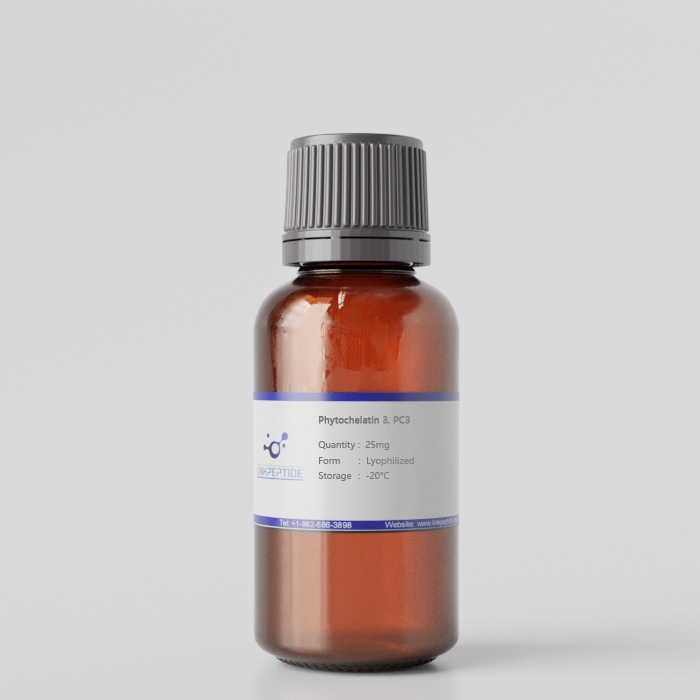
Product Name: Phytochelatin 3, PC3
Sequence One Letter Code: (γE-C)3-G
Sequence Three Letter Code: H-γ-Glu-Cys-γ-Glu-Cys-γ-Glu-Cys-Gly-OH
Chemical Formula:C26H41N7O14S3
Molecular Weight: 771.9
Purity: 95%
Form: Lyophilized
Storage Conditions: - 20 °C
Research Area: Peptide Series
Source / Species: Plants
Conjugation: Unconjugated
Nacres: NA.26
Application: Phytochelatin 3 (PC3) is a glutathione-derived oligopeptide composed of three repeating γ-glutamyl-cysteine units linked to a terminal glycine. Naturally occurring in higher plants, PC3 plays a central role in heavy metal detoxification. Its thiol-rich structure provides strong binding affinity for toxic metal ions such as cadmium, lead, and mercury, facilitating sequestration and reducing cellular toxicity. PC3 is widely used in plant biology and environmental toxicology to investigate metal–peptide coordination chemistry, stress response pathways, and mechanisms of metal tolerance. It also serves as a model system for studying thiol-mediated chelation and redox regulation in biological environments.
Current Research: Phytochelatin 3 (PC3) is a γ-glutamylcysteine-rich oligopeptide with the general structure (γ-Glu–Cys)_3–Gly, derived enzymatically from glutathione in higher plants. As a central component of plant heavy metal detoxification systems, PC3 exemplifies thiol-mediated metal chelation and intracellular sequestration. Its multiple cysteine thiol groups confer high affinity for soft metal ions, particularly cadmium (Cd²⁺), lead (Pb²⁺), mercury (Hg²⁺), and arsenic species, enabling the formation of stable metal–thiolate complexes. Consequently, PC3 is widely applied in plant biology, environmental toxicology, and coordination chemistry research. Biosynthesis and Enzymatic Regulation Phytochelatins are synthesized from glutathione (GSH) via the enzyme phytochelatin synthase (PCS), which catalyzes transpeptidation reactions to elongate the γ-glutamylcysteine chain. The reaction is metal-activated: exposure to heavy metals induces PCS activity, triggering rapid PC production. Among the phytochelatin family, PC3 represents a physiologically relevant intermediate chain length, balancing metal-binding capacity with solubility and transport efficiency. Current research emphasizes the regulatory mechanisms governing PCS activation, including redox status, glutathione availability, and post-translational modulation. Transcriptomic and proteomic analyses in model plants such as Arabidopsis thaliana continue to clarify how phytochelatin biosynthesis integrates with broader stress response networks. Metal Coordination Chemistry PC3’s three γ-Glu–Cys repeats provide multiple thiolate ligands capable of coordinating divalent and trivalent metal ions through sulfur donor atoms. Spectroscopic and crystallographic studies reveal that PC3 can form mono- or polynuclear metal complexes depending on stoichiometry and environmental conditions. Cadmium–PC3 complexes are among the most extensively characterized, typically involving bidentate or multidentate thiolate coordination. Recent investigations employ techniques such as mass spectrometry, NMR spectroscopy, and X-ray absorption spectroscopy (XAS) to resolve coordination geometry and ligand exchange kinetics. These studies provide mechanistic insight into how thiol-rich peptides stabilize metal ions and prevent uncontrolled redox cycling or protein binding that would otherwise induce cytotoxicity. Intracellular Sequestration and Vacuolar Transport In planta, PC–metal complexes are transported into vacuoles via ATP-binding cassette (ABC) transporters, isolating toxic metals from metabolically active compartments. PC3 is frequently used in in vitro transport assays to evaluate substrate specificity and transporter kinetics. Functional studies demonstrate that efficient vacuolar sequestration is critical for maintaining cytosolic metal homeostasis and preventing oxidative stress. Beyond sequestration, PC3-mediated chelation modulates the availability of metal cofactors that influence enzymatic activity and reactive oxygen species (ROS) generation. This positions phytochelatins at the intersection of detoxification and redox biology. Role in Oxidative Stress and Redox Regulation Heavy metal exposure disrupts cellular redox balance by promoting ROS formation. PC3 not only chelates metals but also participates indirectly in redox buffering through its cysteine thiols. The dynamic interplay between glutathione pools and phytochelatin synthesis influences cellular antioxidant capacity. Current studies investigate how perturbations in GSH–PC flux affect stress resilience and signal transduction pathways. Additionally, researchers are examining cross-talk between phytochelatin pathways and metallothioneins, another class of cysteine-rich metal-binding proteins. Comparative analyses highlight distinct yet complementary roles in metal tolerance and stress adaptation. Applications in Environmental and Biotechnological Research PC3 is widely used as a model system to study: Metal–thiolate coordination mechanisms Heavy metal toxicity mitigation strategies Phytoremediation efficiency Stress-induced gene regulation Synthetic biomimetic chelators In environmental toxicology, synthetic PC3 supports controlled binding assays to assess metal affinity and competition among ions in complex mixtures. In phytoremediation research, overexpression of PCS or enhanced phytochelatin production is investigated as a strategy to improve metal accumulation in contaminated soils. Furthermore, PC3 serves as a biochemical template for designing thiol-based chelating agents and biosensors. Its predictable coordination behavior and modular structure make it an effective experimental probe for studying metal-binding thermodynamics and redox-sensitive interactions in biological systems. Emerging Directions Recent systems-level studies integrate metabolomics and metal imaging technologies to quantify phytochelatin–metal distributions in vivo. Advances in single-cell elemental analysis and synchrotron-based imaging are refining our understanding of how PC3-mediated chelation contributes to spatial metal compartmentalization. Overall, Phytochelatin 3 (PC3) represents a structurally defined and functionally significant thiol-rich peptide central to heavy metal detoxification in plants. Its well-characterized coordination chemistry, regulatory biosynthesis, and role in stress physiology make it a valuable tool for mechanistic studies in plant biology, environmental toxicology, and metal–peptide interaction research.
Get a Quote
 LinkPeptide