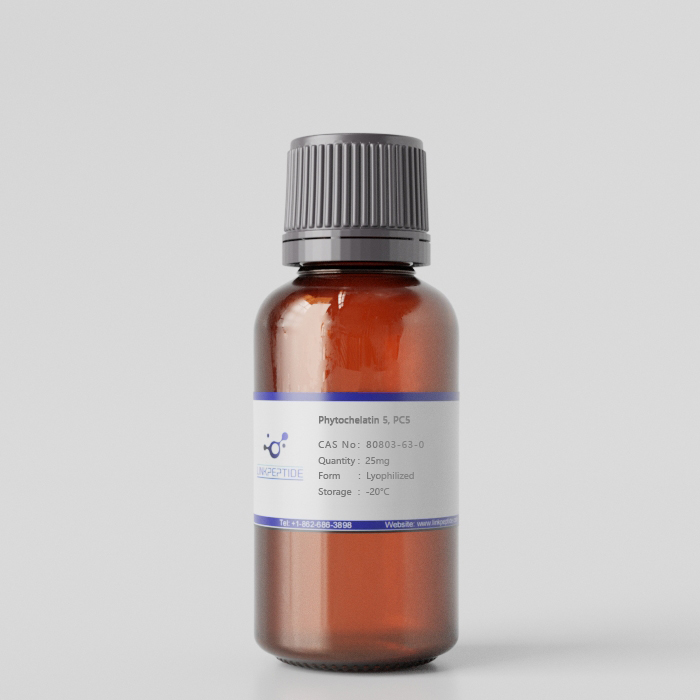
Product Name: Phytochelatin 5, PC5
Sequence One Letter Code: (γE-C)5-G
Sequence Three Letter Code: H-γ-Glu-Cys-γ-Glu-Cys-γ-Glu-Cys-γ-Glu-Cys-γ-Glu-Cys-Gly-OH
Cas No: 80803-63-0
Chemical Formula:C42H66N12O21S5
Molecular Weight: 1236.4
Purity: 95%
Form: Lyophilized
Storage Conditions: - 20 °C
Research Area: Peptide Series
Source / Species: Plants
Conjugation: Unconjugated
Code Nacres: NA.26
Application: Phytochelatin 5 (PC5) is a glutathione-derived peptide composed of five repeating γ-glutamylcysteine units, forming a cysteine-rich structure optimized for heavy metal binding. In higher plants, phytochelatins play a central role in detoxification of toxic metals such as cadmium, lead, and mercury. PC5 chelates metal ions through thiol coordination and facilitates their sequestration into vacuoles, thereby maintaining cellular metal homeostasis. The peptide is widely used in studies of plant stress responses, phytoremediation mechanisms, and thiol-mediated metal coordination chemistry. Its defined repeat structure makes it suitable for investigating metal-binding stoichiometry and redox-dependent interactions. PC5 also supports biochemical analyses of detoxification pathways and comparative studies of metalloprotection strategies across species. It remains an important tool in environmental biology, plant physiology, and metal toxicity research.
Current Research: Phytochelatin 5 (PC5) remains a central model compound in contemporary research on plant metal detoxification and thiol-based coordination chemistry. Composed of five repeating γ-glutamylcysteine (γGlu–Cys) units, PC5 represents an extended phytochelatin isoform with a high density of reactive thiol groups, enabling strong chelation of toxic heavy metals such as cadmium (Cd²⁺), lead (Pb²⁺), mercury (Hg²⁺), and arsenic species. Current research increasingly focuses on how chain length influences binding capacity, complex stability, and intracellular trafficking compared with shorter phytochelatins (e.g., PC2 or PC3). Mechanistic studies demonstrate that PC5 coordinates metal ions through thiolate ligation, forming stable metal–thiol clusters with defined stoichiometries. Advanced spectroscopic and mass spectrometric analyses have revealed multimeric complexes in which several cysteine residues cooperatively bind a single metal ion or assemble higher-order metal–sulfur clusters. These complexes are subsequently transported into vacuoles via ATP-binding cassette (ABC) transporters, effectively isolating toxic metals from cytosolic targets. Investigations into transporter specificity and kinetics continue to clarify how phytochelatin–metal complexes are selectively recognized and compartmentalized. At the regulatory level, phytochelatin synthesis is catalyzed by phytochelatin synthase (PCS), an enzyme activated directly by metal–glutathione complexes. Recent genetic and transcriptomic studies in Arabidopsis, rice, and hyperaccumulator species highlight differential PCS expression and PC chain-length distribution under varying metal stresses. PC5, as a longer-chain species, is often associated with severe or prolonged metal exposure, suggesting adaptive upregulation under high toxic load. Comparative analyses across plant species are elucidating how variations in phytochelatin profiles contribute to differential metal tolerance and accumulation capacity. In phytoremediation research, PC5 is widely used to investigate metal sequestration efficiency and to engineer enhanced tolerance traits. Transgenic approaches overexpressing PCS genes have demonstrated increased phytochelatin production and improved cadmium or arsenic tolerance. Synthetic PC5 enables in vitro modeling of metal-binding equilibria and informs strategies for optimizing plant-based remediation systems. Its defined repeat structure provides a controllable framework for studying binding thermodynamics, redox sensitivity, and competition among multiple metal ions in mixed-contaminant environments. Redox biology represents another expanding area of interest. Because cysteine thiols are susceptible to oxidation, PC5-mediated metal binding is influenced by cellular redox status. Research examining glutathione pools, oxidative stress signaling, and sulfur metabolism has clarified how environmental stressors modulate phytochelatin function. Oxidative conditions can alter thiol availability, affecting both metal affinity and complex stability. These insights link heavy metal detoxification with broader stress response networks involving reactive oxygen species (ROS). Beyond plant systems, PC5 has gained relevance in comparative biochemistry and materials science. Its strong and selective metal-binding properties are being explored for biosensing applications, biomimetic chelation systems, and nanomaterial stabilization. Investigations into synthetic analogs aim to harness phytochelatin-inspired motifs for environmental monitoring and detoxification technologies. Overall, Phytochelatin 5 serves as a robust model for studying thiol-mediated metal coordination, intracellular sequestration mechanisms, and adaptive stress responses. Ongoing research continues to refine understanding of its structural chemistry, regulatory control, and translational potential in environmental remediation and bioinorganic science.
Get a Quote
 LinkPeptide