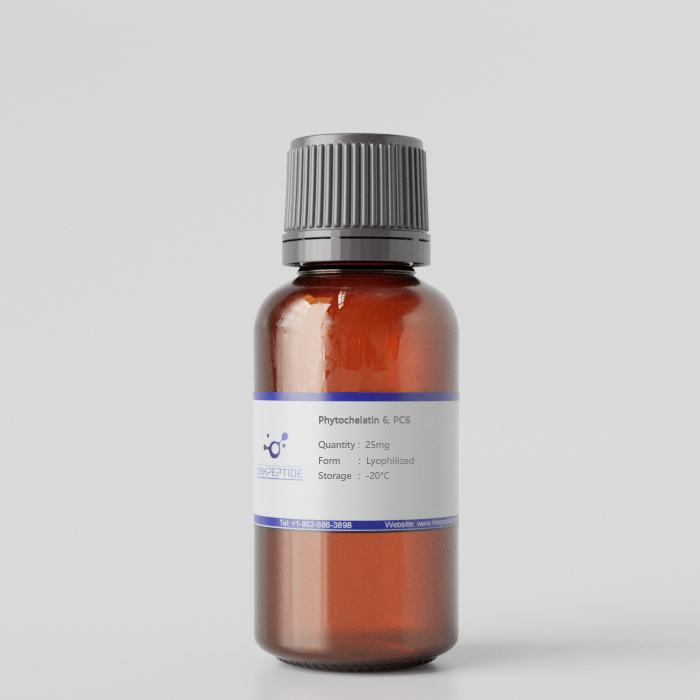
Product Name: Phytochelatin 6, PC6
Sequence One Letter Code: (γE-C)6-G
Sequence Three Letter Code: H-γ-Glu-Cys-γ-Glu-Cys-γ-Glu-Cys-γ-Glu-Cys-γ-Glu-Cys-γ-Glu-Cys-Gly-OH
Chemical Formula:C50H77N13O26S6
Molecular Weight: 1468.6
Purity: 95%
Form: Lyophilized
Storage Conditions: - 20 °C
Research Area: Peptide Series
Source / Species: Plants
Conjugation: Unconjugated
Code Nacres: NA.26
Application: Phytochelatin-6 (PC6) is a glutathione-derived peptide composed of six repeating γ-Glu-Cys units and functions as an important heavy metal–chelating molecule in higher plants. Phytochelatins play a central role in metal detoxification, binding toxic ions such as cadmium, mercury, and arsenic through their thiol groups and facilitating their sequestration into vacuoles. As a longer-chain member of the phytochelatin family, PC6 is particularly useful for studying metal-binding capacity, plant stress responses, and cellular detoxification pathways. This peptide is widely applied in research on plant metal homeostasis, environmental toxicology, and phytoremediation mechanisms, and also serves as a model system for investigating thiol-rich metal-binding peptides and redox-regulated detoxification processes.
Current Research: Plants growing in metal-contaminated environments must cope with potentially toxic ions such as cadmium, mercury, and arsenic. To survive these conditions, they rely on specialized detoxification systems that bind and sequester heavy metals before cellular damage occurs. Among the most important components of this defense system are phytochelatins, a class of glutathione-derived peptides that function as intracellular metal chelators. Phytochelatin-6 (PC6) is a longer-chain member of this family, consisting of six repeating γ-glutamyl-cysteine units, and plays an important role in studies of plant metal homeostasis and detoxification mechanisms. Structure and Origin of Phytochelatins Phytochelatins are synthesized enzymatically from glutathione (GSH) through the activity of phytochelatin synthase, an enzyme that becomes activated in the presence of heavy metal ions. The general structure of phytochelatins follows the formula: (γ-Glu-Cys)ₙ-Gly where n typically ranges from 2 to 11 depending on species and environmental conditions. Phytochelatin-6 represents a relatively long-chain phytochelatin variant, containing six γ-Glu-Cys repeating units. The peptide is rich in cysteine residues, each containing a thiol (–SH) group capable of forming strong coordination bonds with metal ions. These thiol groups are responsible for the peptide’s high metal-binding capacity, making phytochelatins central components of the plant heavy metal detoxification system. Mechanism of Heavy Metal Chelation Heavy metals entering plant cells can disrupt enzyme function, damage membranes, and generate oxidative stress. Phytochelatins mitigate these toxic effects by binding metal ions through cysteine thiol groups. The detoxification process generally involves several steps: Metal ion entry into plant cells Activation of phytochelatin synthase in response to metal exposure Production of phytochelatin peptides from glutathione Chelation of metal ions by the thiol groups of phytochelatins Transport of metal–phytochelatin complexes into vacuoles for sequestration By isolating toxic metals within vacuoles, plants prevent interference with critical metabolic processes. Role of PC6 in Metal Detoxification Studies Because PC6 contains multiple cysteine residues, it provides a particularly useful model for studying metal-binding stoichiometry and coordination chemistry. The increased number of thiol groups allows researchers to investigate how peptide length influences metal-binding affinity and complex stability. In experimental systems, PC6 can interact with a variety of toxic metals, including: Cadmium (Cd²⁺) Mercury (Hg²⁺) Arsenic species Lead (Pb²⁺) These interactions help researchers understand how plants adapt to metal stress and how metal–peptide complexes behave within biological systems. Applications in Plant Stress and Metal Homeostasis Research Phytochelatin-6 is widely used in research exploring how plants respond to environmental stress caused by heavy metals. Studies using PC6 often focus on: Metal detoxification mechanisms in plant cells Regulation of phytochelatin synthesis during stress Transport and sequestration of metal–peptide complexes Interactions between metal detoxification and redox balance Such research contributes to understanding how plants maintain metal homeostasis while surviving in contaminated environments. Role in Environmental Toxicology and Phytoremediation Heavy metal contamination of soil and water is a major environmental concern worldwide. Plants capable of accumulating and detoxifying toxic metals are increasingly studied for their potential use in phytoremediation, a strategy that uses plants to remove contaminants from the environment. Phytochelatin peptides like PC6 play an essential role in this process because they enable plants to tolerate and accumulate large amounts of heavy metals. By examining how PC6 binds and stabilizes metal ions, researchers can better understand the mechanisms that support plant-based remediation strategies. Model System for Thiol-Rich Metal-Binding Peptides Beyond plant biology, PC6 also serves as a model system for studying thiol-rich metal-binding peptides more broadly. The abundance of cysteine residues makes phytochelatins useful for examining: Metal–thiolate coordination chemistry Redox regulation of thiol-containing peptides Structural properties of metal-binding peptide complexes These insights can extend to other biological systems where cysteine-rich proteins participate in metal homeostasis or detoxification. Supporting Research on Metal Detoxification and Cellular Defense Phytochelatin-6 (PC6) represents an important member of the phytochelatin family and provides a powerful experimental tool for studying metal detoxification in plants. Its multiple thiol groups allow strong interactions with toxic metal ions, making it ideal for investigations of metal binding, cellular sequestration, and plant stress responses. Through applications in plant physiology, environmental toxicology, and phytoremediation research, PC6 continues to support scientific efforts aimed at understanding how organisms cope with heavy metal exposure and maintain cellular homeostasis under environmental stress conditions.
Get a Quote
 LinkPeptide