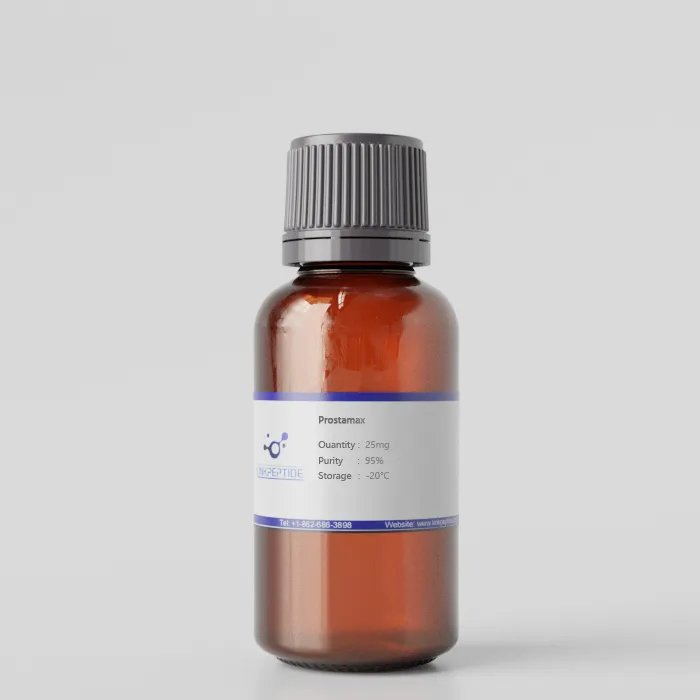
Product Name:Prostamax
Purity:95%
Chemical Formula:C20H33N5O9
Molar Mass:487.5
Synonyms:SCHEMBL6660498
IUPAC Name:(2S)-1-[(2S)-3-carboxy-2-[[(2S)-4-carboxy-2-[[(2S)-2,6-diaminohexanoyl]amino]butanoyl]amino]propanoyl]pyrrolidine-2-carboxylic acid
SMILES:C1C[C@H](N(C1)C(=O)[C@H](CC(=O)O)NC(=O)[C@H](CCC(=O)O)NC(=O)[C@H](CCCCN)N)C(=O)O
InChIKey:WUCUNGRTSFLCLI-XUXIUFHCSA-N
InChI:InChI=1S/C20H33N5O9/c21-8-2-1-4-11(22)17(30)23-12(6-7-15(26)27)18(31)24-13(10-16(28)29)19(32)25-9-3-5-14(25)20(33)34/h11-14H,1-10,21-22H2,(H,23,30)(H,24,31)(H,26,27)(H,28,29)(H,33,34)/t11-,12-,13-,14-/m0/s1
Storage:-20 degree Celsius
Sequence:KEDP
Application:Prostamax is a short peptide bioregulator derived from prostatic tissue, designed to support the restoration of normal prostate function, especially in the context of benign prostatic hyperplasia (BPH), chronic prostatitis, and age-related androgen decline. It acts through epigenetic modulation, regulating gene expression in prostatic cells to normalize growth, reduce inflammation, and improve urogenital function. Prostamax is studied for its role in prostate tissue regeneration, hormone balance, and urinary health. It is a valuable tool for research in andrology, gerontology, and urological peptide therapy, particularly in studies on aging male health and endocrine-urogenital interactions.
Current Research:Introduction: Peptide Bioregulators and Prostate Function Prostamax belongs to a class of cytogenetic peptides—short amino acid sequences derived from organ-specific extracts, developed to restore tissue function at the genetic regulation level. Like other tissue-targeted peptides developed by the St. Petersburg Institute of Bioregulation and Gerontology, Prostamax interacts with specific DNA sequences in the nucleus of prostatic cells, helping normalize gene expression profiles altered by aging, inflammation, or hormonal imbalance. This peptide targets the prostate gland, making it especially relevant for research into benign prostatic hyperplasia (BPH), chronic inflammation, and age-related urogenital decline. Mechanism of Action: Epigenetic Normalization Prostamax works by: Binding to regulatory DNA regions, particularly GC-rich sites in prostatic epithelial and stromal cells Modulating the expression of genes involved in: Cell proliferation and apoptosis Hormonal receptor sensitivity (e.g., androgen receptor expression) Cytokine production and local inflammation Extracellular matrix remodeling By doing so, Prostamax supports homeostatic balance in prostate tissue, reducing hyperplasia, and improving overall prostate gland morphology and function. Applications in Benign Prostatic Hyperplasia (BPH) One of the primary research applications for Prostamax is in BPH, a condition affecting the majority of men over age 50. In preclinical and clinical models, Prostamax has shown: Reduction in prostate volume Improved urinary flow rate Decreased residual bladder volume Lower expression of pro-inflammatory cytokines (e.g., IL-6, TNF-α) Normalized epithelial-stromal interaction, crucial for regulating growth Prostamax does not function as a hormone or hormone blocker; instead, it modulates the gene-level responses to androgens, making it compatible with standard BPH treatments like α-blockers and 5-ARIs. Anti-Inflammatory Effects in Prostatitis Models Chronic prostatitis and chronic pelvic pain syndrome (CPPS) are difficult to treat due to their complex inflammatory and neurogenic components. Prostamax has shown potential in: Reducing leukocyte infiltration in prostatic tissue Suppressing chronic inflammation through local immune modulation Supporting mucosal and epithelial repair Improving symptoms of urinary urgency, pain, and incomplete voiding These findings position Prostamax as a non-antibiotic option for long-term urological inflammation studies. Andrological and Hormonal Health Support Prostamax may also help in age-related hormonal regulation. Aging men often experience: Reduced testosterone Increased estradiol-to-testosterone ratios Prostate-related urinary symptoms Lowered libido and erectile function While Prostamax does not directly increase hormone levels, it restores receptor responsiveness and improves local tissue response to androgens, supporting functional hormonal balance. It is often studied alongside: Testoluten (testicular peptide) Glandokort (adrenal peptide) Epitalon (pineal peptide) Together, these compounds form a multi-system protocol for endocrine and reproductive system support. Safety and Clinical Observations Prostamax has been used in clinical trials and observational studies involving elderly men with: Prostatic hypertrophy Chronic prostatitis Post-prostate surgery recovery Reported benefits include improved urinary function, reduced nocturia, and lower PSA levels in some cases. It has shown no hormonal disruption, no cytotoxicity, and excellent tolerability, even with extended use. Conclusion: A Targeted Peptide for Prostate and Male Health Prostamax offers a novel, epigenetic-based approach to restoring prostate function, managing BPH and inflammation, and supporting urological health in aging males. By regulating gene expression specific to the prostate, it presents a safe, non-hormonal strategy for long-term prostate maintenance, urinary comfort, and andrological well-being.
Reference:
Get a Quote
 LinkPeptide