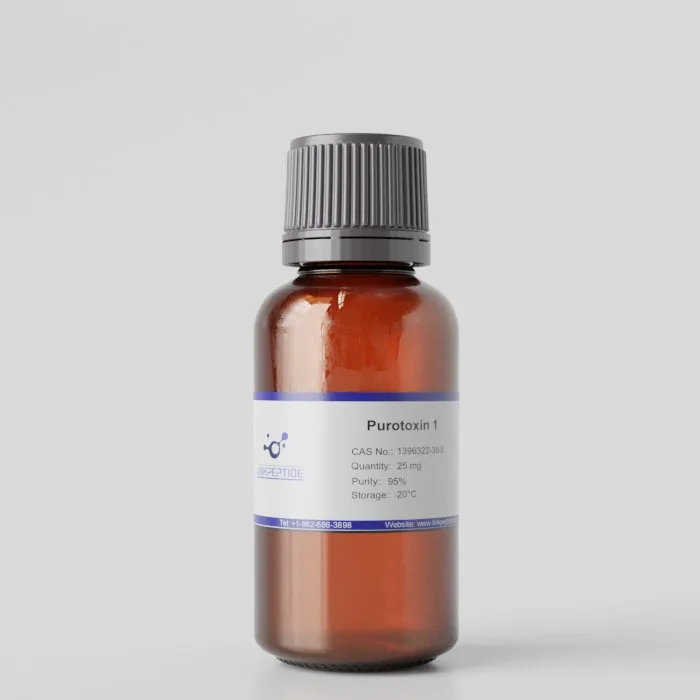
Product Name:ProTx-III
Purity:95%
Molar Mass:3802.41
Chemical Formula:C162H246N52O43S6
Storage:Store at -20 degrees Celsius
Sequence:DCLKFGWKCNPRNDKCCSGLKCGSNHNWCKLHI
Target:Nav1.7 blocker
Application:
ProTx-III is a peptide toxin derived from the venom of the tarantula Thrixopelma pruriens. It is a potent and selective inhibitor of voltage-gated sodium channels, particularly Nav1.7, which plays a crucial role in pain perception. ProTx-III binds to the voltage sensor domain of the channel, preventing its activation and blocking sodium ion flow, thereby inhibiting the propagation of action potentials in sensory neurons. Due to its high specificity for Nav1.7, ProTx-III is a valuable tool in research aimed at understanding pain mechanisms and exploring potential therapeutic approaches for treating chronic pain conditions. Its use in ion channel studies also contributes to the development of novel analgesics targeting Nav1.7.
Current Research:
ProTx-III, also known as μ-TRTX-Tp1a, is a 33-amino-acid peptide toxin isolated from the venom of the Peruvian green-velvet tarantula (Thrixopelma pruriens). It functions as a potent and selective inhibitor of voltage-gated sodium channels, particularly the Naᵥ1.7 subtype, which is critically involved in pain signaling pathways.
Structural Characteristics
ProTx-III adopts an inhibitor cystine knot (ICK) motif, characterized by three disulfide bridges that confer exceptional stability and affinity for its target channels. This structural configuration enables ProTx-III to interact effectively with the voltage-sensing domains of sodium channels, thereby modulating their activity.
Mechanism of Action
ProTx-III inhibits Naᵥ1.7 channels by binding to their voltage-sensor domains, leading to a shift in the voltage dependence of channel activation. This interaction stabilizes the channel in a closed state, preventing sodium ion influx and subsequent neuronal excitation. The peptide exhibits high specificity for Naᵥ1.7, with an IC₅₀ value of approximately 2.1 nM, and demonstrates at least 100-fold selectivity over other sodium channel subtypes.
Pharmacological Effects
In preclinical studies, ProTx-III has demonstrated significant analgesic properties:
Pain Modulation: In animal models, intraplantar injection of ProTx-III effectively reversed pain responses induced by activators of Naᵥ1.7, indicating its potential as a pain-relieving agent.
Research Applications
Due to its specificity and potency, ProTx-III serves as a valuable tool in neurophysiological research:
Ion Channel Characterization: ProTx-III aids in elucidating the functional roles of Naᵥ1.7 channels in neuronal excitability and pain pathways.
Drug Development: Its unique properties make ProTx-III a template for designing novel analgesics targeting Naᵥ1.7 channels, which are implicated in various pain disorders.
Clinical Implications
The selective inhibition of Naᵥ1.7 by ProTx-III underscores its potential therapeutic applications in treating chronic pain conditions. However, further research is necessary to assess its safety, efficacy, and pharmacokinetic profiles in humans before clinical use.
Conclusion
ProTx-III is a potent and selective inhibitor of Naᵥ1.7 channels, offering significant insights into pain modulation and presenting promising avenues for the development of targeted analgesic therapies.
Reference:
Get a Quote
 LinkPeptide

![[Phe1Ψ(CH2-NH)Gly2]Nociceptin(1-13)NH2](https://www.linkpeptide.com/wp-content/uploads/2024/10/Phe1¶aCH2-NHGly2Nociceptin1-13NH2-jpg.webp "[Phe1Ψ(CH2-NH)Gly2]Nociceptin(1-13)NH2")
![SCYLLATOXIN [Tyr2]-](https://www.linkpeptide.com/wp-content/uploads/2024/10/SCYLLATOXIN-Tyr2-jpg-2.webp "SCYLLATOXIN [Tyr2]-")