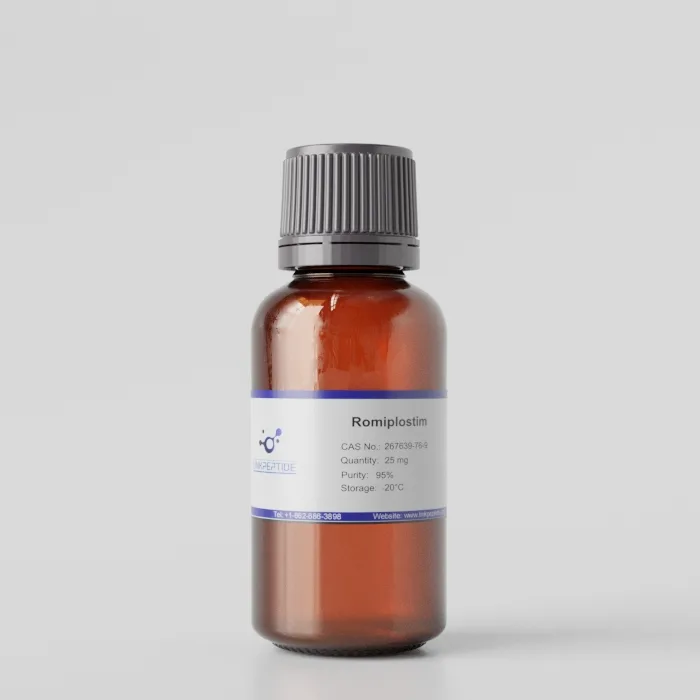
Product Name: Romiplostim
Form: Free base
CAS No: 267639-76-9
Molar Mass: 59085.01
Chemical Formula: C2634H4086N722O790S18
Synonyms: AMG 531, Nplate, Romiplate
Storage: Store at -20℃
Sequence: MDKTHTCPPC PAPELLGGPS VFLFPPKPKD TLMISRTPEV TCVVVDVSHEDPEVKFNWYV DGVEVHNAKT KPREEQYNST YRVVSVLTVL HQDWLNGKEYKCKVSNKALP APIEKTISKA KGQPREPQVY TLPPSRDELT KNQVSLTCLVKGFYPSDIAV EWESNGQPEN NYKTTPPVLD SDGSFFLYSK LTVDKSRWQQGNVFSCSVMH EALHNHYTQK SLSLSPGKGG GGGIEGPTLR QWLAARAGGGGGGGGIEGPT LRQWLAARA
Target: acute radiation syndrome
Application:
Romiplostim (CAS: 267639-76-9) is a pharmaceutical agent with crucial applications in the management of immune thrombocytopenia. As a thrombopoietin receptor agonist, romiplostim stimulates the production and maturation of platelets, addressing the underlying cause of thrombocytopenia. By mimicking the action of endogenous thrombopoietin, romiplostim promotes megakaryocyte proliferation and platelet release, effectively increasing platelet counts in individuals with chronic immune thrombocytopenia. This targeted approach offers a valuable alternative for patients who are unresponsive to conventional therapies. Romiplostim's mechanism of action exemplifies a strategic intervention in the pharmaceutical landscape, providing a tailored solution to restore platelet levels and mitigate the risk of bleeding complications in individuals facing immune thrombocytopenia challenges.
Current Research:
Romiplostim is a thrombopoietin receptor agonist used to treat thrombocytopenia (low platelet counts) in patients with chronic immune thrombocytopenia (ITP) who have not responded adequately to other treatments. ITP is an autoimmune disorder in which the immune system mistakenly destroys platelets, leading to an increased risk of bleeding. Romiplostim works by stimulating the thrombopoietin receptor (c-Mpl) on megakaryocytes and progenitor cells in the bone marrow, promoting the production of platelets. This drug provides an alternative therapy for patients with ITP who have not responded to corticosteroids, immune globulin therapy, or splenectomy.
Mechanism of Action
Romiplostim mimics the action of thrombopoietin, a key regulator of platelet production. It binds to and activates the thrombopoietin receptor (c-Mpl) on the surface of megakaryocytes and early progenitor cells in the bone marrow. By stimulating this receptor, romiplostim enhances the proliferation and maturation of megakaryocytes, leading to increased platelet production. The drug does not directly affect the immune system or the underlying cause of ITP but works by increasing platelet counts, which helps to reduce bleeding risks associated with the disease.
Indications and Uses
Romiplostim is primarily indicated for the treatment of chronic immune thrombocytopenia (ITP) in adults and children aged 1 year and older who have had insufficient response to other treatments, such as corticosteroids, immunoglobulins, or splenectomy. It is administered via subcutaneous injection, typically on a weekly basis, and dosage is adjusted based on platelet counts and patient response. Romiplostim is not a curative treatment for ITP but rather helps to manage platelet counts and reduce the risk of bleeding episodes. It is typically used in conjunction with other therapies in the management of the disease.
Efficacy and Clinical Benefits
Clinical trials have shown that romiplostim significantly increases platelet counts in patients with chronic ITP. This increase in platelet production helps to reduce the incidence of bleeding episodes and improve overall clinical outcomes. Patients treated with romiplostim have shown a reduction in the need for other interventions, such as platelet transfusions, and have experienced fewer bleeding complications. The drug's ability to stimulate platelet production provides a novel approach for managing chronic ITP, especially in patients who have not responded to standard therapies. In some patients, romiplostim has been shown to allow them to achieve a durable platelet response with reduced or no need for additional ITP treatments.
Safety and Tolerability
Romiplostim is generally well tolerated, but like all medications, it can cause side effects. The most common adverse reactions include headache, fatigue, joint pain, and injection site reactions (such as pain, redness, or swelling). A more serious, but rare, side effect is the development of bone marrow fibrosis, a condition in which the bone marrow becomes scarred, potentially leading to reduced blood cell production. Regular monitoring of platelet counts, liver function, and bone marrow health is recommended during treatment with romiplostim. Additionally, there may be an increased risk of thrombosis (blood clots) in some patients, so careful monitoring for signs of clotting is advised.
Advantages and Limitations
The main advantage of romiplostim is its ability to stimulate platelet production in patients with chronic ITP, a disease where platelet counts are often insufficient to prevent bleeding. It provides an important treatment option for patients who do not respond to other therapies. However, romiplostim is not a curative treatment, and its effects are primarily limited to managing platelet counts rather than addressing the underlying immune dysfunction in ITP. Additionally, romiplostim requires regular subcutaneous injections, which may be inconvenient for some patients. The long-term safety of romiplostim, particularly in terms of bone marrow health and potential thrombotic events, requires ongoing monitoring.
Future Directions
Research into romiplostim continues, focusing on its long-term safety, particularly concerning the potential risks of bone marrow fibrosis and thrombosis. Studies are also exploring its use in other thrombocytopenic conditions, including those associated with chemotherapy or other bone marrow disorders. New formulations or delivery methods, such as longer-acting versions, are being investigated to improve patient adherence and convenience. Further exploration of romiplostim's role in combination with other therapies, such as immunosuppressants or corticosteroids, may offer more comprehensive treatment approaches for ITP and other platelet-related disorders.
Reference:
Get a Quote
 LinkPeptide