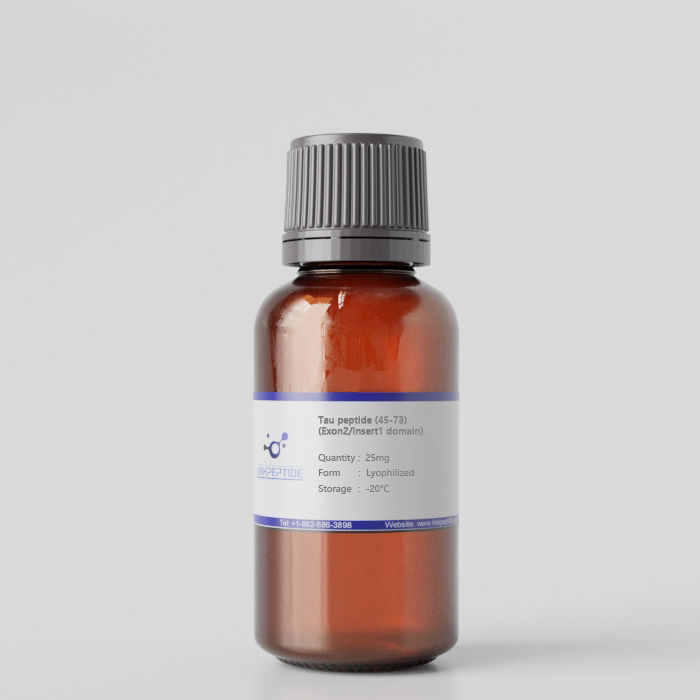
Product Name: Tau peptide (45-73) (Exon2/Insert1 domain)
Sequence One Letter Code: ESPLQTPTEDGSEEPGSETSDAKSTPTAE
Sequence Three Letter Code: Glu-Ser-Pro-Leu-Gln-Thr-Pro-Thr-Glu-Asp-Gly-Ser-Glu-Glu-Pro-Gly-Ser-Glu-Thr-Ser-Asp-Ala-Lys-Ser-Thr-Pro-Thr-Ala-Glu-OH
Chemical Formula:C120H189N31O57
Molecular Weight: 2978.2
Purity: 95%
Form: Lyophilized
Storage Conditions: - 20 °C
Research Area: Neurological Disease Research
Source / Species: human
Conjugation: Unconjugated
Code Nacres: NA.26
Application: Tau Peptide (45–73) is a 29-amino acid fragment derived from the exon 2 insert (N-terminal insert 1) domain of the human tau protein. Tau is a microtubule-associated protein essential for neuronal cytoskeletal stability and is centrally implicated in Alzheimer’s disease and other tauopathies. The N-terminal insert domains distinguish tau isoforms and influence subcellular localization, protein interactions, and functional regulation. This peptide is used to study isoform-specific structural features, interaction motifs, and early molecular alterations associated with tau dysfunction. It supports investigations into tau-mediated signaling, protein–protein interactions, and mechanisms contributing to neurodegeneration and pathological tau aggregation.
Current Research: Tau Peptide (45–73) corresponds to a 29–amino acid segment derived from exon 2 of the human MAPT gene, representing the first N-terminal insert (N1) domain present in specific tau isoforms. Alternative splicing of MAPT generates six major central nervous system isoforms in adult human brain, differing by inclusion or exclusion of exons 2, 3 (N-terminal inserts), and exon 10 (microtubule-binding repeat domain). The N-terminal inserts (0N, 1N, 2N isoforms) are increasingly recognized as modulators of tau’s subcellular localization, interaction landscape, and signaling properties rather than passive structural appendages. Current research has shifted from viewing tau solely as a microtubule-stabilizing protein toward understanding its multifaceted roles in synaptic function, intracellular signaling, and protein scaffolding. The N-terminal projection domain, including residues 45–73, extends away from the microtubule surface and participates in interactions with plasma membrane components, cytoskeletal adaptors, and signaling proteins. Structural studies suggest that this region contributes to tau’s “paperclip” conformation, in which N- and C-terminal regions fold toward the microtubule-binding domain. Perturbations in this intramolecular organization are thought to represent early steps in pathological conformational changes. The exon 2–encoded region encompassed by Tau (45–73) is particularly relevant for isoform-specific behavior. Isoforms containing N1 (and N2) inserts exhibit altered subcellular distribution and differential interactions with SH3-domain–containing proteins such as Fyn kinase. Tau–Fyn interactions are implicated in synaptic signaling, especially at postsynaptic densities where tau helps anchor Fyn to NMDA receptor complexes. Dysregulation of this interaction has been linked to excitotoxic signaling and synaptic vulnerability in Alzheimer’s disease models. The 45–73 segment contributes to mapping these interaction interfaces and dissecting isoform-dependent binding dynamics. In the context of tauopathies, early molecular alterations often precede fibrillar aggregation. Increasing evidence indicates that soluble tau species and mislocalized tau contribute to neuronal dysfunction before neurofibrillary tangles form. Studies using defined N-terminal fragments, including peptides spanning exon 2 regions, help examine how cleavage products or conformational exposure of normally shielded domains may influence aggregation propensity, membrane association, or interaction with signaling partners. Proteolytic processing of tau during stress or apoptosis can generate N-terminal fragments that exert distinct biological effects, including modulation of calcium signaling and mitochondrial function. Biophysical investigations utilize Tau Peptide (45–73) to probe intrinsic disorder characteristics and transient secondary structure formation within the N-terminal projection domain. Although tau is largely intrinsically disordered, local sequence elements may adopt context-dependent conformations that regulate binding specificity. Techniques such as NMR spectroscopy, circular dichroism, and molecular dynamics simulations are applied to characterize structural preferences and to model how exon 2 inclusion alters overall tau flexibility and intramolecular contacts. Another area of active research concerns tau’s interaction with cellular membranes. The N-terminal region has been implicated in binding to lipid membranes and vesicular structures, potentially influencing tau secretion and intercellular propagation. Since tau spreading between neurons is thought to contribute to disease progression, understanding how specific domains—including residues 45–73—participate in membrane engagement or extracellular interactions remains an important focus. In cellular models, the peptide supports mapping of antibody epitopes and validation of isoform-specific detection strategies. It is also used in competition assays to identify proteins that selectively bind exon 2–containing tau isoforms. Comparative studies between 0N and 1N/2N tau variants reveal differences in microtubule spacing, axonal targeting, and synaptic enrichment, highlighting functional consequences of N-terminal insert inclusion. Overall, Tau Peptide (45–73) provides a defined molecular tool for investigating isoform-specific structural features and interaction motifs within the tau N-terminal projection domain. As research increasingly emphasizes early tau dysfunction, synaptic signaling perturbations, and domain-specific contributions to neurodegeneration, this exon 2–derived fragment supports mechanistic studies aimed at clarifying how subtle isoform differences influence tau biology and the pathogenesis of Alzheimer’s disease and related tauopathies.
Get a Quote
 LinkPeptide

![SCYLLATOXIN [Tyr2]-](https://www.linkpeptide.com/wp-content/uploads/2024/10/SCYLLATOXIN-Tyr2-jpg-2.webp "SCYLLATOXIN [Tyr2]-")