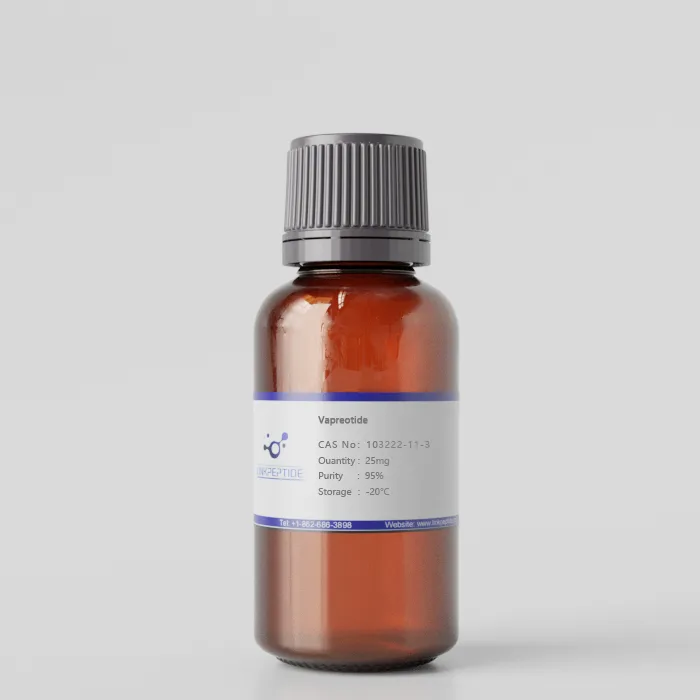
Product Name:Vapreotide
Form:Acetate salt
Purity:95%
Storage:-20oC
Cas No:103222-11-3
Molar Mass:1131.4
Chemical Formula:C57H70N12O9S2
Synonyms:RC 160; CCRIS 6495; BMY 41606; RC-160
IUPAC Name:10-(4-aminobutyl)-N-[1-amino-3-(1H-indol-3-yl)-1-oxopropan-2-yl]-19-[(2-amino-3-phenylpropanoyl)amino]-16-[(4-hydroxyphenyl)methyl]-13-(1H-indol-3-ylmethyl)-6,9,12,15,18-pentaoxo-7-propan-2-yl-1,2-dithia-5,8,11,14,17-pentazacycloicosane-4-carboxamide
SMILES:CC(C)C1C(=O)NC(CSSCC(C(=O)NC(C(=O)NC(C(=O)NC(C(=O)N1)CCCCN)CC2=CNC3=CC=CC=C32)CC4=CC=C(C=C4)O)NC(=O)C(CC5=CC=CC=C5)N)C(=O)NC(CC6=CNC7=CC=CC=C76)C(=O)N
InChIKey:SWXOGPJRIDTIRL-UHFFFAOYSA-N
InChI:InChI=1S/C57H70N12O9S2/c1-32(2)49-57(78)68-48(55(76)64-44(50(60)71)26-35-28-61-41-16-8-6-14-38(35)41)31-80-79-30-47(67-51(72)40(59)24-33-12-4-3-5-13-33)56(77)65-45(25-34-19-21-37(70)22-20-34)53(74)66-46(27-36-29-62-42-17-9-7-15-39(36)42)54(75)63-43(52(73)69-49)18-10-11-23-58/h3-9,12-17,19-22,28-29,32,40,43-49,61-62,70H,10-11,18,23-27,30-31,58-59H2,1-2H3,(H2,60,71)(H,63,75)(H,64,76)(H,65,77)(H,66,74)(H,67,72)(H,68,78)(H,69,73)
Sequence:FCYWKVCW
Application:Vapreotide is a synthetic somatostatin analog with potent inhibitory effects on hormone secretion, particularly growth hormone, insulin, and gastrointestinal peptides. It is primarily used in the management of gastroesophageal variceal bleeding in cirrhotic patients by reducing splanchnic blood flow and portal pressure. Additionally, Vapreotide is being investigated for its potential role in neuroendocrine tumors, acromegaly, and pancreatic disorders. Compared to natural somatostatin, it has a longer half-life, making it a more effective therapeutic option. Current research is exploring its use in various endocrine-related disorders, emphasizing its impact on tumor growth inhibition and gastrointestinal disease management.
Current Research:Vapreotide is a potent somatostatin analog that mimics the natural inhibitory effects of somatostatin on hormone secretion and gastrointestinal function. Its primary clinical use has been in the management of acute variceal bleeding in patients with cirrhosis, but ongoing research is expanding its potential in neuroendocrine tumors, acromegaly, and pancreatic disorders. Gastroesophageal Variceal Bleeding (GEVB) in Cirrhosis Vapreotide is widely used to control acute esophageal variceal hemorrhage, a life-threatening complication in patients with portal hypertension due to cirrhosis. By inhibiting splanchnic vasodilation and reducing portal vein pressure, Vapreotide effectively decreases bleeding risk and improves hemodynamic stability. Clinical trials have demonstrated its effectiveness when used alongside endoscopic variceal ligation (EVL) and beta-blockers. Current research is focusing on comparing Vapreotide to other somatostatin analogs (e.g., Octreotide) in terms of efficacy, safety, and cost-effectiveness in managing variceal bleeding. Neuroendocrine Tumors (NETs) and Cancer Research Given its potent hormone-inhibitory properties, Vapreotide is being explored as a treatment for neuroendocrine tumors (NETs), particularly those that secrete excess hormones, such as carcinoid tumors and insulinomas. Early studies suggest that Vapreotide may help control hormone-mediated symptoms (e.g., flushing and diarrhea in carcinoid syndrome) and may have antiproliferative effects on tumor growth. Ongoing research is evaluating Vapreotide??s role in combination therapies with targeted agents to enhance tumor suppression. Acromegaly and Pituitary Disorders Acromegaly, a condition caused by excess growth hormone (GH) secretion from a pituitary adenoma, is traditionally treated with somatostatin analogs. Vapreotide has been studied as a potential alternative to Octreotide and Lanreotide in acromegaly patients who require GH suppression. Recent clinical trials have focused on comparing Vapreotide??s efficacy in controlling GH levels and reducing tumor size in acromegalic patients. Pancreatic Disorders and Endocrine Dysregulation Vapreotide??s ability to inhibit pancreatic enzyme and insulin secretion has sparked interest in its potential use in pancreatitis, pancreatic tumors, and insulinomas. Studies suggest that Vapreotide may help control hyperinsulinemic episodes in insulinoma patients and manage excessive pancreatic enzyme secretion in chronic pancreatitis. Researchers are also investigating its effects on glucose metabolism and its potential role in diabetes management, particularly in cases of insulin hypersecretion. Emerging Research Areas Beyond its established uses, Vapreotide is being explored for: Inflammatory bowel disease (IBD), including Crohn??s disease, due to its ability to modulate gut inflammation. Postoperative management of gastrointestinal surgeries, reducing complications such as fistulas and excessive secretions. Potential neuroprotective effects in neurodegenerative diseases, leveraging its ability to modulate neuroendocrine signaling. With continued research, Vapreotide is emerging as a promising therapeutic agent with expanding indications beyond its traditional role in gastroenterology and endocrinology.
Get a Quote
 LinkPeptide