 LinkPeptide
Neuropeptides in Cellular Communication: Signaling Networks, Physiological Regulation, and Research Directions
Introduction: Neuropeptides as Biological Signaling Molecules
Neuropeptides are a diverse class of endogenous signaling molecules that contribute to communication within the nervous system and between neural and peripheral tissues. Rather than functioning exclusively as conventional neurotransmitters, neuropeptides can act as neuromodulators, local signaling molecules, and neuroendocrine messengers.
More than 100 neuropeptides have been identified in humans, with additional peptide sequences predicted through genomic research. Their functions span sensory signaling, neural plasticity, metabolic regulation, behavioral state, cardiovascular physiology, reproduction, and other homeostatic processes.
For researchers, the significance of neuropeptides lies in their molecular diversity and highly organized receptor interactions. Studying these systems can provide insights into how peptide-mediated communication contributes to complex biological networks.
What Are Neuropeptides?
Neuropeptides are short chains of amino acids synthesized by neurons and other specialized cells. Examples commonly investigated in experimental research include:
- Neuropeptide Y (NPY)
- Substance P
- Calcitonin gene-related peptide (CGRP)
- Galanin
- Orexins
- Pituitary adenylate cyclase-activating polypeptide (PACAP)
Other peptide families are also involved in neural and neuroendocrine communication, demonstrating the extensive diversity of peptidergic signaling.
Many neuropeptides are not synthesized directly in their final active form. Instead, cells initially produce larger precursor proteins that undergo enzymatic processing to generate smaller peptide products. These peptides can subsequently be stored within secretory vesicles and released in response to appropriate cellular stimulation.
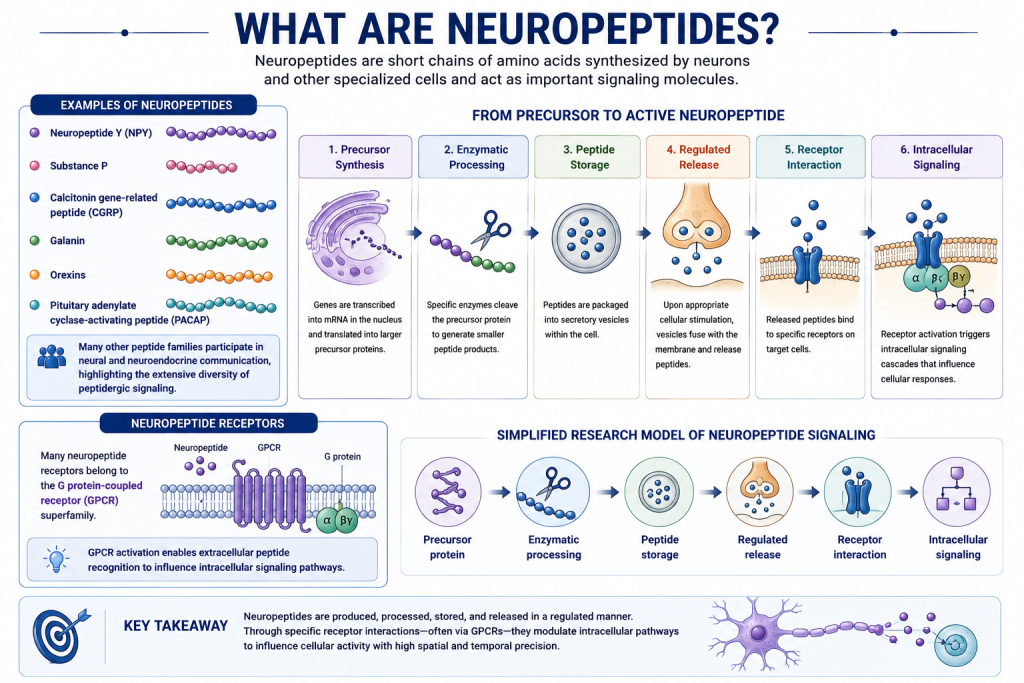
Following release, neuropeptides interact with specific receptors on target cells. Many neuropeptide receptors belong to the G protein-coupled receptor (GPCR) superfamily, allowing extracellular peptide recognition to influence intracellular signaling pathways.
A simplified research model is:
Precursor protein → enzymatic processing → peptide storage → regulated release → receptor interaction → intracellular signaling
This regulated sequence allows peptide signals to influence cellular activity with substantial spatial and temporal specificity.
How Neuropeptides Regulate Cellular Communication
Neuropeptide signaling should not be viewed as a simple one-peptide–one-response process.
Neurons may contain neuropeptides alongside classical neurotransmitters. Consequently, multiple chemical messengers can contribute to communication within the same neural network. Classical transmitters frequently support rapid synaptic signaling, while neuropeptides can modify cellular responses across different spatial and temporal scales.
Depending on the peptide, receptor, and cellular environment, neuropeptide signaling may influence:
- neuronal excitability,
- neurotransmitter release,
- receptor responsiveness,
- intracellular signaling,
- synaptic plasticity,
- cellular metabolism,
- and longer-term neural adaptation.
An additional layer of complexity arises from peptide metabolism.
Proteolytic processing does not necessarily eliminate biological activity. Certain peptide systems can produce fragments that retain signaling properties or exhibit activity distinct from their parent molecule. Substance P, NPY, and other peptide systems illustrate how peptide processing can contribute additional diversity to signaling networks.
Researchers therefore need to consider the complete signaling environment—including precursor processing, peptide release, receptor distribution, enzymatic metabolism, and cellular context.
Neuropeptides in Sensory Signaling Research
Sensory pathways provide an important model for understanding neuropeptide function.
Substance P is a member of the tachykinin peptide family and interacts preferentially with the NK1 receptor. Research involving Substance P has helped characterize peptide-mediated signaling within sensory neural networks.
CGRP is another extensively investigated sensory neuropeptide. It is expressed within specific neuronal populations and participates in communication between sensory neurons and their target tissues.
Rather than defining these peptides according to a particular medical outcome, their research value lies in understanding how peptide ligands, receptors, and downstream pathways interact within sensory systems.
These models have contributed substantially to the broader understanding of peptide–receptor recognition, neural communication, and pathway-specific signaling.
Neuropeptides and Metabolic Signaling Networks
Neuropeptides also contribute to the neural networks involved in energy homeostasis.
NPY is widely studied in hypothalamic signaling and provides an important experimental model for investigating how the nervous system integrates peripheral and central metabolic information.
Galanin participates in several neural signaling networks and has been studied in relation to neuroendocrine and metabolic regulation.
Orexin peptides provide another example of multifunctional signaling. Orexin-producing neurons are concentrated primarily within the hypothalamus but communicate with multiple brain regions. Through these networks, orexin signaling connects physiological state with arousal, behavioral activity, and energy-related neural processes.
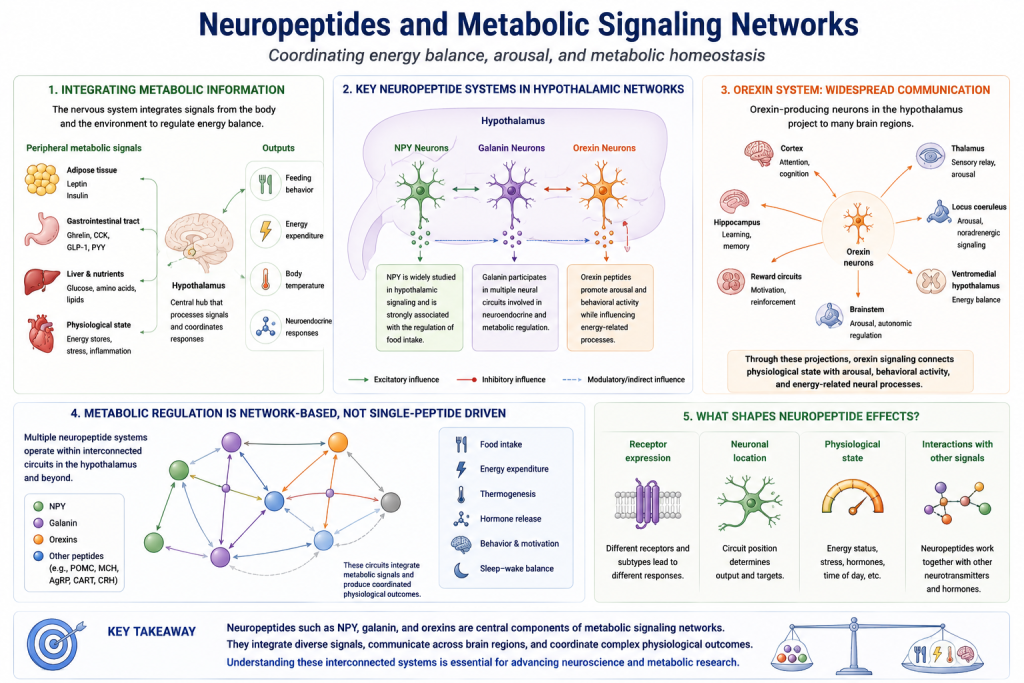
The key research principle is that metabolic regulation does not depend on one isolated peptide.
Instead, multiple peptide systems operate within interconnected networks. Their biological effects depend on receptor expression, neuronal location, physiological state, and interactions with other signaling molecules.
This network-based perspective has become increasingly important for understanding neuropeptide biology.
Orexins and Behavioral-State Signaling
The orexin system provides a particularly useful example of how neuropeptides can coordinate multiple neural functions.
Orexin-producing neurons project broadly throughout the central nervous system. Their signaling has been studied extensively in relation to the organization of arousal and behavioral-state networks.
Importantly, orexins demonstrate that one neuropeptide family may participate in several interconnected physiological processes rather than performing one narrowly defined function.
Research into the orexin system therefore provides a model for investigating:
- neuronal circuit organization,
- peptide receptor distribution,
- state-dependent signaling,
- hypothalamic communication,
- and interactions between neural and metabolic networks.
This multifunctionality is characteristic of many neuropeptide systems and explains why individual peptides should be studied within their broader signaling environment.
Neuropeptide Plasticity and Neural Adaptation
Another defining feature of neuropeptide biology is plasticity.
Peptide expression does not necessarily remain constant. Changes in neuronal activity, physiological stress, development, or tissue injury can alter peptide synthesis and receptor expression.
This phenomenon allows neurons to reorganize their chemical signaling profile according to changing biological conditions.
Galanin provides an informative example. Its expression can change substantially following certain forms of neuronal disturbance, making it useful for investigating adaptive changes in neural signaling.
NPY expression can also vary in response to changes within neuronal environments.
Such observations suggest that neuropeptides may participate not only in routine neural communication but also in longer-term adaptation of signaling networks.
For researchers, this creates opportunities to examine how:
cellular state → peptide expression → receptor signaling → network activity
changes under different experimental conditions.
Neuropeptides in Neural Circuit Research
Because neuropeptide systems influence neuronal excitability and communication, they have become useful tools for studying the organization of neural circuits.
NPY, galanin, neurotensin, PACAP, and other peptide systems have been investigated in experimental models involving changes in neuronal activity and network behavior.
PACAP is particularly interesting because it participates in multiple signaling pathways and has been investigated in experimental models involving neuronal responses to cellular stress.
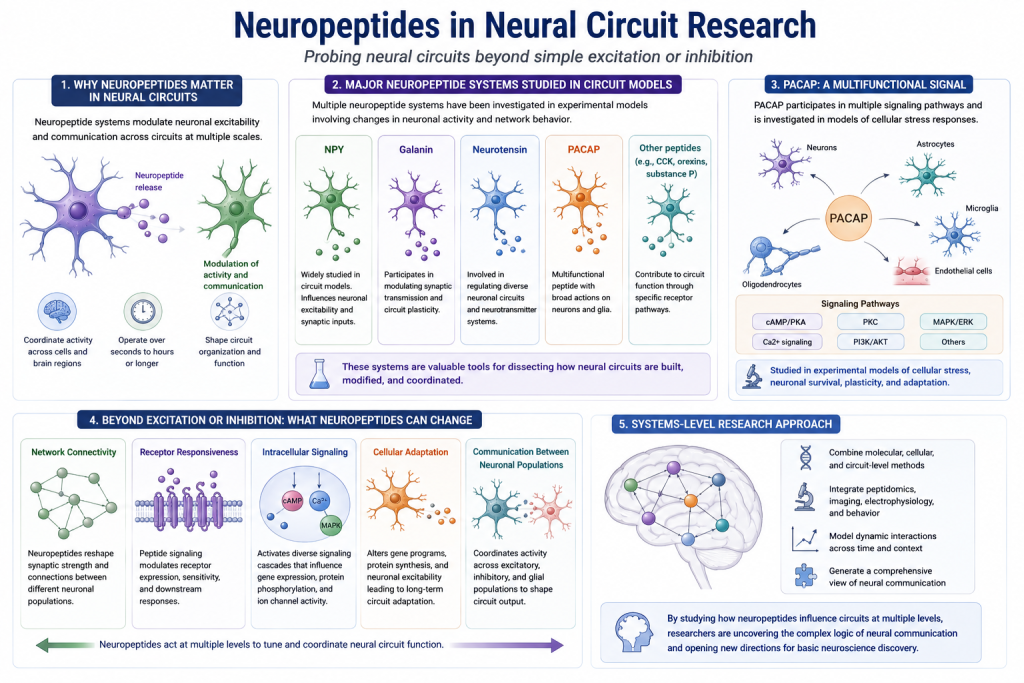
These studies illustrate an important distinction.
Neuropeptide research is not limited to determining whether a peptide increases or decreases neuronal activity. Researchers increasingly examine how peptide signaling changes:
- network connectivity,
- receptor responsiveness,
- intracellular signaling,
- cellular adaptation,
- and communication between different neuronal populations.
This systems-level approach is helping build a more detailed picture of neural communication.
Why Neuropeptide Receptors Are Important Research Targets
A major advantage of neuropeptide systems for experimental research is the specificity of many peptide–receptor interactions.
Different peptides may interact preferentially with particular receptor families or receptor subtypes. Characterizing these interactions allows researchers to investigate the molecular mechanisms underlying a signaling pathway.
Research can therefore focus on several complementary questions:
Which peptide binds the receptor?
Which structural features determine recognition?
Where is the receptor expressed?
Which intracellular pathway is activated?
How does receptor signaling change under different experimental conditions?
This information supports structure–activity relationship studies and the development of selective molecular probes.
The objective is not necessarily to reproduce the complete endogenous peptide. Instead, researchers can identify the structural features responsible for receptor recognition and investigate how modifications affect signaling behavior.
Peptide Engineering and Peptidomimetic Research
Native neuropeptides can present experimental challenges because peptide bonds are susceptible to enzymatic cleavage and many peptides exhibit relatively short biological stability.
Peptide engineering provides several approaches for investigating these limitations.
One strategy involves incorporating unnatural amino acids into a peptide sequence. These substitutions can help researchers examine the relationship between peptide structure, enzymatic stability, and receptor recognition.
Conformational restriction represents another approach. Cyclization or other structural constraints can reduce peptide flexibility and help identify conformations associated with receptor interaction.
Researchers can also investigate non-hydrolyzable amide-bond surrogates or transfer important peptide recognition features onto alternative molecular scaffolds.
These strategies support a fundamental objective of peptide science:
identify the molecular features required for biological recognition while systematically modifying other structural elements.
Such experiments are valuable for studying receptor selectivity, peptide stability, structure–activity relationships, and signaling mechanisms.
Future Directions in Neuropeptide Research
Modern neuropeptide research is increasingly moving from individual molecules toward integrated signaling networks.
Future studies are likely to combine:
- peptide synthesis,
- receptor biology,
- peptidomics,
- structural analysis,
- computational modeling,
- cellular assays,
- neural circuit analysis,
- and advanced molecular imaging.
Particular attention is being directed toward understanding how peptide expression changes across cell types and physiological states.
The same neuropeptide may produce different biological responses depending on receptor distribution, tissue environment, concentration, and interactions with other signaling systems. Mapping these variables will be essential for developing a more complete understanding of peptidergic communication.
Conclusion
Neuropeptides represent a highly diverse molecular communication system connecting neuronal activity with sensory processing, metabolic signaling, behavioral state, neural plasticity, and physiological adaptation.
Molecules such as NPY, Substance P, CGRP, galanin, orexins, and PACAP provide valuable experimental models for investigating how peptide signals are generated, released, recognized, processed, and integrated within biological networks.
Their scientific importance extends beyond the activity of individual peptides. Neuropeptide research provides a framework for studying peptide–receptor interactions, GPCR signaling, cellular communication, structure–activity relationships, and neural network regulation.
As peptide synthesis, molecular biology, structural analysis, and computational technologies continue to advance, researchers will be able to characterize these signaling systems with increasing precision. This shift from individual peptide molecules toward integrated signaling networks is likely to remain a major direction in neuropeptide and cellular communication research.