 LinkPeptide
Neuropeptides in Health and Disease: From Cellular Signaling to Therapeutic Targets
Introduction: Neuropeptides Are More Than Neurotransmitters
Communication within the nervous system is far more complex than the transmission of electrical impulses between neurons. Alongside classical neurotransmitters such as glutamate, GABA, acetylcholine, and monoamines, neurons produce a diverse group of signaling molecules known as neuropeptides.
Neuropeptides can regulate neuronal excitability, synaptic transmission, metabolism, pain, appetite, sleep, stress responses, and adaptive changes following nervous-system injury. Importantly, they frequently coexist with classical neurotransmitters and modify their effects rather than functioning as simple substitutes.
This gives the nervous system access to multiple layers of communication. Classical neurotransmitters can provide rapid synaptic signaling, while neuropeptides can produce broader and often longer-lasting modulation of cellular activity.
As our understanding of these signaling networks grows, neuropeptides and their receptors are becoming increasingly interesting targets for therapeutic peptide research and drug discovery.
What Are Neuropeptides?
Neuropeptides are short chains of amino acids produced by neurons and other specialized cells. They include several well-known signaling molecules, such as:
- Substance P
- Neuropeptide Y (NPY)
- Calcitonin gene-related peptide (CGRP)
- Galanin
- Somatostatin
- Cholecystokinin (CCK)
- Oxytocin and vasopressin
- Dynorphins and enkephalins
- Orexins
- Corticotropin-releasing hormone
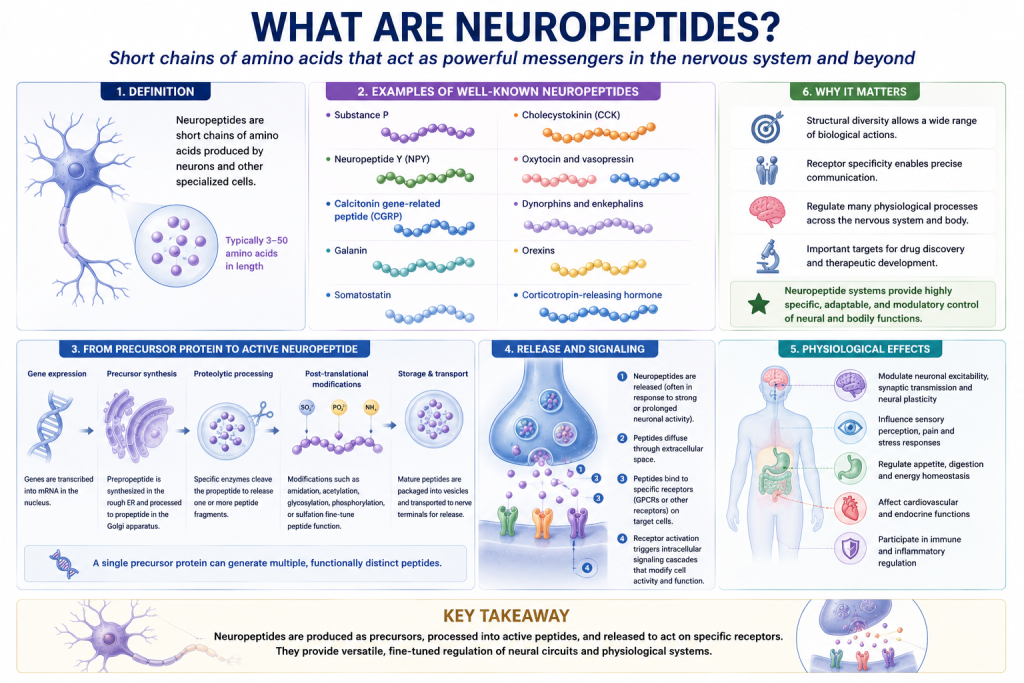
Many peptide signals originate from larger precursor proteins that are synthesized inside cells and subsequently processed into biologically active peptides. Their production can involve enzymatic cleavage and post-translational modifications, allowing cells to generate functionally distinct signaling molecules from peptide precursors.
Once released, neuropeptides interact with specific receptors on target cells. The resulting signaling can alter neuronal activity and influence physiological processes ranging from sensory perception to feeding behavior.
This combination of structural diversity and receptor specificity helps explain why neuropeptide systems have become an important area of pharmacological research.
How Neuropeptides Regulate Cellular Communication
One particularly interesting characteristic of neuropeptide biology is co-transmission.
A neuron does not necessarily communicate using only one chemical messenger. Classical neurotransmitters and neuropeptides can coexist within the same neuronal system, allowing different molecules to contribute to different components of the biological response.
In this way, neurons can release a molecular “cocktail” capable of generating responses across different time scales.
Neuropeptides can influence:
- neuronal excitability,
- neurotransmitter release,
- receptor responsiveness,
- synaptic plasticity,
- metabolic processes,
- cellular growth,
- and long-term neuronal adaptation.
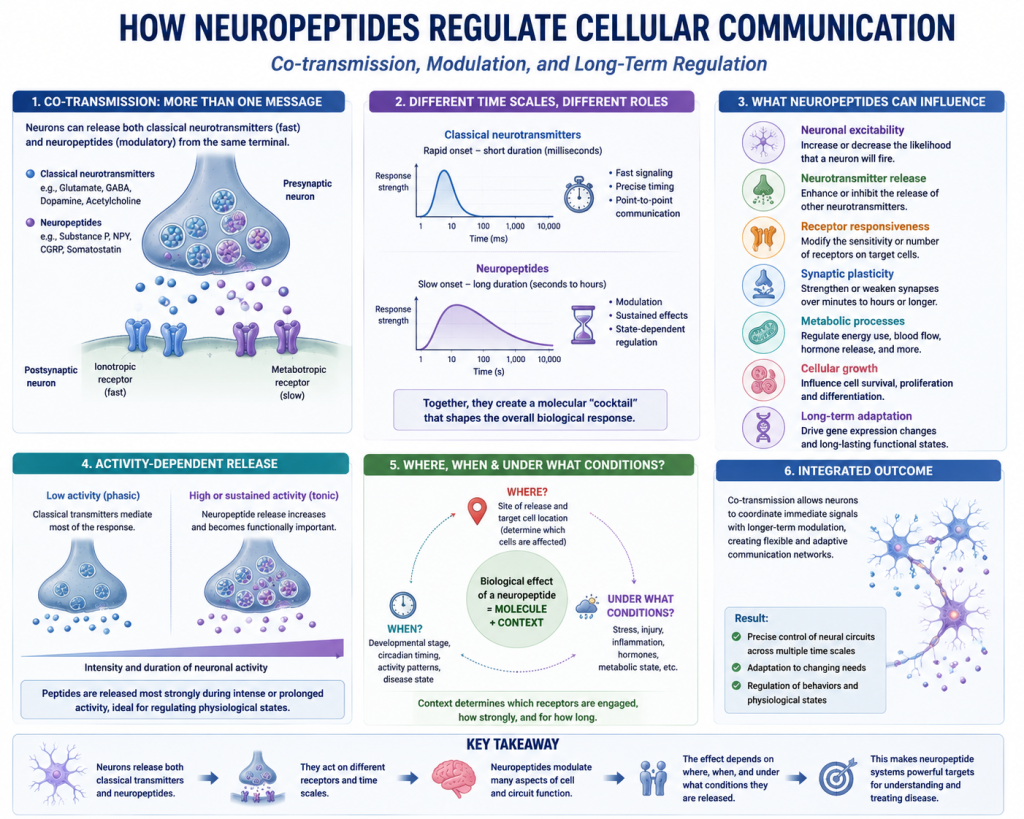
Peptide release may also become particularly important during intense or sustained neuronal activity. This distinguishes neuropeptide signaling from many rapidly released classical neurotransmitters and makes peptides particularly suitable for regulating physiological states rather than simply transmitting individual signals.
The biological effect of a neuropeptide therefore depends not only on its molecular identity but also on where, when, and under what physiological conditions it is released.
Neuropeptide Plasticity During Stress and Nerve Injury
Neuropeptide systems are remarkably dynamic.
Expression levels can change in response to development, physiological stress, neuronal activity, and injury. Some peptides are normally abundant, whereas others may occur at relatively low concentrations until a biological challenge causes their expression to increase dramatically.
Peripheral nerve injury provides a striking example.
Following axonal damage, the expression of some sensory peptides can decrease, while other neuropeptide systems become strongly activated. Substance P and CGRP, for example, may decline in many injured sensory neurons. In contrast, galanin, neuropeptide Y, and vasoactive intestinal peptide can become substantially upregulated. Changes in peptide receptor expression may occur simultaneously.
These molecular changes suggest that injured neurons undergo a broader functional transformation.
Rather than concentrating exclusively on normal sensory transmission, neurons may activate signaling programs associated with survival, adaptation, regeneration, and altered excitability.
This makes injury-associated neuropeptide pathways particularly interesting for research into neuropathic pain, nerve regeneration, and neurological recovery.
Major Physiological Roles of Neuropeptides
Pain Signaling
Pain biology is one of the most extensively investigated areas of neuropeptide research.
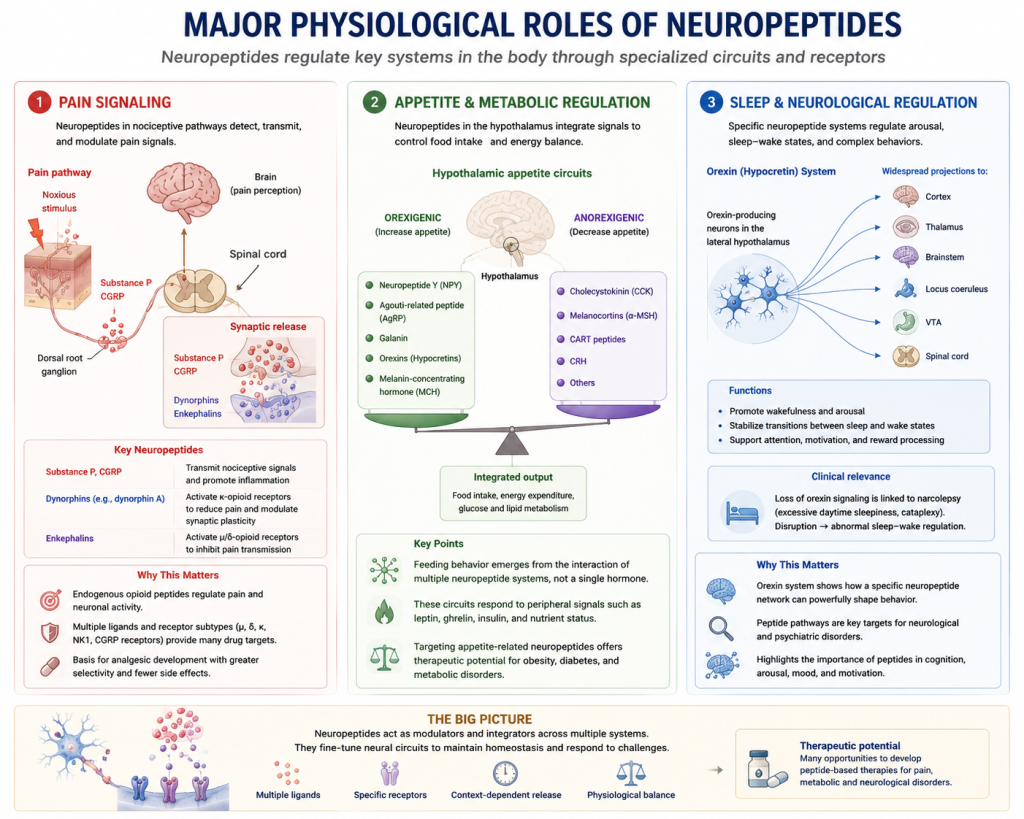
Substance P and CGRP are closely associated with sensory pathways involved in nociceptive signaling. Opioid peptides such as dynorphins and enkephalins also participate in endogenous mechanisms regulating pain and neuronal activity.
For example, endogenous dynorphin signaling can influence synaptic plasticity through κ-opioid receptors.
Because these pathways contain different peptide ligands and receptor subtypes, they provide multiple opportunities for pharmacological intervention.
Appetite and Metabolic Regulation
Neuropeptides also form complex signaling networks controlling food intake and energy homeostasis.
Important peptide systems include neuropeptide Y, CCK, galanin, orexins, melanocortins, melanin-concentrating hormone, agouti-related peptide, and CART peptides.
Rather than operating through a single “hunger hormone,” feeding behavior emerges from interactions between multiple orexigenic and anorexigenic pathways.
Understanding these networks has become particularly relevant as peptide-based strategies play increasingly prominent roles in metabolic research.
Sleep and Neurological Regulation
Orexins, also known as hypocretins, demonstrate how a relatively specific peptide signaling system can have profound effects on behavior.
Orexin-producing neurons are concentrated primarily in the lateral hypothalamus but project widely throughout the brain. Experimental studies connecting disruption of orexin signaling with narcoleptic phenotypes established an important relationship between neuropeptide biology and sleep regulation.
Such discoveries demonstrate why neuropeptide systems are increasingly being examined in neurological and behavioral research.
Why Neuropeptide Receptors Are Attractive Drug Targets
Neuropeptide biology offers several potential routes for therapeutic intervention.
Researchers can develop molecules that activate peptide receptors, antagonists that block specific receptors, or inhibitors that prevent enzymatic degradation of endogenous peptides.
Peptidase inhibition is particularly interesting because it can enhance naturally occurring peptide signaling rather than directly introducing an external receptor agonist. The development of non-peptide receptor antagonists has also expanded opportunities for manipulating peptide pathways with molecules possessing different pharmacokinetic characteristics.
Another attractive characteristic is the context dependence of neuropeptide signaling.
Some peptide systems become particularly influential during strong neuronal activity, stress, injury, or pathological conditions. Consequently, modulation of these pathways may have relatively limited effects under baseline conditions but become much more significant when abnormal signaling is strongly activated.
For drug discovery, this raises an important possibility: targeting disease-associated peptide signaling while minimizing disruption of essential baseline neurotransmission.
From Neuropeptide Biology to Therapeutic Development
The expanding understanding of neuropeptide networks is changing how researchers approach therapeutic peptides.
Instead of considering individual peptides as isolated messengers, modern research increasingly examines interactions among peptide ligands, receptor subtypes, classical neurotransmitters, intracellular signaling pathways, and disease-specific cellular environments.
This systems-level perspective could be particularly important for developing therapies targeting pain, metabolic dysfunction, neurological disease, stress-related disorders, and nerve injury.
At the same time, advances in peptide synthesis, sequence optimization, receptor pharmacology, peptidomics, and drug-delivery technologies are providing researchers with increasingly sophisticated tools for translating peptide biology into therapeutic candidates.
Conclusion
Neuropeptides represent a highly adaptable molecular communication system within the nervous system. They regulate processes ranging from pain and appetite to sleep, neuronal plasticity, and responses to injury.
Their biological importance lies not simply in transmitting signals, but in modulating how neural circuits behave under different physiological and pathological conditions. Changes in peptide expression following injury and the existence of diverse peptide receptor systems further demonstrate how dynamically these signaling networks can respond to biological challenges.
As researchers continue to clarify neuropeptide signaling networks and develop more selective approaches to peptide and receptor modulation, neuropeptides are likely to remain important both as research tools and as starting points for next-generation therapeutic development.
Reference
Moore, M. R., & Black, P. M. (1991). Neuropeptides. Neurosurgical review, 14(2), 97-110.