 LinkPeptide
Peptide Linkers in Protein Engineering: Controlling Functional Dynamics in Multidomain Proteins
Abstract
Peptide linkers are essential structural elements that connect protein domains and regulate their movement, orientation, spacing, and functional cooperation. In multidomain proteins, linkers can behave as flexible hinges that permit large conformational rearrangements, or as rigid molecular rulers that maintain defined distances between functional modules. The review by Wriggers, Chakravarty, and Jennings highlights how peptide linker composition, length, rigidity, and sequence-dependent properties influence protein architecture, biomolecular dynamics, and chimeric protein design. For researchers in peptide science, protein engineering, and pharmaceutical biotechnology, understanding linker behavior is critical for designing fusion proteins, antibody fragments, biosensors, multifunctional enzymes, and targeted delivery systems. This article summarizes the structural principles of peptide linkers and discusses their relevance to modern biopharmaceutical development.
Introduction: Why Peptide Linkers Matter in Protein Architecture
Proteins are often described as compact folded structures, but many biologically important proteins are better understood as dynamic molecular systems. Multidomain proteins contain separate structural or functional domains connected by peptide linkers. These linkers are not passive spacers; they can determine whether domains move freely, remain separated, contact each other, or transmit conformational signals.
The attached article, “Control of Protein Functional Dynamics by Peptide Linkers,” emphasizes that structural flexibility is essential for the function of many proteins and multiprotein complexes. At the residue level, flexibility arises from local relaxation of peptide bond angles, but these small changes can accumulate into large-scale secondary, tertiary, or quaternary structural rearrangements .
For companies such as Linkpeptide, which support peptide and protein-related research, peptide linkers are highly relevant because they sit at the intersection of peptide chemistry, protein design, structural biology, and therapeutic biotechnology.
Flexible Linkers: Molecular Hinges for Functional Motion
Flexible peptide linkers allow connected domains to move relative to each other. This is especially important when protein domains need to interact transiently, undergo ligand-induced conformational change, or access multiple spatial arrangements.
Wriggers and colleagues describe hinge regions as “soft-linker” regions where localized torsion angle changes allow attached domains to pivot while maintaining the stable structure of the domains themselves . In this model, the domains behave like relatively rigid bodies, while the linker provides rotational freedom.
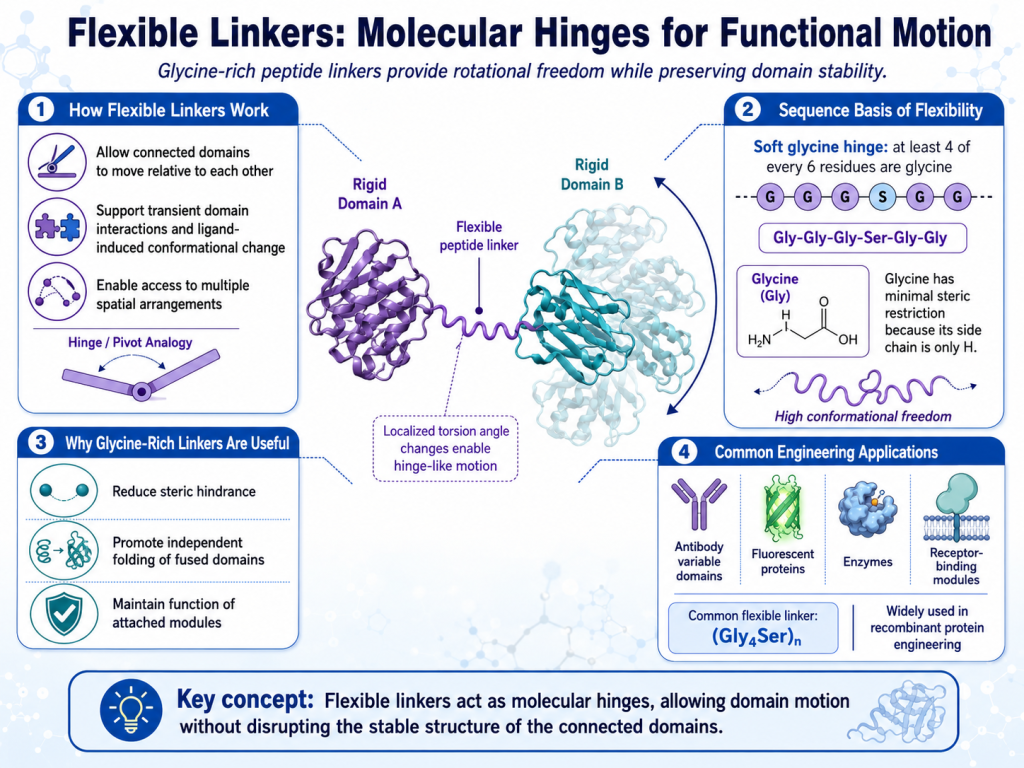
A classic feature of flexible linkers is their enrichment in glycine. Glycine has minimal steric restriction because its side chain is only a hydrogen atom. As a result, glycine-rich sequences can adopt many backbone conformations and function as flexible hinges. The article notes that soft glycine hinges may be designed as amino acid stretches in which at least four of every six residues are glycine .
This principle is widely used in recombinant protein engineering. For example, flexible linkers such as (Gly₄Ser)n are commonly used to connect antibody variable domains, fluorescent proteins, enzymes, or receptor-binding modules. These linkers reduce steric hindrance and allow fused domains to fold and function independently.
Rigid Linkers and Molecular Rulers
Not all linker applications require flexibility. In some engineered proteins, domains must be held apart at a predictable distance. In these cases, rigid linkers act as molecular rulers.
The article contrasts glycine-rich flexible linkers with more rigid peptide sequences such as polyproline and α-helical linkers. Polyproline chains, for example, provide predictable end-to-end distances because their backbone conformations are sterically restricted. Wriggers et al. describe how poly-L-proline peptides have historically been used as “spectroscopic rulers” to measure distance-dependent energy transfer between attached molecular groups .
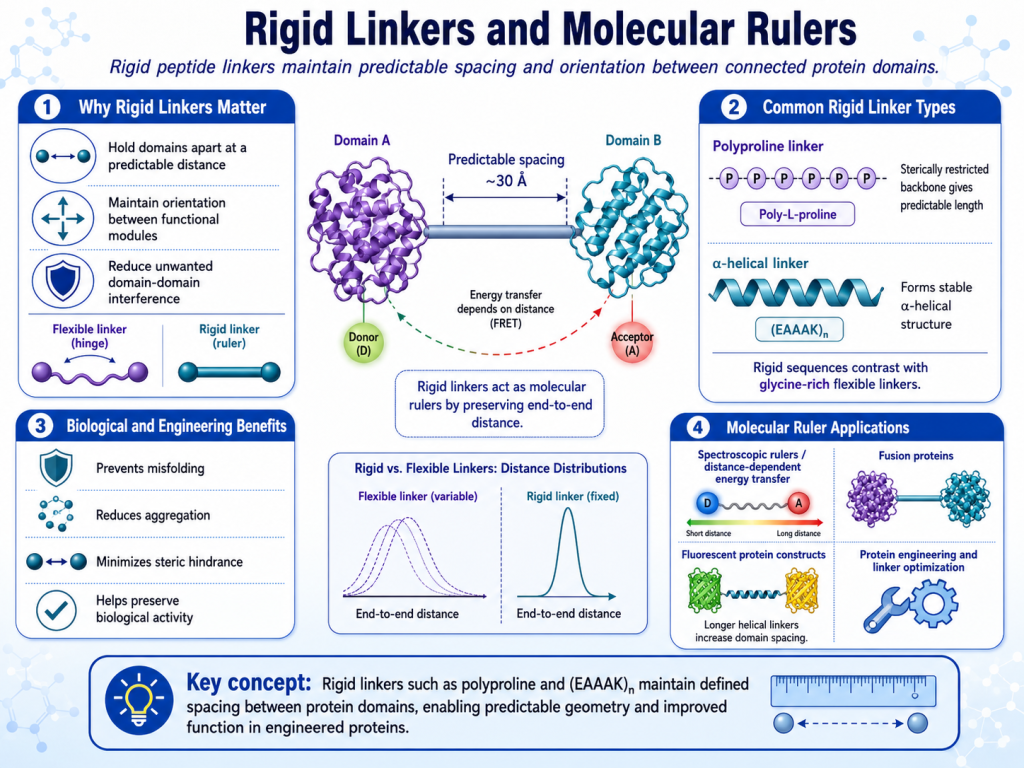
Rigid linkers are useful when domain spacing affects biological activity. In fusion proteins, inappropriate proximity can cause misfolding, aggregation, steric interference, or loss of function. Rigid linkers help reduce these problems by maintaining separation between domains.
One frequently used rigid linker motif is (EAAAK)n, which forms stable α-helical structures. The reviewed article discusses studies in which helical linkers were inserted between green fluorescent protein variants; the distance between fluorescent domains increased as linker length increased, supporting the molecular ruler concept .
Sequence-Dependent Properties of Peptide Linkers
The behavior of a peptide linker depends on multiple sequence features:
Length: Short linkers may restrict domain movement, while longer linkers provide greater freedom but may increase conformational heterogeneity.
Amino acid composition: Glycine increases flexibility; proline can introduce rigidity or structural disruption; charged residues improve solubility.
Hydrophilicity: Hydrophilic linkers can reduce aggregation and help maintain domain independence.
Secondary-structure propensity: Some linkers form helices, while others remain disordered or coil-like.
The article reports that natural linker lengths vary and that linkers may occur as helical, coiled, β-strand, or turn-like conformations. It also notes that proline is a common terminal linker residue, probably because it does not donate hydrogen bonds and does not comfortably participate in regular secondary structures, helping separate neighboring domains .
For researchers, this means linker design should not be treated as a random sequence insertion. Linker selection should be aligned with the intended function: flexibility, spacing, solubility, folding independence, or mechanical control.
Peptide Linkers in Chimeric Protein Design
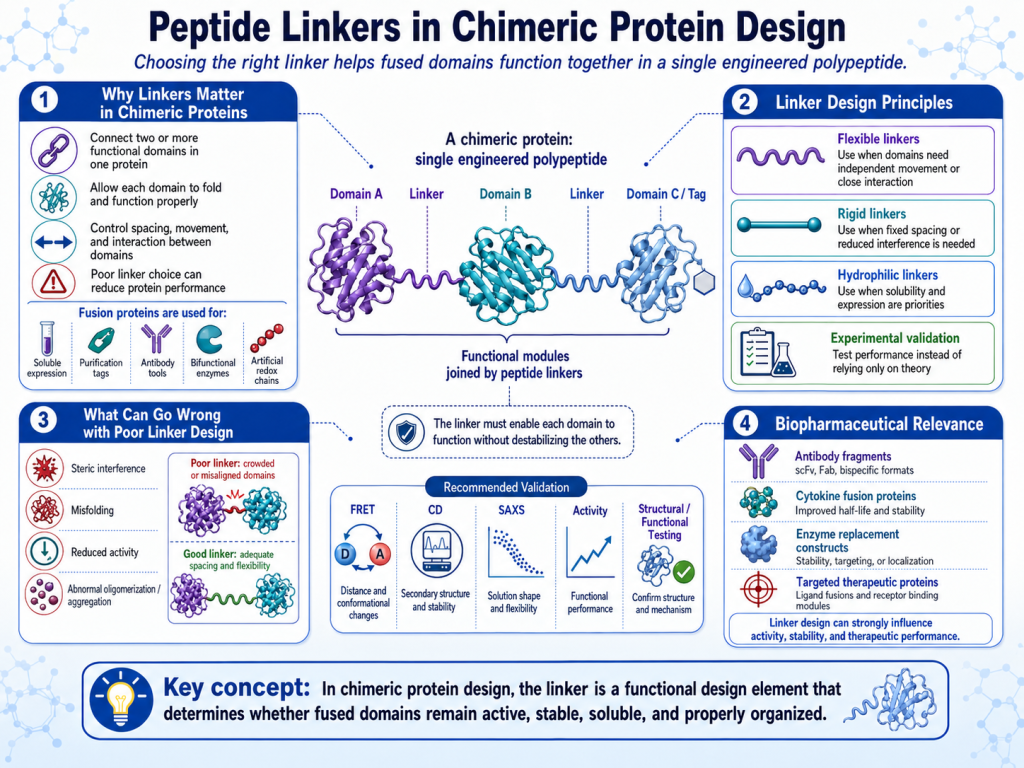
One of the most important applications of peptide linkers is the construction of chimeric proteins and fusion proteins. These engineered proteins combine two or more functional domains into a single polypeptide chain.
The review highlights that gene fusion techniques are now indispensable in biochemical research. Fusion proteins are used to improve soluble expression, facilitate purification, generate antibody-based tools, engineer bifunctional enzymes, and design artificial redox chains .
In such systems, the linker must allow each domain to perform its function without destabilizing the other. A poorly designed linker can cause steric interference, misfolding, reduced activity, or abnormal oligomerization.
A useful design principle is:
- Use flexible linkers when domains need independent movement or close interaction.
- Use rigid linkers when domains need fixed spacing or reduced interference.
- Use hydrophilic linkers when solubility and expression are major concerns.
- Validate linker performance experimentally rather than relying only on theoretical design.
This is particularly important for pharmaceutical biotechnology, where linker design can influence the activity of antibody fragments, cytokine fusion proteins, enzyme replacement constructs, and targeted therapeutic proteins.
Biophysical Validation of Linker Design
The article emphasizes that linker engineering should be accompanied by experimental and computational validation. Several techniques are especially useful:
FRET: Measures distance changes between fluorescently labeled domains.
Circular dichroism (CD): Evaluates secondary-structure formation, including α-helical content in rigid linkers.
SAXS: Provides low-resolution structural information about domain arrangement in solution.
Cryo-EM: Captures conformational states of large protein complexes.
Molecular dynamics and normal mode analysis: Predict domain motions and linker-dependent flexibility.
The article gives an example of SAXS modeling of chimeric green and blue fluorescent proteins connected by helical linkers. According to the figure on page 9, SAXS envelopes were used to visualize how GFP variants connected by (EAAAK)4 and (EAAAK)5 linkers adopt elongated domain arrangements .
This point is highly relevant for modern protein engineering: linker performance is not fully predictable from sequence alone. Structural validation helps confirm whether the designed protein adopts the intended spatial organization.
Applications in Pharmaceutical and Biomedical Research
Peptide linkers have broad utility in pharmaceutical research and biotechnology.
Antibody Engineering
Single-chain variable fragments require linkers that connect VH and VL domains while preserving antigen binding. Flexible glycine-serine linkers are commonly used because they provide mobility without excessive structural interference.
Enzyme Engineering
Bifunctional enzymes can be created by linking catalytic domains. Linker choice influences substrate channeling, catalytic efficiency, and folding.
Biosensors
Fluorescent protein-based biosensors often depend on linker-mediated conformational changes. Linker length and flexibility can control signal strength and dynamic range.
Targeted Delivery Systems
Multidomain toxins, receptor ligands, and carrier proteins may require linkers that balance stability with functional accessibility.
Synthetic Biology
Modular signaling circuits and artificial protein assemblies depend heavily on predictable linker behavior.
For Linkpeptide’s research audience, peptide linkers represent a practical design element that can determine whether a fusion protein construct succeeds or fails.
Practical Linker Design Considerations
When selecting or designing a peptide linker, researchers should define the functional requirement first.
For maximum flexibility, glycine-serine-rich linkers are often suitable. For spacing and rigidity, α-helical motifs such as (EAAAK)n or proline-rich sequences may be preferred. For soluble expression, charged and hydrophilic residues may help reduce aggregation.
Researchers should also consider:
- linker length optimization
- protease sensitivity
- immunogenicity risk for therapeutic proteins
- impact on folding kinetics
- effect on domain-domain interaction
- compatibility with expression host systems
- need for structural validation
The review concludes that although many empirical linker databases and computational tools exist, the structural principles governing interdomain flexibility are still not completely understood . Therefore, rational design should be combined with experimental screening.
Conclusion
Peptide linkers are powerful molecular design elements that control the functional dynamics of multidomain proteins. Flexible linkers act as hinges that enable domain movement, while rigid linkers function as molecular rulers that maintain defined spacing. Their sequence, length, hydrophilicity, and structural propensity influence protein folding, stability, activity, and domain communication.
For pharmaceutical researchers, peptide linkers are central to the development of fusion proteins, antibody fragments, enzyme systems, biosensors, and synthetic biological tools. A well-designed linker can enhance function, while a poorly chosen linker can compromise the entire construct.
As protein engineering becomes increasingly modular, peptide linker design will remain a critical step in translating molecular architecture into biological function.
FAQ
What is a peptide linker?
A peptide linker is a short amino acid sequence that connects two protein domains or functional modules within a multidomain or fusion protein.
What is the difference between flexible and rigid peptide linkers?
Flexible linkers allow domains to move freely, while rigid linkers maintain defined spacing and reduce unwanted domain-domain interference.
Why are glycine-rich linkers commonly used?
Glycine has low steric restriction, allowing peptide backbones to adopt many conformations. This makes glycine-rich sequences useful as flexible hinges.
What are rigid peptide linkers used for?
Rigid linkers are used when domains must remain separated or oriented in a predictable way. They are useful in biosensors, fusion proteins, and structural protein design.
How should peptide linkers be validated?
Common methods include FRET, circular dichroism, SAXS, cryo-EM, molecular dynamics simulations, and functional activity assays.