 LinkPeptide
Peptide Reconstitution: Buffers, Techniques & Common Mistakes in Research Workflows
Blog 430
Peptide reconstitution is one of the most important “small steps” in peptide research because it sets the foundation for everything that follows: dose accuracy, assay consistency, and clean repeatability. When you handle lyophilized peptides with a simple, consistent routine, you typically get smoother dissolution, stronger data alignment across replicates, and clearer interpretation of biological effects.
Why peptide reconstitution matters more than most labs expect
Even when the peptide itself is synthesized and purified well, differences in reconstitution can change:
- The concentration you think you have versus the concentration you actually have
- how evenly the peptide is distributed in solution
- how stable the solution remains during the workday
- how well the peptide performs across repeated runs
A good reconstitution routine supports better peptide stability and helps your downstream data feel more consistent.
Before you start: quick prep for lyophilized peptides
Bring the vial to room temperature.
Let lyophilized peptides warm to room temperature before opening. This helps reduce condensation effects and supports more consistent weighing, rehydration, and handling.
Confirm the basics you’ll document
A strong workflow includes a short “reconstitution record”:
- peptide name and lot number
- solvent/buffer used
- pH (if adjusted)
- stock concentration
- date/time prepared
- storage temperature and aliquot plan
This small habit improves reproducibility and makes troubleshooting far easier.
Solvent selection: the key decision that drives dissolution
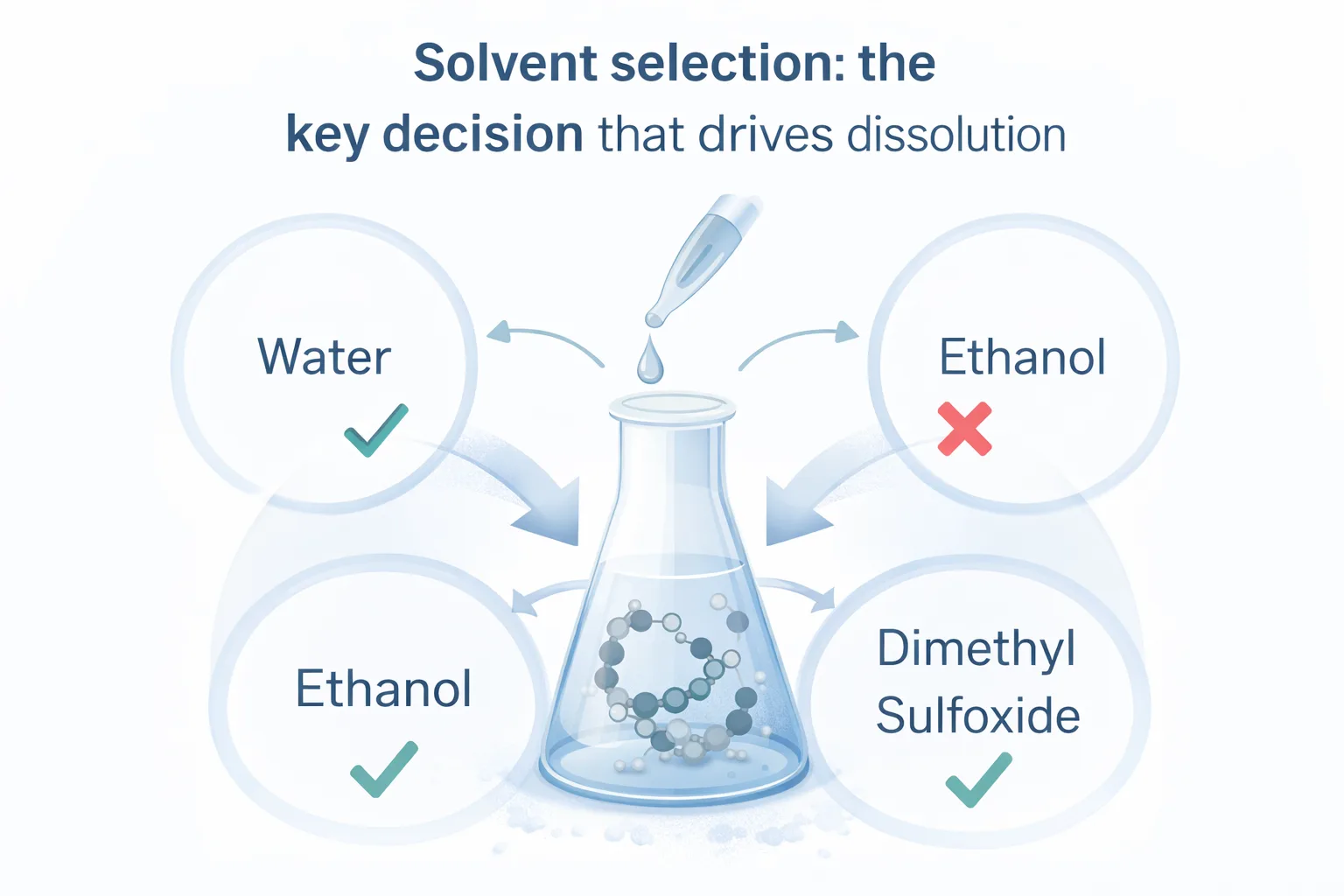
Solvent selection is most effective when you match it to peptide properties (charge and hydrophobicity) and your assay requirements.
Option A: Water or aqueous buffer (great for many peptides)
Many peptides dissolve smoothly in sterile water, PBS, or a low-salt buffer. If your assay tolerates it, this is often the most convenient starting point.
Tips:
- Start with a small volume first
- Mix gently and allow time for complete hydration
- Add the remaining volume after the peptide begins dissolving
Option B: pH-adjusted approach (helpful when charge is near neutral)
If a peptide struggles to dissolve, a mild pH shift can improve solubility by increasing net charge.
Practical approach:
- make small, measured pH adjustments
- Keep the final pH compatible with your assay
- document the final conditions for future repeats
Option C: Stepwise organic-to-aqueous approach (for more hydrophobic sequences)
Some peptides dissolve best when a small fraction of compatible organic cosolvent is used first, followed by dilution into an aqueous buffer.
Tips:
- Use the lowest effective cosolvent fraction
- Keep the final solvent composition assay-friendly
- standardize the sequence of steps for repeatability
Dissolution techniques: simple methods that work consistently
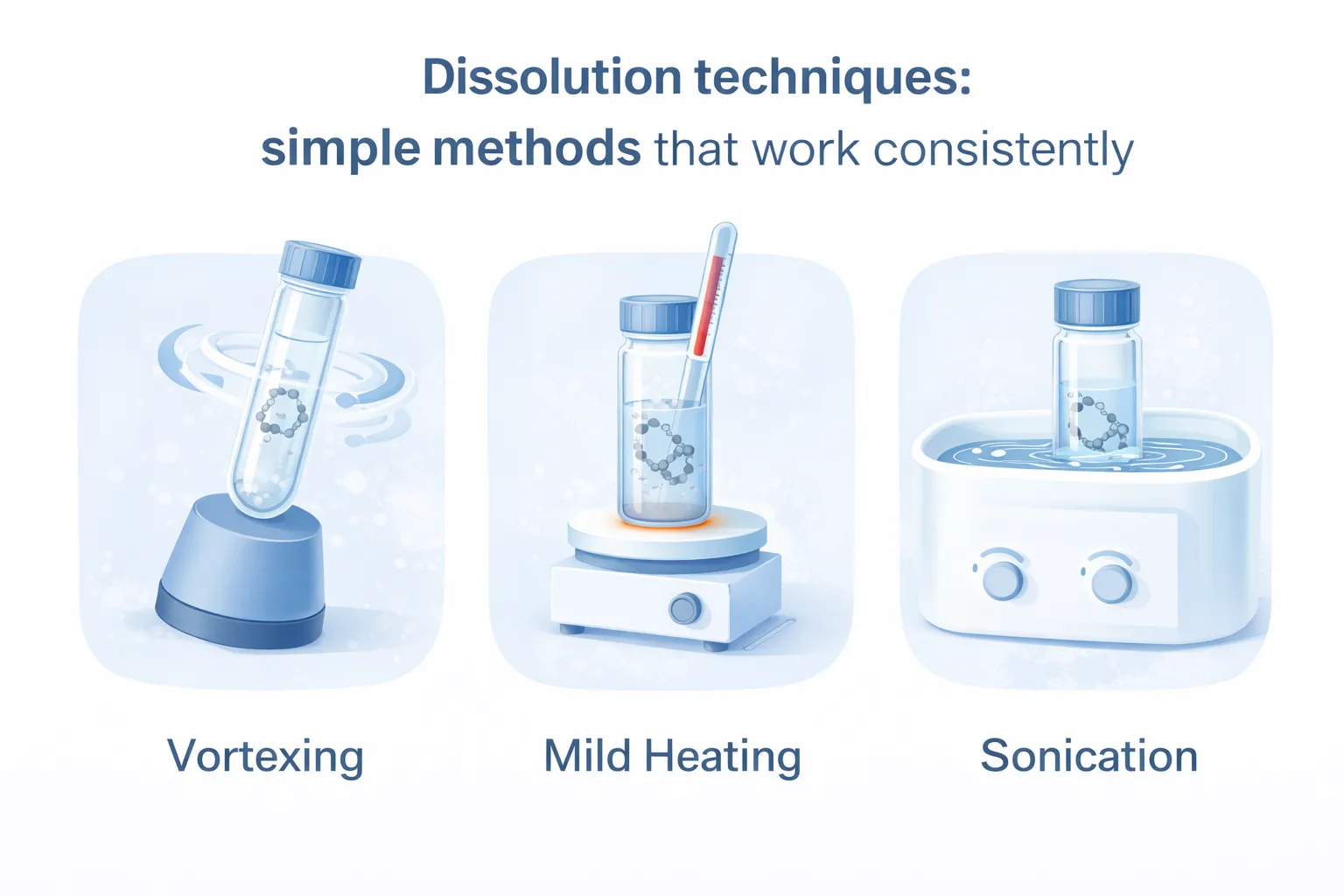
Good dissolution techniques focus on steady hydration and gentle mixing.
Technique 1: Concentrated first contact
Add a small initial volume to form a concentrated stock, swirl gently, and allow the peptide to hydrate. Then bring it to the final volume.
This method often reduces film formation and improves clarity.
Technique 2: Gentle inversion and short rest cycles
Many peptides dissolve best with:
- gentle inversion
- brief vortexing (when appropriate)
- short “rest” periods to allow hydration
This approach supports consistent dissolution without overhandling.
Technique 3: Light warming (when compatible)
Mild warming can support dissolution for some peptides. Keep the temperature modest and consistent.
Peptide stability and smart workflow timing
Once dissolved, some peptides remain stable for a productive work window, while others benefit from immediate aliquoting and storage. A stable workflow usually includes:
- preparing only what you need for the day
- aliquoting the remainder into single-use portions
- minimizing repeated freeze–thaw cycles
These habits improve peptide stability and maintain consistent concentration across experiments.
Peptide storage: best practices that protect your work
Clear peptide storage routines help your peptide performance feel predictable.
For lyophilized storage
- store sealed and dry
- avoid frequent temperature cycling
- Keep vials protected from moisture exposure
For solution storage
- aliquot into single-use volumes
- label solvent, pH, and concentration
- Use consistent thawing and mixing routines
This simple consistency helps protect your data and your timeline.
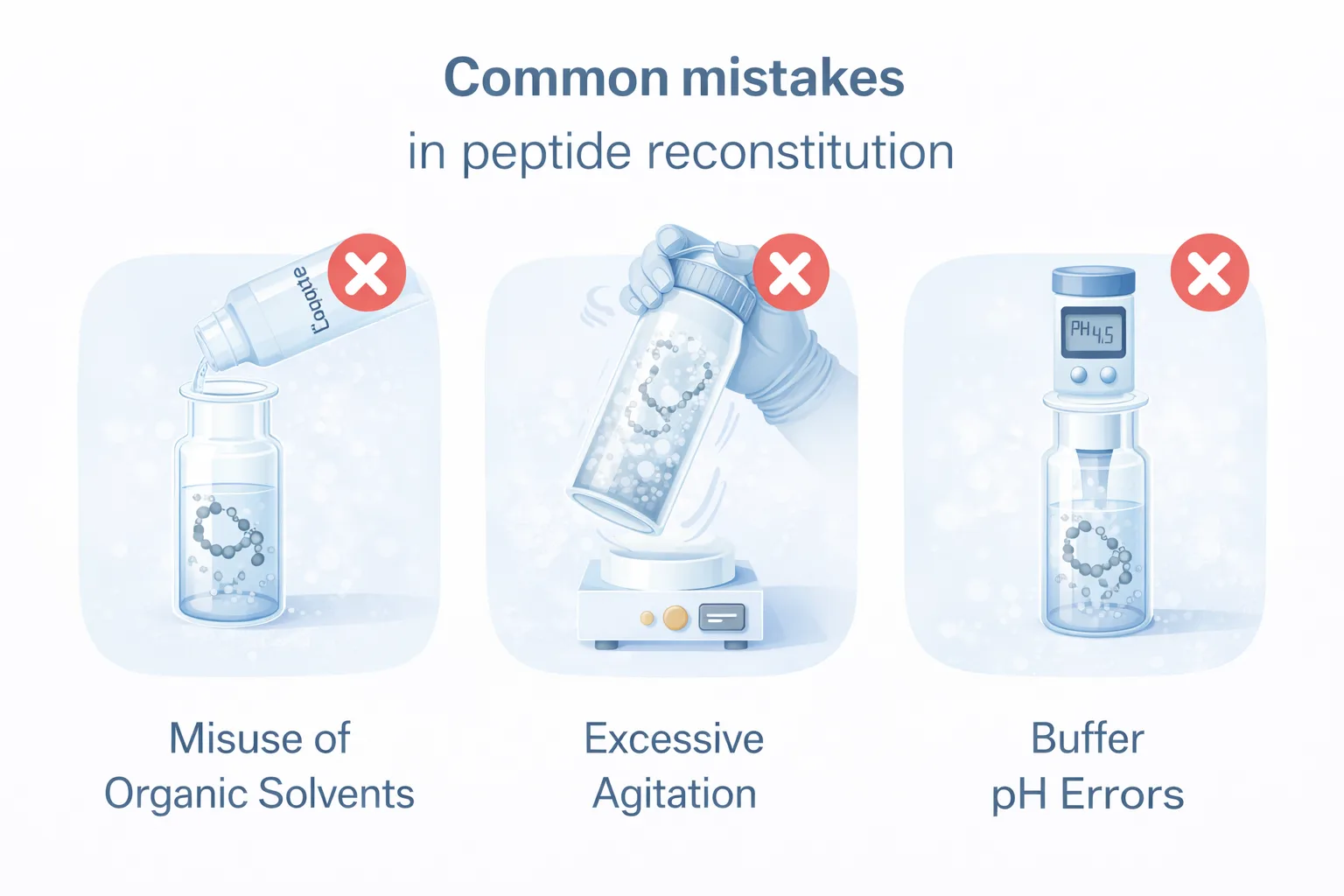
Common mistakes in peptide reconstitution (and easy fixes)
Mistake 1: Opening cold vials immediately
Cold vials can collect condensation, which makes weighing and reconstitution less consistent. Warming to room temperature first is a smooth fix.
Mistake 2: Skipping documentation
Without written notes on solvent, pH, and concentration, repeat experiments become harder than they need to be. A short reconstitution record helps every time.
Mistake 3: Using a solvent that clashes with your assay
Solvents can affect cells, enzymes, and readouts. Choosing solvent conditions with assay compatibility in mind supports cleaner results.
Mistake 4: Repeated freeze–thaw cycles
Repeated freeze–thaw handling can reduce performance and create variability. Aliquoting improves consistency quickly.
Mistake 5: Forcing dissolution with aggressive handling
Strong vortexing or extended high heat can stress sensitive peptides. Gentle, stepwise dissolution is usually more effective.
Peptide degradation: how to reduce risk with practical habits
Peptide degradation is often minimized with smart control of temperature, time in solution, and handling cycles.
Helpful habits include:
- preparing fresh working dilutions when possible
- minimizing time at room temperature during long workflows
- using aliquots to limit repeated handling
- storing with stable, documented conditions
These steps keep the peptide’s behavior more consistent across experiments.
How LinkPeptide supports reliable reconstitution in your workflow
At LinkPeptide, we provide research peptides and custom peptide services designed for reproducible lab work. When your workflow depends on consistent reconstitution whether you’re screening peptides, validating pathways, or scaling a study, reliable peptide quality and clear specifications help you focus on biology instead of troubleshooting. If your team regularly uses lyophilized peptides in multi-step assays, building a repeatable peptide reconstitution SOP can quickly improve daily efficiency and experimental consistency.
Conclusion
Peptide reconstitution becomes simple and dependable when you combine thoughtful solvent selection, gentle dissolution techniques, and a consistent plan for peptide storage. By warming vials before opening, starting with small volumes, documenting conditions, and aliquoting solutions, you improve peptide stability and reduce the risk of handling-related variability. These practical steps help you protect your experimental timeline and make your peptide data easier to trust.
FAQs
What is the best way to reconstitute lyophilized peptides?
A reliable method is to bring the vial to room temperature, add a small initial volume, mix gently, allow hydration, and then bring to the final volume with an assay-compatible solvent or buffer.
How do I choose the right solvent selection strategy?
Match solvent choice to peptide properties (charge and hydrophobicity) and to your assay’s tolerance. Water or buffer works for many peptides, while some benefit from pH adjustment or stepwise cosolvent methods.
How can I improve peptide stability after reconstitution?
Prepare only what you need, aliquot the remainder, store under consistent conditions, and minimize repeated freeze–thaw cycles.
What are the most common peptide reconstitution mistakes?
Opening cold vials, skipping documentation, using assay-incompatible solvents, repeated freeze–thaw handling, and forcing dissolution with aggressive mixing are common issues that are easy to avoid.