 LinkPeptide
Therapeutic Peptide Delivery Systems: Formulation Strategies, Administration Routes, and Future Technologies
Abstract
Therapeutic peptides have emerged as one of the fastest-growing classes of modern pharmaceuticals, bridging the gap between traditional small-molecule drugs and large biologics. Their exceptional target specificity, potent biological activity, and generally favorable safety profiles have led to increasing applications in metabolic diseases, cancer, cardiovascular disorders, infectious diseases, autoimmune conditions, and neurological illnesses. However, the clinical success of peptide therapeutics depends not only on peptide discovery but also on overcoming significant delivery challenges. Rapid enzymatic degradation, poor membrane permeability, short plasma half-life, and limited oral bioavailability have historically restricted peptide drugs to injectable administration. Recent advances in pharmaceutical formulation, chemical modification, nanotechnology, and sustained-release delivery systems are transforming the peptide landscape. This article reviews the major biological barriers limiting peptide therapeutics, compares current administration routes, summarizes formulation and molecular engineering strategies, discusses advanced delivery technologies, and explores future innovations that are expected to make peptide medicines more effective, longer lasting, and increasingly patient friendly.
Keywords: Therapeutic peptides; Peptide delivery; Drug formulation; Sustained-release systems; Peptide pharmacokinetics
Introduction
Therapeutic peptides have become an increasingly important component of modern drug discovery. Positioned between conventional small-molecule drugs and monoclonal antibodies, peptides combine many of the advantages of both therapeutic classes. Their relatively small molecular size enables better tissue penetration than large biologics, while their highly specific interactions with receptors, enzymes, and signaling proteins often result in greater selectivity than traditional small molecules.
Over the past two decades, peptide therapeutics have experienced remarkable growth. Advances in solid-phase peptide synthesis, recombinant biotechnology, computational peptide design, and structural biology have dramatically expanded the number of peptides entering clinical development. Today, peptide drugs are widely used to treat diabetes, obesity, osteoporosis, cardiovascular disease, endocrine disorders, infectious diseases, and various forms of cancer. The recent success of glucagon-like peptide-1 (GLP-1) receptor agonists has further demonstrated the enormous therapeutic and commercial potential of peptide-based medicines.
Despite these advances, peptide drug development continues to face one fundamental challenge: effective delivery. Unlike many conventional pharmaceuticals, peptides are inherently unstable within biological environments. Proteolytic enzymes rapidly degrade peptide chains, while their hydrophilic nature limits passive diffusion across biological membranes. Additionally, their relatively small molecular size often leads to rapid renal clearance, producing short circulation times and requiring frequent administration.
Consequently, modern peptide drug development has evolved into two closely connected disciplines: peptide engineering and delivery engineering. Optimizing delivery systems has become just as important as discovering new peptide sequences. Innovative formulation technologies, chemical modifications, and advanced drug delivery platforms are now enabling peptide therapeutics to achieve improved stability, prolonged circulation, enhanced tissue targeting, and greater patient convenience.
Why Peptide Delivery Remains the Greatest Challenge
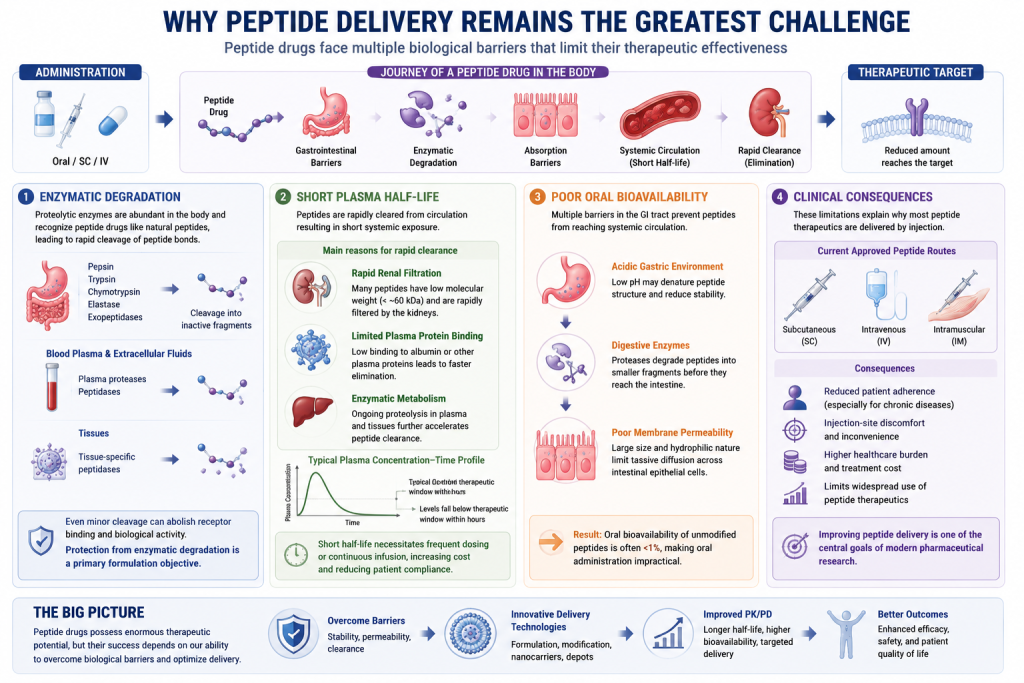
The pharmacokinetic behavior of peptide drugs differs fundamentally from that of traditional small molecules. Once administered, peptides encounter multiple physiological barriers that reduce their therapeutic effectiveness before they can reach their intended targets.
Enzymatic Degradation
One of the most significant obstacles is enzymatic degradation. Proteolytic enzymes are abundant throughout the human body and serve essential physiological functions by digesting dietary proteins and regulating endogenous peptides. Unfortunately, therapeutic peptides are recognized by these enzymes in much the same way as naturally occurring peptides.
In the gastrointestinal tract, pepsin, trypsin, chymotrypsin, elastase, and numerous exopeptidases rapidly hydrolyze peptide bonds. Similar proteases are also present in blood plasma, extracellular fluids, and tissues, continuously degrading circulating peptide molecules. Even relatively minor enzymatic cleavage can abolish receptor-binding activity, rendering a peptide therapeutically inactive.
Consequently, protecting peptide drugs from enzymatic degradation has become one of the primary objectives of pharmaceutical formulation.
Short Plasma Half-Life
Most peptides also exhibit extremely short plasma half-lives. Because many therapeutic peptides possess molecular weights below the renal filtration threshold, they are rapidly eliminated through glomerular filtration. At the same time, continuous enzymatic metabolism within plasma and tissues further accelerates their clearance.
Short systemic exposure often requires repeated daily injections or continuous infusion, increasing treatment costs and reducing patient compliance.
Poor Oral Bioavailability
Although oral administration represents the most desirable route for chronic therapies, peptides are notoriously difficult to deliver orally. Multiple barriers contribute to poor oral absorption.
First, gastric acid may denature peptide structures. Second, digestive enzymes degrade peptides before they reach the intestinal epithelium. Finally, their relatively large size and hydrophilic character severely restrict passive diffusion across intestinal membranes.
As a result, many unmodified peptides exhibit oral bioavailability of less than one percent, making conventional oral formulations clinically impractical.
Clinical Consequences
These pharmacokinetic limitations explain why most currently approved peptide therapeutics remain injectable products administered subcutaneously or intravenously. While these routes ensure effective systemic exposure, they may reduce patient adherence, particularly during long-term treatment of chronic diseases such as diabetes or obesity.
Therefore, improving peptide delivery has become one of the central goals of modern pharmaceutical research.
Administration Routes for Therapeutic Peptides
Selecting the optimal administration route significantly influences both therapeutic efficacy and patient experience.
Intravenous Administration
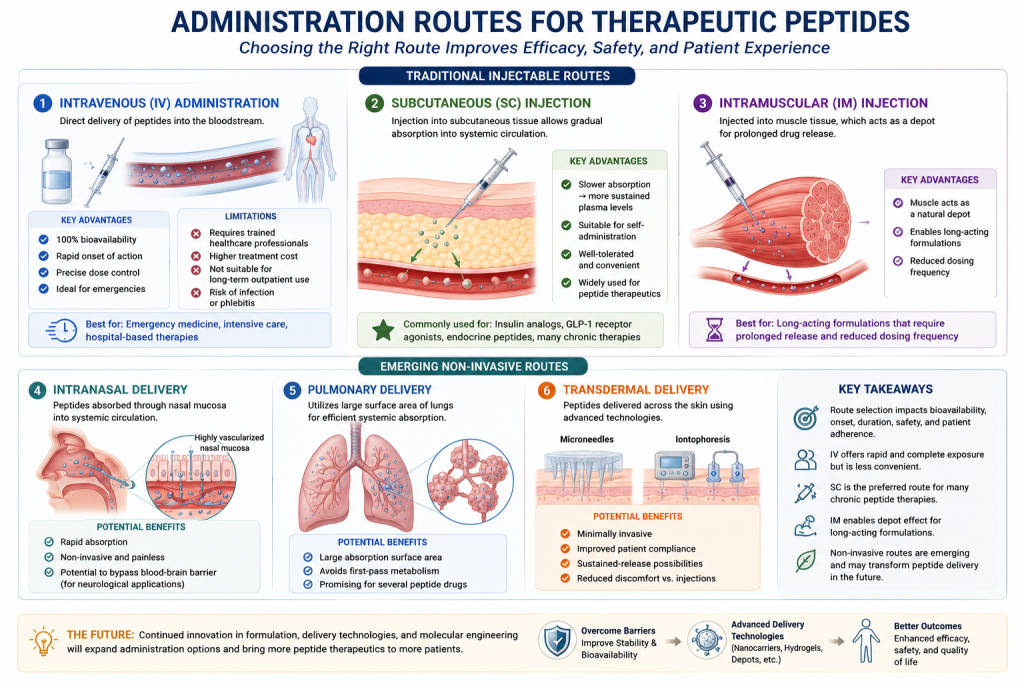
Intravenous delivery provides complete bioavailability by directly introducing peptides into systemic circulation. This approach enables rapid therapeutic action and precise dose control, making it particularly suitable for emergency medicine, intensive care, and hospital-based treatments.
However, intravenous administration often requires trained healthcare professionals, increases treatment costs, and is generally unsuitable for long-term outpatient therapy.
Subcutaneous Injection
Subcutaneous administration has become the preferred route for many peptide therapeutics. Injection into subcutaneous tissue allows gradual absorption into circulation, producing more sustained plasma concentrations than intravenous injection.
Many clinically successful peptide drugs, including insulin analogs, GLP-1 receptor agonists, and various endocrine therapies, utilize subcutaneous administration because it balances efficacy with patient convenience.
Intramuscular Administration
Intramuscular injection provides another option for certain long-acting formulations. Muscle tissue can act as a depot, allowing prolonged drug release and reducing dosing frequency.
Emerging Non-Invasive Routes
To improve patient convenience, researchers are actively investigating alternative administration routes.
Intranasal delivery offers rapid absorption through highly vascularized nasal mucosa while potentially bypassing the blood-brain barrier for neurological applications.
Pulmonary delivery utilizes the enormous surface area of the lungs for systemic absorption and has shown promise for several peptide drugs.
Transdermal systems, including microneedles and iontophoresis, aim to overcome the barrier function of the skin while minimizing discomfort associated with traditional injections.
Although each approach presents unique technical challenges, continued innovation may significantly expand future administration options.
Formulation and Molecular Engineering Strategies
Because peptides are inherently unstable, formulation optimization is essential for maintaining biological activity throughout manufacturing, storage, and administration.
Optimized Pharmaceutical Formulations
Modern peptide formulations incorporate carefully selected excipients that improve stability without altering therapeutic function.
Buffers maintain physiological pH, minimizing chemical degradation.
Stabilizers such as sugars and amino acids preserve native peptide conformation during storage and lyophilization.
Surfactants reduce adsorption to container surfaces and minimize aggregation.
Chelating agents remove trace metal ions that may catalyze oxidation reactions.
Together, these components significantly improve formulation stability and shelf life.
Chemical Modification
Chemical modification provides another powerful strategy for improving peptide pharmacokinetics.
PEGylation
Attachment of polyethylene glycol chains increases hydrodynamic size, reducing renal filtration while simultaneously shielding peptides from enzymatic degradation.
Lipidation
Conjugating fatty acid chains promotes reversible albumin binding, substantially extending plasma half-life. Several long-acting GLP-1 receptor agonists employ this strategy.
Cyclization
Cyclizing peptide backbones reduces structural flexibility, making peptides more resistant to proteolytic enzymes while often increasing receptor affinity.
Amino Acid Substitution
Replacing naturally occurring amino acids with D-amino acids or non-natural analogues can dramatically enhance metabolic stability without compromising biological activity.
These molecular engineering approaches often complement formulation strategies to maximize therapeutic performance.
Advanced Peptide Delivery Technologies
Recent advances in biomaterials and nanotechnology have transformed peptide delivery from simple injection systems into highly engineered therapeutic platforms.
Nanoparticles
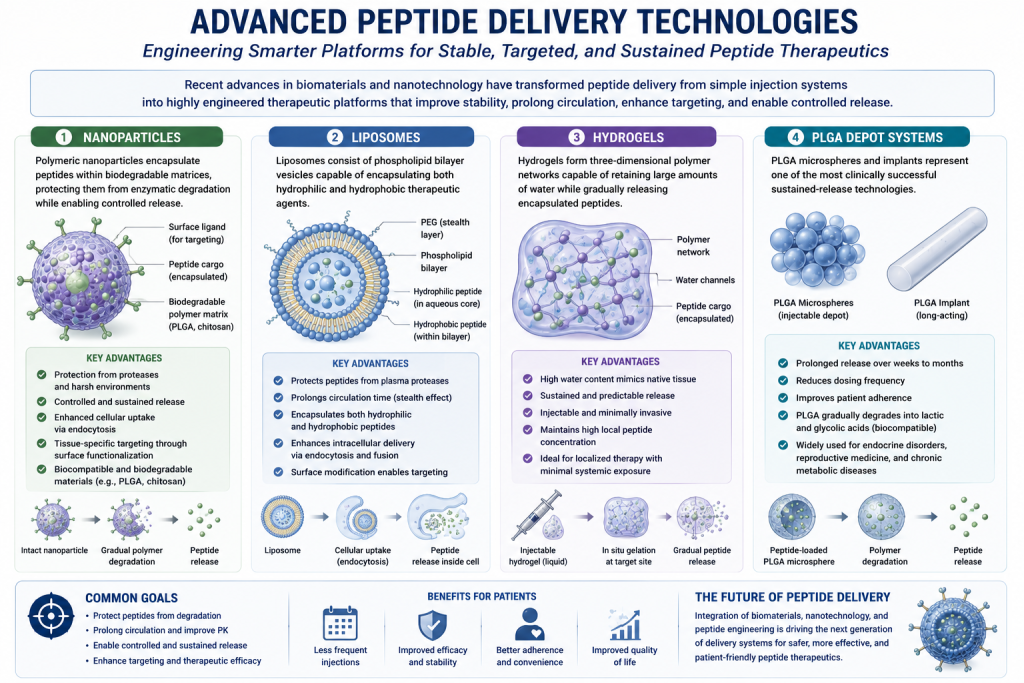
Polymeric nanoparticles encapsulate peptides within biodegradable matrices, protecting them from enzymatic degradation while enabling controlled release.
Materials such as PLGA and chitosan have received extensive investigation because of their excellent biocompatibility and well-characterized degradation profiles.
Surface functionalization further enables tissue-specific targeting through receptor-mediated uptake.
Liposomes
Liposomes consist of phospholipid bilayer vesicles capable of encapsulating both hydrophilic and hydrophobic therapeutic agents.
For peptides, liposomes provide protection from plasma proteases, prolong circulation time, and enhance intracellular delivery through endocytosis.
Hydrogels
Hydrogels form three-dimensional polymer networks capable of retaining large amounts of water while gradually releasing encapsulated peptides.
Injectable hydrogel systems are particularly attractive for localized therapy because they maintain high local drug concentrations while minimizing systemic exposure.
PLGA Depot Systems
PLGA microspheres and implants represent one of the most clinically successful sustained-release technologies.
As PLGA gradually degrades within the body, encapsulated peptides are released over weeks or even months, reducing injection frequency and improving treatment adherence.
Depot formulations have become increasingly important for endocrine disorders, reproductive medicine, and chronic metabolic diseases.
Future Perspectives
The future of peptide delivery extends well beyond conventional sustained-release systems.
Artificial intelligence is increasingly being applied to optimize peptide formulation by predicting molecular stability, degradation pathways, and excipient compatibility before laboratory testing begins.
Stimuli-responsive nanoparticles capable of releasing peptides in response to pH changes, enzyme activity, oxidative stress, or temperature are enabling highly localized drug delivery with reduced systemic toxicity.
Self-assembling peptide nanostructures offer the possibility of constructing multifunctional therapeutic platforms that simultaneously provide structural support, sustained release, and biological activity.
Meanwhile, oral peptide technologies combining permeation enhancers, enzyme inhibitors, enteric coatings, and advanced carrier systems continue to progress toward wider clinical application.
Future peptide therapeutics will likely integrate molecular engineering, computational design, biomaterials science, and precision drug delivery into unified therapeutic systems tailored to individual patients.
Conclusion
Therapeutic peptides represent one of the most promising frontiers in modern medicine. Their remarkable biological specificity and broad therapeutic potential have already transformed the treatment of numerous diseases. Nevertheless, pharmacokinetic limitations—including rapid enzymatic degradation, poor oral bioavailability, and short systemic half-life—remain major barriers to their widespread clinical application.
Fortunately, advances in pharmaceutical formulation, chemical modification, nanotechnology, biodegradable polymers, liposomal carriers, hydrogel systems, and long-acting depot formulations are steadily overcoming these challenges. These innovations are extending peptide stability, improving bioavailability, reducing dosing frequency, and enhancing patient compliance.
As peptide engineering and delivery science continue to evolve together, future therapeutics will become increasingly sophisticated, enabling safer, longer-lasting, and more precisely targeted treatments. Delivery technology is no longer merely a supporting component of peptide drug development—it has become one of its primary drivers, shaping the next generation of peptide-based precision medicine.