 LinkPeptide
Peptide–Drug Conjugates for Hematological Malignancies: Design, Applications, and Future Directions
Abstract
Peptide–drug conjugates (PDCs) are emerging as a flexible platform for targeted drug delivery in hematological malignancies. A typical PDC combines a targeting or cell-penetrating peptide with a linker and a pharmacologically active payload. This modular architecture allows researchers to optimize target recognition, intracellular transport, circulatory stability, and payload release independently. PDCs may offer advantages such as small molecular size, defined chemical composition, adaptable synthesis, and relatively low immunogenic potential. This article examines the fundamental design principles of PDCs, their experimental and clinical development in multiple myeloma, leukemia, myelodysplastic syndromes, and lymphoma, and emerging directions involving PROTAC payloads, nanotechnology, biomarkers, and artificial intelligence.
Keywords: peptide–drug conjugates; hematological malignancies; targeted drug delivery; peptide linkers; multiple myeloma
What Are Peptide–Drug Conjugates?
Peptide–drug conjugates are chemically defined molecules designed to deliver therapeutic payloads to selected cells, tissues, receptors, or intracellular compartments. Most PDCs contain three essential components:
- A targeting or cell-penetrating peptide
- A chemical or peptide-based linker
- A biologically active payload
The peptide serves as the delivery element. It may bind a receptor on the malignant cell surface, recognize a disease-associated biomarker, or promote transport across the plasma membrane. The linker connects the peptide to the payload and determines when and where the active agent is released. The payload produces the intended effect, such as DNA damage, microtubule disruption, apoptosis induction, receptor inhibition, or targeted protein degradation.
This modular arrangement is one of the most important characteristics of PDC technology. Researchers can modify the peptide, linker, or payload without necessarily redesigning the entire molecule. For example, a targeting sequence can be optimized to increase receptor affinity, while linker chemistry can be adjusted to improve plasma stability or intracellular cleavage.
PDCs share the targeted-delivery principle of antibody–drug conjugates (ADCs), but their physical and manufacturing properties differ substantially. A conventional antibody is approximately 150 kDa, whereas many peptide conjugates are considerably smaller. Their compact dimensions may facilitate tissue diffusion and access to malignant cells in the bone marrow.
Peptides are also compatible with solid-phase peptide synthesis, site-specific modification, and controlled conjugation. These methods can produce molecules with defined sequences, conjugation sites, and payload-to-peptide ratios. Such structural uniformity is especially useful when studying relationships among sequence, target affinity, cellular uptake, pharmacokinetics, and biological activity.
Why Study PDCs in Hematological Malignancies?
Hematological malignancies include leukemia, lymphoma, multiple myeloma, and myelodysplastic syndromes. These cancers arise in the blood, bone marrow, or lymphatic system and represent biologically diverse diseases with distinct molecular drivers and treatment responses.
Modern therapies have significantly improved disease management. Proteasome inhibitors, immunomodulatory drugs, BCL-2 inhibitors, BCR–ABL inhibitors, monoclonal antibodies, bispecific antibodies, ADCs, and CAR-T cells have all transformed specific areas of hematological oncology. Nevertheless, relapse, refractory disease, clonal evolution, antigen loss, and acquired drug resistance continue to limit durable responses.
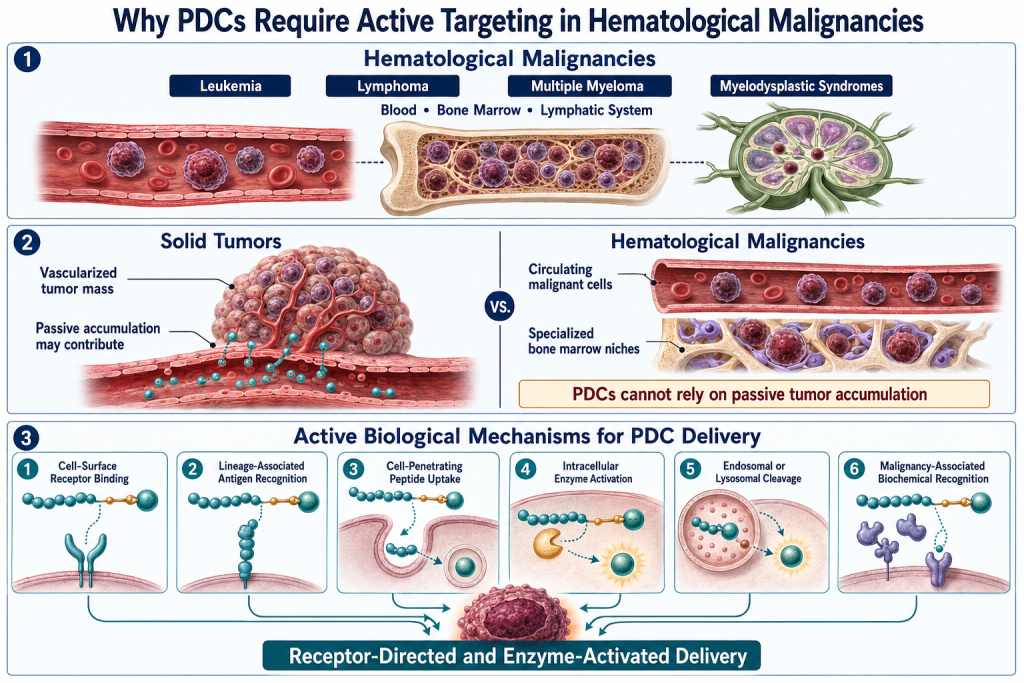
Targeted delivery in hematological malignancies differs from delivery to solid tumors. Solid-tumor delivery is often discussed in relation to tumor vasculature and the enhanced permeability and retention effect. Leukemic and myeloma cells, however, may circulate in the blood or occupy specialized bone marrow niches without forming a conventional vascularized tumor mass.
Consequently, a PDC intended for a hematological malignancy generally cannot depend on passive tumor accumulation. It requires active biological mechanisms, such as:
- Binding to a cell-surface receptor
- Recognition of a lineage-associated antigen
- Uptake through a cell-penetrating peptide
- Activation by an overexpressed intracellular enzyme
- Cleavage within endosomes or lysosomes
- Recognition of biochemical conditions associated with malignant cells
These requirements make hematological cancers scientifically important models for studying receptor-directed delivery and enzyme-activated peptide conjugates.
How the Peptide Component Controls PDC Targeting
The peptide component strongly influences target selectivity, cellular uptake, tissue distribution, metabolic stability, and intracellular trafficking. Peptides used in PDC research can broadly be classified as cell-targeting peptides or cell-penetrating peptides.
Cell-targeting peptides
Cell-targeting peptides recognize receptors or other molecular features enriched on malignant cells. After binding to the target, the receptor–PDC complex may undergo internalization, allowing the conjugate to enter endosomal and lysosomal compartments.
An appropriate target for PDC development should ideally have:
- High or preferential expression on malignant cells
- Limited expression in essential healthy tissues
- Accessibility from the circulation
- Sufficient internalization after ligand binding
- Consistent expression within the target patient population
Target expression must be quantitatively evaluated. A receptor may appear elevated in one cell line but vary substantially among patient samples. Target density can also change during disease progression or after therapy. Evaluating expression heterogeneity is therefore essential before advancing a targeting peptide.
Cell-penetrating peptides
Cell-penetrating peptides (CPPs) are generally short sequences capable of transporting molecular cargo across cellular membranes. Many CPPs contain arginine and lysine residues, giving them a positive charge under physiological conditions. Others use amphipathic or hydrophobic sequence arrangements to interact with lipid membranes.
CPP-mediated uptake may occur through direct translocation, macropinocytosis, clathrin-mediated endocytosis, caveolae-associated pathways, or other endocytic mechanisms. The dominant route depends on the peptide sequence, cargo, concentration, cell type, and experimental conditions.
CPPs can improve intracellular delivery, but nonspecific uptake remains a major concern. A peptide that enters malignant cells efficiently may also enter healthy blood cells. One solution is to combine a tumor-recognition sequence with a cell-penetrating region. Another is to use an activatable CPP whose membrane-translocating function is initially masked and becomes exposed only after encountering a disease-associated enzyme.
Improving peptide stability
Unmodified peptides may be rapidly degraded by serum and tissue proteases. Common optimization strategies include:
- Peptide cyclization
- N-terminal acetylation
- C-terminal amidation
- Incorporation of D-amino acids
- Use of noncanonical amino acids
- Backbone modification
- Hydrocarbon stapling
- PEGylation or lipidation
- Multivalent peptide presentation
Each modification can affect more than stability. Cyclization may improve receptor affinity but reduce conjugation flexibility. Lipidation may extend circulation yet increase nonspecific membrane binding. Peptide optimization should therefore evaluate affinity, specificity, solubility, stability, uptake, toxicity, and pharmacokinetics together.
Linker Design: Balancing Stability and Payload Release
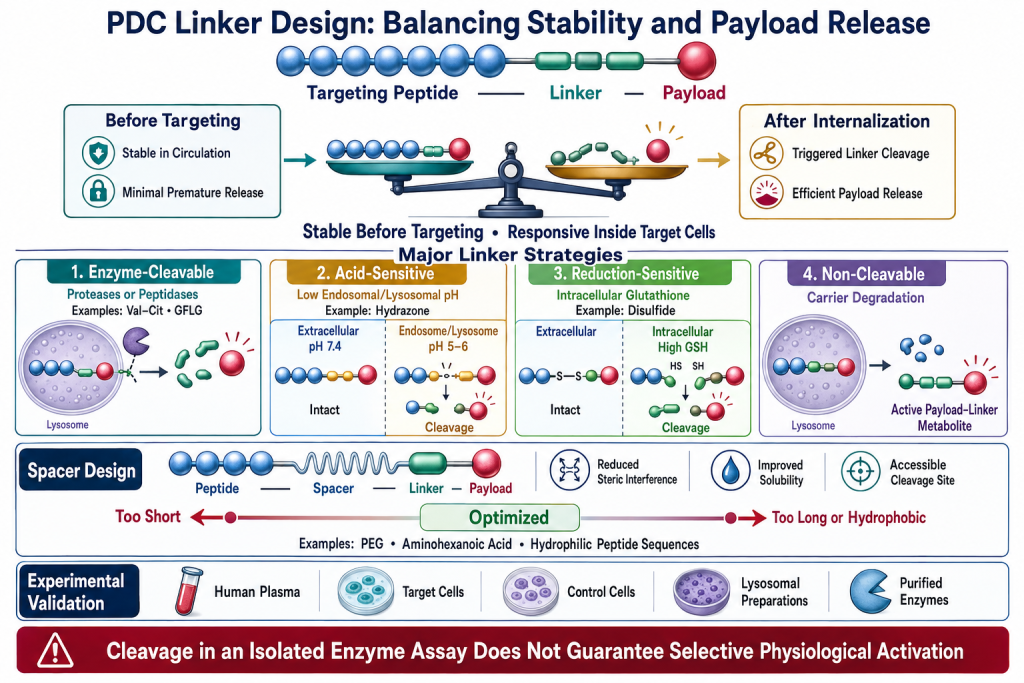
The linker is a functional control element rather than a passive spacer. It influences circulatory stability, solubility, steric accessibility, intracellular trafficking, and release kinetics.
The central design challenge is straightforward: the linker should remain sufficiently stable before the PDC reaches its target but release the payload efficiently after localization or internalization.
Enzyme-cleavable linkers
Enzyme-responsive linkers contain sequences recognized by proteases or peptidases enriched in particular intracellular compartments or disease environments. Valine–citrulline is a widely investigated lysosomal protease-responsive linker. Other examples include glycine–phenylalanine–leucine–glycine and sequences designed for cleavage by matrix metalloproteinases, caspases, or disease-associated peptidases.
Enzyme responsiveness can increase selectivity, but cleavage should be tested in human plasma, target cells, control cells, lysosomal preparations, and purified-enzyme systems. Efficient cleavage by an isolated enzyme does not necessarily predict selective activation under physiological conditions.
Acid-sensitive linkers
Endosomes and lysosomes are more acidic than blood and the extracellular environment. Hydrazone and related acid-sensitive linkers can exploit this pH difference. However, premature hydrolysis in circulation may narrow the therapeutic window, making careful stability evaluation necessary.
Reduction-sensitive linkers
Disulfide linkers are designed to respond to differences between extracellular and intracellular reducing conditions. Intracellular glutathione can promote disulfide cleavage and payload release. Steric shielding around the disulfide bond can be adjusted to control reduction sensitivity.
Non-cleavable linkers
Non-cleavable linkers depend on enzymatic degradation of the peptide carrier to generate an active payload-containing metabolite. They can provide greater plasma stability but may not release the original, unmodified drug. Researchers must determine whether the resulting metabolite retains sufficient potency and reaches the intended intracellular target.
Spacer design
A spacer may be introduced between the peptide and payload to reduce steric interference, improve solubility, or support enzymatic cleavage. Polyethylene glycol units, aminohexanoic acid, and hydrophilic amino acid sequences are commonly studied spacers. Spacer length should be optimized experimentally because excessive flexibility or hydrophobicity may alter receptor binding and pharmacokinetics.
Choosing an Appropriate PDC Payload
The payload determines the principal biological effect of the conjugate. It must remain sufficiently potent after release and should be compatible with the chosen linker and conjugation chemistry.
Payload classes explored in PDC development include:
- DNA-alkylating agents
- Microtubule inhibitors
- Topoisomerase inhibitors
- Kinase inhibitors
- Proapoptotic peptides
- Radionuclide chelates
- Immune-modulating compounds
- Oligonucleotides
- Targeted protein degraders
Payload potency alone does not ensure an effective PDC. Conjugation may block a functional group required for activity. The released compound may also have different solubility, permeability, or target affinity from the parent drug.
Payload selection should reflect the biology of the target malignancy. DNA-damaging agents may be effective in cells with specific repair deficiencies, whereas targeted degraders may be more appropriate when a malignant phenotype depends on a defined intracellular protein. Researchers should also anticipate resistance mechanisms, including drug-efflux transporters, altered apoptotic signaling, enhanced DNA repair, target mutation, and changes in intracellular processing.
Melflufen: A Major Case Study in Enzyme-Activated Delivery
Melphalan flufenamide, or melflufen, is an important example of an enzyme-potentiated PDC developed for relapsed or refractory multiple myeloma. It was designed to improve intracellular delivery of the alkylating agent melphalan.
Melflufen is highly lipophilic and can rapidly cross the plasma membrane. Inside the cell, esterases and aminopeptidases process the molecule and release more hydrophilic metabolites, including melphalan. Because these products cross the membrane less readily, they become intracellularly retained.
This combination of rapid entry, enzymatic processing, and intracellular trapping can generate substantially greater intracellular alkylator exposure than free melphalan at an equivalent extracellular concentration.
Melflufen illustrates several valuable PDC design principles:
- A peptide-like structure can serve as an enzyme-recognized carrier.
- Intracellular enzymes can transform a permeable conjugate into retained metabolites.
- Enzymatic conversion can maintain a concentration gradient that supports continued uptake.
- Aminopeptidase expression may influence sensitivity and could be evaluated as a biomarker.
Clinical studies demonstrated activity in heavily pretreated multiple myeloma, but the compound’s regulatory history also revealed important limitations. Following survival findings from the confirmatory OCEAN study, the FDA withdrew the approval of melflufen in the United States in 2024. This outcome emphasizes that improved intracellular delivery and antitumor activity must be evaluated alongside long-term safety, patient selection, comparator performance, and overall survival.
Melflufen should therefore be viewed as both a proof of concept and a cautionary case study. It demonstrates that rational PDC design can markedly alter intracellular drug exposure, while also showing that promising pharmacology does not guarantee a favorable benefit–risk profile across every clinical population.
PDC Applications in Leukemia, Lymphoma, and Multiple Myeloma
Multiple myeloma
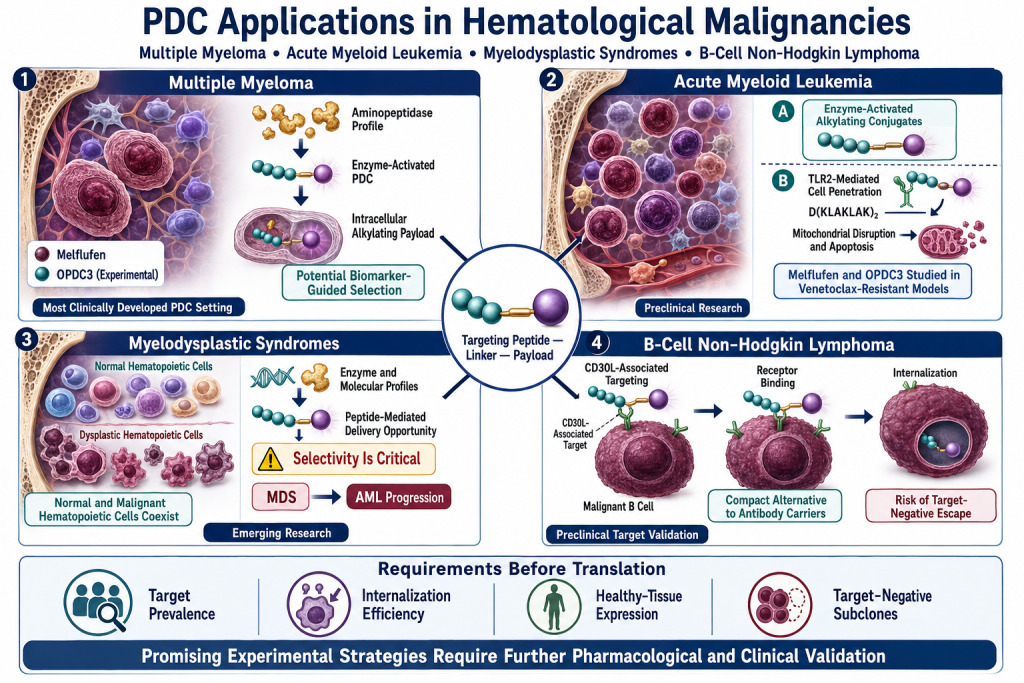
Multiple myeloma remains the most clinically developed hematological setting for PDC research. Malignant plasma cells may express elevated levels of aminopeptidases capable of activating peptide-associated prodrugs. Researchers are examining whether aminopeptidase profiles can identify disease subsets more likely to respond to enzyme-potentiated conjugates.
OPDC3 is an experimental conjugate related to the aminopeptidase-targeting concept but uses a different alkylating payload. Preclinical studies have reported activity across several hematological malignancy models. Further pharmacological and clinical validation is required before its therapeutic significance can be determined.
Acute myeloid leukemia
AML is molecularly heterogeneous and frequently develops resistance to targeted or apoptosis-directed therapies. Experimental PDC strategies in AML include enzyme-activated alkylating conjugates and peptide–peptide constructs that deliver proapoptotic sequences.
One reported approach combines a Toll-like receptor 2-mediated cell-penetrating peptide with D(KLAKLAK)₂, a mitochondria-disrupting proapoptotic peptide. The delivery peptide facilitates entry into selected AML cells, while the effector sequence promotes mitochondrial damage and apoptosis.
Preclinical work has also investigated melflufen and OPDC3 in venetoclax-resistant AML models. These studies support continued investigation of whether PDC payloads can address resistance mechanisms that do not overlap with BCL-2 inhibition.
Myelodysplastic syndromes
Myelodysplastic syndromes comprise clonal hematopoietic disorders that may progress to AML. Enzyme expression patterns and shared molecular abnormalities could create opportunities for peptide-mediated delivery. However, selectivity is particularly important because normal and malignant hematopoietic cells coexist in the same bone marrow environment.
B-cell non-Hodgkin lymphoma
Targeted peptide conjugates are being investigated against cell-surface molecules associated with B-cell lymphoma. CD30 ligand has been proposed as a potential target in selected B-cell non-Hodgkin lymphoma models. Peptides that recognize such surface features may provide compact alternatives to antibody-based carriers.
Before translation, researchers must establish target prevalence, internalization efficiency, expression in healthy tissues, and whether target-negative lymphoma subclones can escape treatment.
Emerging PROTAC–PDC Hybrids
Proteolysis-targeting chimeras, or PROTACs, induce the degradation of selected intracellular proteins by recruiting them to an E3 ubiquitin ligase. Their event-driven mechanism differs from conventional occupancy-based inhibition: a degrader can potentially initiate the destruction of multiple target-protein molecules.
However, some PROTACs have high molecular weight, limited permeability, or unfavorable pharmacokinetic properties. A PROTAC–PDC hybrid may address these limitations by using a peptide to direct the degrader toward selected cells.
A representative design contains:
- A targeting or cell-penetrating peptide
- An enzyme-cleavable linker
- A PROTAC payload
After cellular uptake, an intracellular enzyme such as cathepsin B cleaves the linker. The released PROTAC recruits an E3 ligase to the target protein and promotes its ubiquitination and proteasomal degradation.
This strategy may reduce exposure of healthy cells to the degrader while expanding the range of intracellular proteins addressable through targeted delivery. Nevertheless, successful design requires efficient uptake, timely linker cleavage, sufficient cytosolic release, and preservation of PROTAC activity after conjugation.
Challenges Limiting PDC Development
Disease heterogeneity
Receptor and enzyme expression can differ between patients, disease stages, and malignant subclones. Target-negative cells may survive and become dominant after treatment. Multivalent or dual-targeting PDCs may help address this problem, but their specificity and pharmacokinetics must be carefully evaluated.
Short circulation time
Many peptides undergo rapid proteolysis and renal clearance. This may reduce cumulative toxicity but can also limit target exposure. Cyclization, D-amino acid incorporation, albumin-binding motifs, polymer conjugation, and nanoparticle formulation may improve systemic stability.
Endosomal entrapment
Internalization does not guarantee cytosolic delivery. PDCs entering through endocytosis may remain inside endosomes or lysosomes. Payloads acting in the cytosol or nucleus require suitable release and escape mechanisms.
Premature payload release
An unstable linker may release its payload before the PDC reaches malignant cells, reducing selectivity and increasing systemic toxicity. Plasma stability should be assessed alongside intracellular activation rather than treated as a separate development step.
Payload resistance
Targeted delivery may increase intracellular concentration but cannot necessarily overcome resistance at the payload’s pharmacological target. Rational PDC development should investigate both delivery biomarkers and payload-sensitivity biomarkers.
Limited clinical evidence
Many PDCs for hematological malignancies remain at the discovery or preclinical stage. Their apparent advantages over ADCs, bispecific antibodies, or cellular therapies should therefore be interpreted as design opportunities rather than established clinical superiority.
Future Directions for PDC Research
The future of PDC development will likely involve integration of peptide engineering, molecular diagnostics, advanced payloads, nanotechnology, and computational modeling.
Biomarker-guided development is especially important. Receptor density, internalization rate, peptidase activity, lysosomal function, and payload sensitivity could be evaluated together to identify responsive disease subsets.
Nanotechnology may help extend PDC circulation, protect peptides from degradation, and support multivalent presentation. However, increasing the size of a PDC formulation could compromise some advantages of the original small-molecule architecture. Carrier selection should therefore be guided by the intended biological application.
Artificial intelligence may assist with peptide-sequence generation, receptor-binding prediction, protease-stability modeling, linker optimization, and pharmacokinetic assessment. Databases containing PDC structures and biological activities can support computational screening, while machine-learning models may help prioritize candidates before synthesis.
Experimental validation remains indispensable. Computationally designed conjugates must be tested through binding assays, plasma-stability studies, cleavage experiments, cellular uptake analysis, intracellular localization, cytotoxicity testing, pharmacokinetic studies, and appropriate disease models.
FAQ
What is a peptide–drug conjugate?
A peptide–drug conjugate is a chemically linked molecule containing a peptide, a linker, and a pharmacologically active payload. The peptide supports targeting or cellular entry, while the linker regulates stability and payload release.
How do PDCs differ from antibody–drug conjugates?
PDCs use peptides instead of full-length antibodies as delivery components. They are generally smaller and can be produced through controlled chemical synthesis. However, they may have shorter circulation times and can be more susceptible to enzymatic degradation.
Which linkers are used in PDC development?
Common options include enzyme-cleavable peptide sequences, acid-sensitive linkers, reduction-sensitive disulfides, ester or amide bonds, and non-cleavable linkers. Selection depends on the target cell, uptake pathway, payload, and desired release mechanism.
Can cell-penetrating peptides be used in PDCs?
Yes. CPPs can transport drugs, peptides, nucleic acids, and other cargoes across cellular membranes. Because many CPPs lack intrinsic cell selectivity, they may be combined with targeting sequences or activatable designs.
Why are PDCs being investigated for hematological malignancies?
Hematological cancer cells may express targetable surface receptors, transport pathways, or intracellular enzymes. PDCs can exploit these features to improve intracellular payload delivery in leukemia, lymphoma, multiple myeloma, and related disorders.
What is the role of melflufen in PDC research?
Melflufen demonstrates how a lipophilic peptide-associated prodrug can enter cells, undergo enzymatic processing, and produce intracellular trapping of an alkylating payload. Its clinical history also highlights the importance of patient selection and long-term benefit–risk evaluation.
What are PROTAC–PDC hybrids?
PROTAC–PDC hybrids combine peptide-mediated delivery with a targeted protein degrader. The peptide directs or facilitates uptake, while the released PROTAC induces degradation of a selected intracellular protein.
How LinkPeptide Supports PDC Research
PDC development requires careful coordination of peptide sequence design, chemical modification, linker placement, payload compatibility, and analytical characterization. LinkPeptide supports researchers through custom synthesis of targeting peptides, cell-penetrating peptides, enzyme-cleavable sequences, and modified peptide intermediates for conjugation studies.
Available research options may include terminal modification, incorporation of D-amino acids or noncanonical amino acids, fluorescent labeling, biotinylation, spacer introduction, cyclization, and preparation of peptides containing functional groups for site-specific conjugation.
By selecting an appropriate peptide, attachment site, linker, and modification strategy at the beginning of a project, researchers can reduce the risk of compromising receptor affinity, cellular uptake, solubility, or enzymatic release during subsequent PDC development.
All LinkPeptide products are supplied for research use only and are not intended for diagnostic, therapeutic, or human use.
Reference