 LinkPeptide
Peptide-Drug Conjugates with Different Linkers for Cancer Therapy
Abstract
Peptide-drug conjugates (PDCs) are an emerging class of targeted therapeutic systems designed to improve the delivery of cytotoxic drugs to cancer cells while reducing off-target toxicity. A PDC typically consists of three core components: a tumor-targeting peptide, a cytotoxic payload, and a chemical linker that connects them. Among these components, the linker plays a decisive role in circulation stability, tumor accumulation, intracellular release, pharmacokinetics, and therapeutic efficacy. The reviewed article emphasizes that linker chemistry can determine whether a PDC releases its payload too early, too slowly, or at the desired tumor site. This blog summarizes major PDC linker strategies, including enzyme-cleavable, acid-cleavable, reducible disulfide, and non-cleavable linkers, and discusses their relevance for cancer research and pharmaceutical development.
Introduction: Why Peptide-Drug Conjugates Matter
Conventional chemotherapy remains important in cancer treatment, but many cytotoxic drugs suffer from a fundamental limitation: they damage both malignant and nonmalignant cells. Drugs such as doxorubicin, paclitaxel, gemcitabine, and camptothecin derivatives can be highly potent, yet their nonspecific toxicity often restricts dose, treatment duration, and therapeutic benefit.
Peptide-drug conjugates are designed to address this limitation by using a peptide ligand to guide a cytotoxic drug toward cancer-associated receptors or biomarkers. In a typical PDC, the peptide provides tumor-targeting capability, the drug provides cytotoxic activity, and the linker controls when and where the payload is released. The article describes PDCs as a rapidly developing modality for targeted cancer therapy, with potential advantages including improved efficacy, lower off-target toxicity, and better control over drug delivery.
Compared with antibody-drug conjugates (ADCs), PDCs are much smaller. Antibodies are typically about 150 kDa, whereas many targeting peptides contain only 5–25 amino acids and PDCs often fall in the 2–5 kDa range. This smaller size can support more homogeneous synthesis, easier characterization, and potentially improved tissue penetration. The article also notes that some PDCs may have advantages in brain delivery, which is relevant for cancers with brain metastases.
The Three-Part Architecture of a PDC
A peptide-drug conjugate can be understood as a modular system:
Targeting peptide: binds a receptor or biomarker enriched on cancer cells.
Cytotoxic payload: kills the target cell after release or intracellular processing.
Linker: controls stability, circulation time, and drug release behavior.
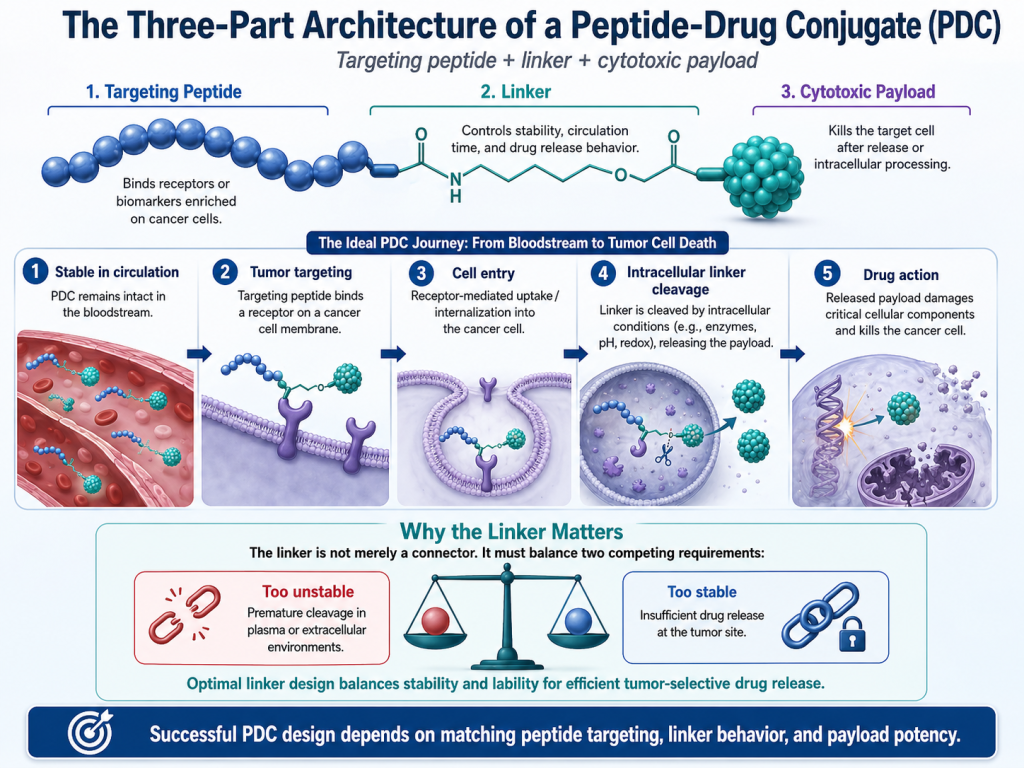
The linker is not merely a connector. It is a functional design element. Ideally, a PDC should remain stable during circulation, accumulate at the tumor site, enter the target cell, and then release the active drug inside the cancer cell. The article explains that the ideal linker would release the drug only after intracellular uptake, but in practice, many linkers begin to undergo partial cleavage in plasma or extracellular environments before reaching the target cell.
Therefore, linker selection must balance two competing requirements: enough stability to avoid premature payload release, and enough lability to release the drug efficiently at the tumor site.
Major Linker Chemistries Used in PDC Design
The article classifies PDC linker chemistries into four broad categories:
- Enzyme-cleavable linkers
Examples: ester, amide, carbamate, Val-Cit, Ala-Ala-Asn - Acid-cleavable linkers
Examples: hydrazone, carbonate, acetal, ketal - Reducible disulfide linkers
Designed to respond to intracellular reducing environments - Non-cleavable or relatively stable linkers
Examples: thioether, oxime, triazole
This classification is based on how the linker behaves under biological conditions such as plasma circulation, tumor extracellular pH, endosomal and lysosomal pH, lysosomal enzyme activity, and intracellular reducing conditions.
Enzyme-Cleavable Linkers: Using Tumor Biology for Payload Release
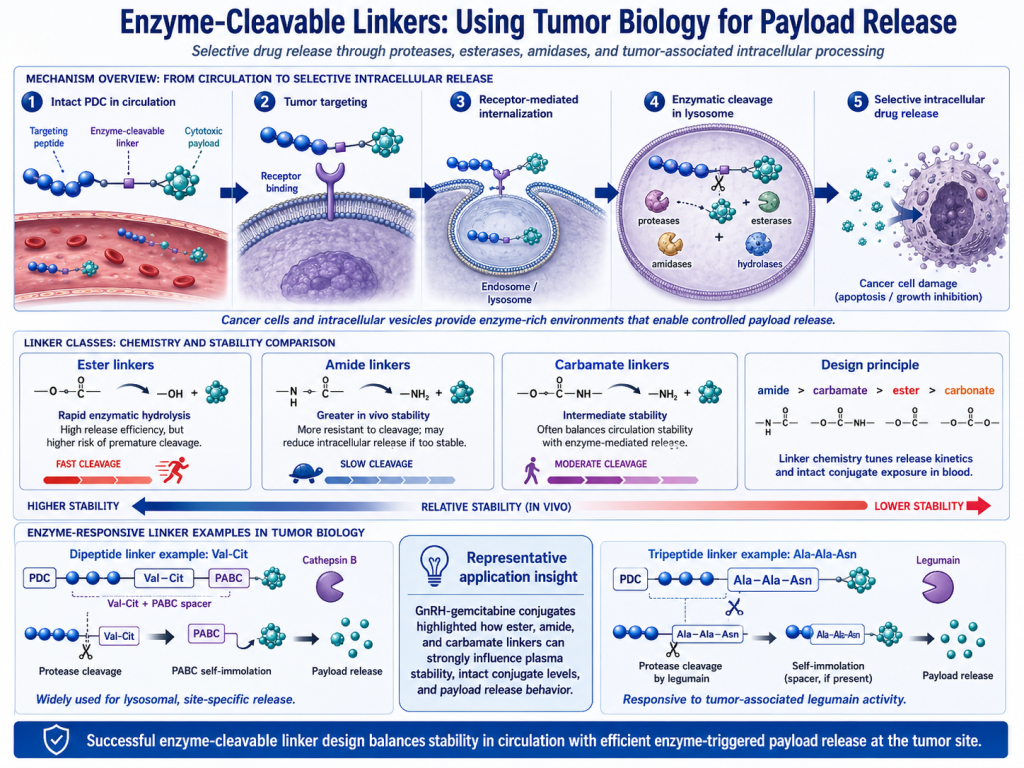
Enzyme-cleavable linkers are among the most important linker classes in PDC and ADC research. Cancer cells often exhibit altered enzyme expression, and intracellular compartments such as endosomes and lysosomes contain proteases, esterases, amidases, and other hydrolytic enzymes. PDCs can exploit this environment to release cytotoxic drugs more selectively.
Ester and Amide Linkers
Ester and amide linkers are commonly used because they can be hydrolyzed by enzymes. However, their stability profiles differ significantly. Ester linkers may release drugs rapidly, which can improve potency but may also increase premature release. Amide linkers are generally more stable, but excessive stability may reduce intracellular drug release.
The article discusses GnRH-gemcitabine conjugates in which an ester bond connects gemcitabine to a linker and an amide bond connects the linker to the targeting peptide. In animal studies, the GSG conjugate inhibited tumor growth more effectively than equimolar gemcitabine, although high plasma gemcitabine levels suggested rapid ester cleavage.
Carbamate Linkers
Carbamate linkers can provide greater stability than ester linkers while still allowing enzyme-mediated cleavage. The reviewed studies suggest a general in vivo stability trend of:
amide > carbamate > ester > carbonate
This hierarchy is useful for designing PDCs where drug release rate must be carefully tuned. For example, carbamate-containing gemcitabine PDCs released drug more slowly than ester-linked analogs, resulting in higher levels of intact conjugate in blood but lower free drug release.
Dipeptide and Tripeptide Linkers
Dipeptide and tripeptide linkers allow more specific enzyme-triggered release. One well-known example is the Val-Cit linker, which is cleaved by cathepsin B in lysosomes. The article highlights a cyclic RGD-doxorubicin conjugate using a Val-Cit linker and PABC spacer, where enzymatic cleavage triggers self-immolation and site-specific payload release. This strategy resembles linker systems used in clinically successful ADCs.
Another example is the Ala-Ala-Asn tripeptide, which can be cleaved by legumain, an enzyme reported to be overexpressed in some tumors and tumor microenvironments. Such enzyme-responsive systems are attractive because they can align drug release with cancer-associated biology.
Acid-Cleavable Linkers: Responding to Tumor and Lysosomal pH
Acid-sensitive linkers are designed to remain relatively stable at physiological pH but hydrolyze in acidic environments, such as tumor extracellular regions, endosomes, or lysosomes. Hydrazone linkers are among the most commonly studied acid-cleavable systems.
The article describes hydrazone-containing doxorubicin conjugates, including aldoxorubicin-related systems. These conjugates can release doxorubicin in acidic tumor or lysosomal environments. In several examples, hydrazone-based PDCs showed improved tumor accumulation or selective toxicity compared with free doxorubicin, although plasma stability could vary.
This is an important design lesson: acid sensitivity alone is not sufficient. A hydrazone linker must be tuned so that it is stable enough in circulation but labile enough in acidic tumor-relevant environments.
Reducible Disulfide Linkers: Exploiting the Intracellular Redox Gradient
Disulfide linkers are designed to respond to intracellular reducing conditions. Cancer cells often have elevated glutathione levels, and intracellular glutathione concentrations are much higher than extracellular levels. This redox gradient can be used to trigger payload release after cellular uptake.
The article discusses Bicycle peptide-drug conjugates targeting EphA2, in which a constrained peptide is linked to a cytotoxic payload through a disulfide bond. Optimization of peptide hydrophilicity reduced liver uptake and improved therapeutic performance in xenograft models.
However, disulfide linkers must be used carefully. In comparative studies, a disulfide-containing RGD-doxorubicin PDC showed reduction-responsive release but lower uptake, cytotoxicity, and in vivo efficacy than some thioether or dipeptide-containing analogs.
Non-Cleavable Linkers: Stability with Controlled Intracellular Processing
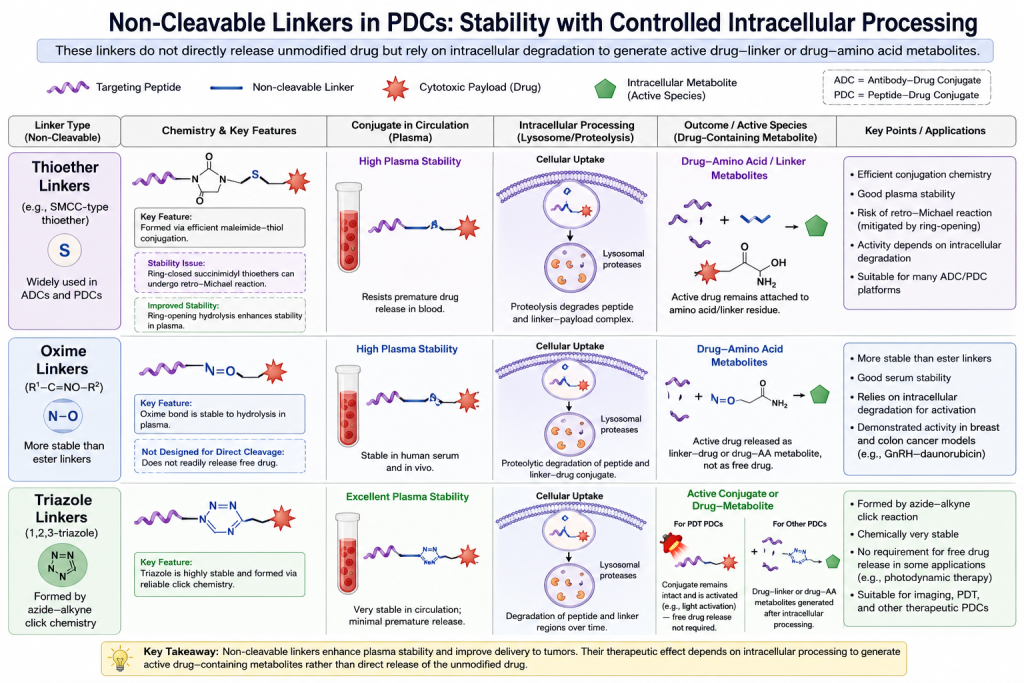
Non-cleavable linkers such as thioether, oxime, and triazole linkages are often used to improve plasma stability. These linkers may not directly release the unmodified drug, but intracellular processing can generate active drug-linker or drug-amino acid metabolites.
Thioether Linkers
Thioether linkers are widely used in ADCs and PDCs because maleimide-thiol conjugation is efficient. However, ring-closed succinimidyl thioethers may undergo instability through retro-Michael reactions. The article notes that ring-opening hydrolysis can improve thioether stability, making this chemistry more attractive when longer circulation stability is needed.
Oxime Linkers
Oxime linkers are generally more stable than ester linkers. In GnRH-daunorubicin conjugates, oxime-linked PDCs showed activity against breast and colon cancer models and stability in human serum. However, because oxime linkers are not readily cleaved to release free drug, activity may depend on lysosomal degradation and formation of active drug-containing metabolites.
Triazole Linkers
Triazoles are commonly formed through azide-alkyne click chemistry. They provide chemical stability and synthetic convenience. In photodynamic therapy PDCs, triazole-based linkers can be suitable because free drug release is not always required; the conjugate itself may remain active after tumor accumulation and light activation.
Lessons for PDC Design
The article makes clear that linker chemistry controls multiple performance variables:
- plasma stability
- tumor accumulation
- intracellular uptake
- drug release rate
- active metabolite formation
- toxicity profile
- therapeutic index
A highly cleavable linker may release drug too early. A highly stable linker may prevent sufficient payload release. The optimal linker depends on the target receptor, internalization pathway, payload potency, tumor microenvironment, and desired pharmacokinetic profile.
The article also notes that higher drug-to-peptide ratios can improve efficacy if solubility and stability are maintained. Some PDCs with drug-to-peptide ratios of 2 or 3 showed stronger delivery of drug to the target site than conjugates with a ratio of 1.
Future Outlook
PDCs are likely to become increasingly important in targeted cancer therapy. Their small size, synthetic accessibility, and potential for homogeneous production make them attractive alternatives or complements to ADCs. However, their success depends heavily on rational linker design.
The reviewed article concludes that knowledge from ADC linker chemistry can guide PDC development, but PDCs also allow broader chemical innovation because peptides are easier to modify than antibodies. Future PDC research will likely focus on smarter linker systems, improved tumor specificity, optimized drug-to-peptide ratios, and better control of release kinetics.
Conclusion
Peptide-drug conjugates represent a powerful strategy for targeted cancer drug delivery. Their therapeutic performance depends not only on the targeting peptide and cytotoxic payload but also on the linker that connects them. Enzyme-cleavable, acid-cleavable, disulfide, and non-cleavable linkers each offer distinct advantages and limitations. The best linker is not universally fixed; it must be matched to the drug, target receptor, tumor biology, and desired release mechanism.
For researchers and pharmaceutical developers, linker chemistry is therefore one of the most important design variables in PDC development. A well-designed linker can improve circulation stability, enhance tumor-selective drug release, and reduce off-target toxicity. A poorly selected linker can compromise the entire conjugate.
FAQ
What is a peptide-drug conjugate?
A peptide-drug conjugate is a targeted drug delivery system composed of a peptide ligand, a cytotoxic drug, and a chemical linker.
Why is linker chemistry important in PDCs?
The linker controls circulation stability, tumor-site drug release, intracellular payload release, and overall therapeutic efficacy.
What are enzyme-cleavable linkers?
These are linkers designed to be cleaved by enzymes such as esterases, amidases, cathepsin B, or legumain, often after uptake into cancer cells.
What is the advantage of disulfide linkers?
Disulfide linkers can respond to the reducing intracellular environment, especially elevated glutathione levels in tumor cells.
Are non-cleavable linkers useful in PDCs?
Yes. Non-cleavable linkers can improve plasma stability, although activity may depend on intracellular degradation and formation of active metabolites rather than release of the free drug.