 LinkPeptide
Ziconotide: Revolutionizing Non-Opioid Pain Management through N-Type Calcium Channel Inhibition
Blog 191
Abstract
Ziconotide, a synthetic peptide derived from the venom of the Conus magus snail, represents a groundbreaking advancement in non-opioid pain management. Approved by the FDA for intrathecal administration in 2004, it selectively inhibits N-type voltage-gated calcium channels in the spinal cord, effectively blocking the release of pain-related neurotransmitters. Its unique mechanism offers significant advantages over opioids, including the absence of tolerance, addiction, and respiratory depression. However, Ziconotide’s narrow therapeutic window and potential neuropsychiatric side effects pose challenges in clinical use. Despite these limitations, it remains a vital option for patients with severe chronic pain refractory to other treatments. Ongoing research aims to optimize its delivery methods and enhance its therapeutic profile, expanding its potential in pain management and beyond.
Ziconotide: A Breakthrough in Non-Opioid Pain Management
Ziconotide, a synthetic peptide derived from the venom of the Conus magus snail, is a pivotal development in the field of pain management, particularly for patients suffering from severe chronic pain. Originally discovered in the early 1980s, Ziconotide has gained recognition for its ability to provide potent analgesia without the drawbacks associated with opioid medications, such as tolerance, addiction, and respiratory depression. Its mechanism of action involves blocking N-type voltage-gated calcium channels in the spinal cord, which are responsible for the transmission of pain signals to the brain. This unique approach disrupts the release of key neurotransmitters like glutamate and substance P, which play a major role in the sensation of pain.
Ziconotide’s administration is primarily intrathecal, meaning it is delivered directly into the cerebrospinal fluid to bypass the blood-brain barrier, allowing for targeted action at the spinal level. Approved by the FDA in 2004, Ziconotide is specifically indicated for patients who have not responded to other pain treatments, including those with neuropathic pain, cancer-related pain, and conditions such as HIV-associated pain. Despite its significant benefits, Ziconotide has a narrow therapeutic window, requiring careful dose management to avoid side effects like cognitive and neuropsychiatric issues. Nonetheless, it remains an essential option for individuals whose pain is otherwise unmanageable, offering a new avenue for non-opioid pain relief in an era where opioid-related complications are a growing concern in healthcare.
Mechanism of Action: How Ziconotide Targets Pain at Its Source
Ziconotide operates through a distinct pharmacological pathway that sets it apart from traditional pain medications. As a selective blocker of N-type voltage-gated calcium channels, it inhibits the flow of calcium ions into nerve cells located in the spinal cord. This inhibition is crucial because calcium influx triggers the release of neurotransmitters that mediate pain perception, such as glutamate, substance P, and calcitonin gene-related peptide (CGRP). By preventing this process, Ziconotide effectively reduces the transmission of pain signals to the brain, offering significant relief for patients experiencing chronic pain.
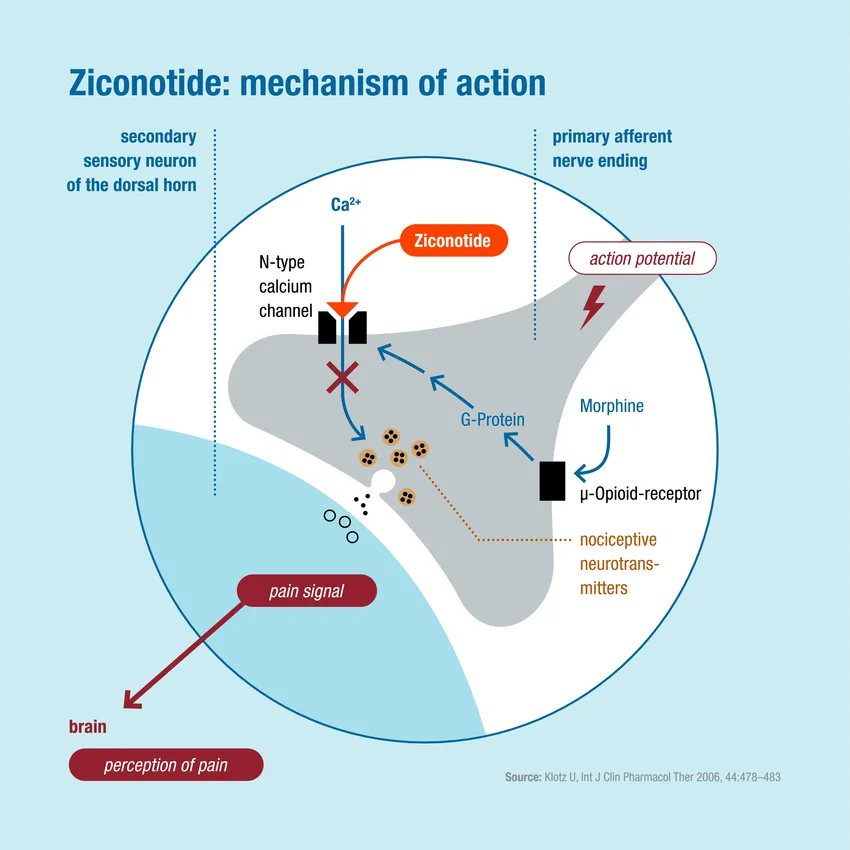
Unlike opioids, which work by binding to receptors and influencing G-protein-coupled pathways, Ziconotide’s mechanism does not involve these receptors. This allows it to provide powerful analgesia without the common side effects seen with opioids, such as respiratory depression, tolerance, or physical dependence. Additionally, Ziconotide’s non-opioid mechanism of action means that it does not contribute to the risk of addiction, making it an attractive alternative in pain management.
However, due to its poor ability to cross the blood-brain barrier, Ziconotide must be administered intrathecally, directly into the cerebrospinal fluid. This route ensures that the drug reaches the central nervous system effectively, but it also presents challenges in terms of dosing precision and management of potential side effects. Despite these hurdles, Ziconotide’s unique mechanism offers a highly targeted and effective option for patients who require long-term relief from severe, refractory pain.
Clinical Impact: Efficacy of Ziconotide in Chronic Pain Treatment
Ziconotide is a crucial option for patients with severe chronic pain unresponsive to conventional treatments. Its primary clinical applications include managing pain associated with neuropathy, cancer, and spinal cord injuries. Patients with neuropathic pain, particularly those who have not found relief from other analgesics, benefit significantly from Ziconotide. By inhibiting N-type calcium channels in the spinal cord, Ziconotide effectively reduces pain signals from nerve damage or dysfunction.

Clinical trials have demonstrated its effectiveness, with many patients experiencing significant pain relief, often exceeding a 30% improvement, even in cases where opioids or other treatments failed. Unlike opioids, Ziconotide does not cause tolerance or dependence, offering longer-lasting pain relief without the need for increasing doses over time.
Ziconotide can be used as monotherapy or in combination with other intrathecal drugs like morphine to enhance its effects. However, it is particularly valued for its ability to reduce the risks associated with opioid use. Despite its effectiveness, Ziconotide requires careful monitoring due to its narrow therapeutic window and potential neuropsychiatric side effects. For patients with limited pain management options, it remains an essential and powerful treatment.
Overcoming Barriers: Challenges in Ziconotide’s Use and Administration
While Ziconotide provides significant benefits in managing severe chronic pain, its use comes with challenges and limitations. One key issue is its narrow therapeutic window, meaning the margin between an effective and toxic dose is small. This necessitates precise dosing and careful monitoring to avoid serious side effects such as cognitive disturbances, confusion, dizziness, and neuropsychiatric problems like hallucinations or mood changes. These risks limit the drug’s widespread use and require healthcare providers to adjust doses gradually.
Another limitation is the need for intrathecal administration. Ziconotide cannot cross the blood-brain barrier effectively, so it must be delivered directly into the cerebrospinal fluid via an intrathecal pump. This invasive procedure requires specialized care, increasing both the cost and complexity of treatment. As a result, only certain patients with access to these resources can benefit from the therapy.
Ziconotide is also unsuitable for some individuals, particularly those with psychiatric conditions or a history of depression, who may face an elevated risk of severe side effects. Despite its restricted approval in some regions, Ziconotide remains an invaluable option for patients whose pain is unmanageable with other treatments, offering hope for improved quality of life without opioid-related complications.
Future Innovations: Expanding the Potential of Ziconotide in Pain Therapy
As Ziconotide remains vital in pain management, ongoing research seeks to expand its therapeutic potential and address its limitations. One key focus is improving delivery methods. Researchers are exploring alternative routes, such as transdermal patches or oral formulations, to bypass the need for intrathecal pumps and make Ziconotide more accessible. These innovations would reduce the invasiveness of treatment and enhance patient compliance.
Another promising area is the structural modification of Ziconotide to improve its ability to cross the blood-brain barrier. By altering its molecular structure, scientists aim to boost the drug’s efficacy while reducing neuropsychiatric side effects. Efforts are also underway to develop Ziconotide analogs with a broader therapeutic window, allowing for safer, more flexible dosing.
Additionally, combination therapies are being investigated to optimize Ziconotide’s use alongside other pain-relieving agents, such as local anesthetics or non-opioid analgesics, maximizing pain relief while minimizing side effects.
With these advancements, the future of Ziconotide looks promising, offering enhanced clinical utility and making it a more versatile and widely available option for chronic pain management.
Reference
- Lin, J., Chen, S., Butt, U. D., Yan, M., & Wu, B. (2024). A comprehensive review on ziconotide. Heliyon.
- Williams, J. A., Day, M., & Heavner, J. E. (2008). Ziconotide: an update and review. Expert opinion on pharmacotherapy, 9(9), 1575-1583.
- Schmidtko, A., Lötsch, J., Freynhagen, R., & Geisslinger, G. (2010). Ziconotide for treatment of severe chronic pain. The Lancet, 375(9725), 1569-1577.
- Smith, H. S., & Deer, T. R. (2009). Safety and efficacy of intrathecal ziconotide in the management of severe chronic pain. Therapeutics and clinical risk management, 521-534.