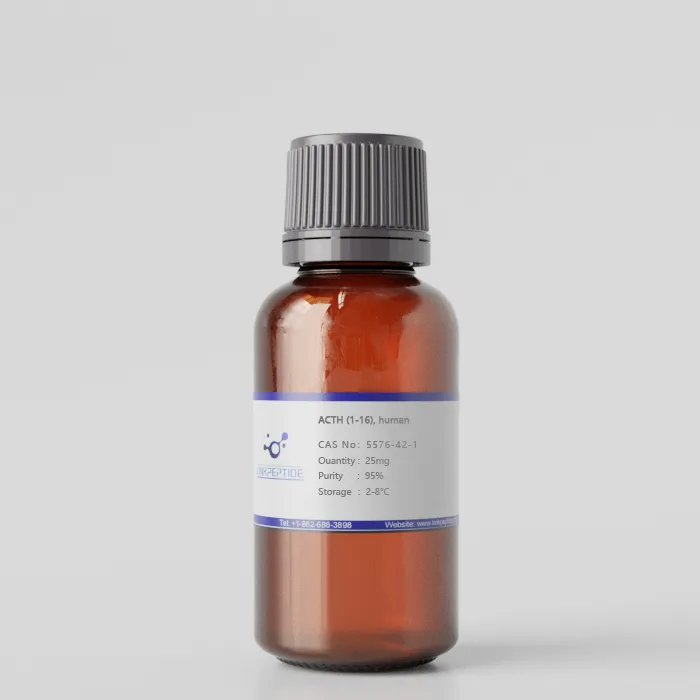
Product Name:ACTH (1-16), human
Form:TFA salt
Purity:95%
Storage:2-8 degree Celsius
Cas No:5576-42-1
Molar Mass:1937.3
Chemical Formula:C89H133N25O22S1
IUPAC Name: 6-amino-2-[[6-amino-2-[[2-[[2-[[1-[6-amino-2-[[2-[[2-[[2-[[2-[[2-[[2-[[2-[[2-[[2-[(2-amino-3-hydroxypropanoyl)amino]-3-(4-hydroxyphenyl)propanoyl]amino]-3-hydroxypropanoyl]amino]-4-methylsulfanylbutanoyl]amino]-4-carboxybutanoyl]amino]-3-(1H-imidazol-5-yl)propanoyl]amino]-3-phenylpropanoyl]amino]-5-carbamimidamidopentanoyl]amino]-3-(1H-indol-3-yl)propanoyl]amino]acetyl]amino]hexanoyl]pyrrolidine-2-carbonyl]amino]-3-methylbutanoyl]amino]acetyl]amino]hexanoyl]amino]hexanoic acid
SMILES:CC(C)C(C(=O)NCC(=O)NC(CCCCN)C(=O)NC(CCCCN)C(=O)O)NC(=O)C1CCCN1C(=O)C(CCCCN)NC(=O)CNC(=O)C(CC2=CNC3=CC=CC=C32)NC(=O)C(CCCNC(=N)N)NC(=O)C(CC4=CC=CC=C4)NC(=O)C(CC5=CN=CN5)NC(=O)C(CCC(=O)O)NC(=O)C(CCSC)NC(=O)C(CO)NC(=O)C(CC6=CC=C(C=C6)O)NC(=O)C(CO)N
InChIKey:BLBPSTKPAGOHPL-UHFFFAOYSA-N
InChI:InChI=1S/C89H133N25O22S/c1-50(2)74(86(133)100-46-71(118)102-59(21-9-12-33-90)77(124)107-64(88(135)136)23-11-14-35-92)113-85(132)70-25-16-37-114(70)87(134)63(22-10-13-34-91)103-72(119)45-99-76(123)67(41-53-43-98-58-20-8-7-19-56(53)58)110-78(125)60(24-15-36-97-89(94)95)104-81(128)66(39-51-17-5-4-6-18-51)109-83(130)68(42-54-44-96-49-101-54)111-79(126)61(30-31-73(120)121)105-80(127)62(32-38-137-3)106-84(131)69(48-116)112-82(129)65(108-75(122)57(93)47-115)40-52-26-28-55(117)29-27-52/h4-8,17-20,26-29,43-44,49-50,57,59-70,74,98,115-117H,9-16,21-25,30-42,45-48,90-93H2,1-3H3,(H,96,101)(H,99,123)(H,100,133)(H,102,118)(H,103,119)(H,104,128)(H,105,127)(H,106,131)(H,107,124)(H,108,122)(H,109,130)(H,110,125)(H,111,126)(H,112,129)(H,113,132)(H,120,121)(H,135,136)(H4,94,95,97)
Sequence:Ser-Tyr-Ser-Met-Glu-His-Phe-Arg-Trp-Gly-Lys-Pro-Val-Gly-Lys-Lys
Application:ACTH (1-16), human is a bioactive N-terminal fragment of adrenocorticotropic hormone (ACTH), comprising 16 amino acids essential for melanocortin receptor activation. This peptide retains the core sequence required for adrenal stimulation, promoting glucocorticoid synthesis via the melanocortin 2 receptor (MC2R). ACTH (1-16) is widely used in endocrinology, neurobiology, and immunology research to study HPA axis regulation, adrenal insufficiency, and stress adaptation. Additionally, it exhibits neuromodulatory and anti-inflammatory properties, making it relevant for neuroprotection, cognitive function, and immune response regulation. Researchers explore its applications in adrenal disorders, neuroimmune interactions, and peptide-based therapeutic development.
Current Research:
Introduction
ACTH (1-16), human, is a truncated but bioactive fragment of adrenocorticotropic hormone (ACTH) that retains the core functional domain for melanocortin receptor binding. While full-length ACTH (1-39) is required for full adrenal stimulation and prolonged receptor activation, ACTH (1-16) still exhibits biological activity in melanocortin receptor modulation, stress regulation, and immune interactions. This peptide is widely studied for its effects on adrenal function, neuropeptide signaling, and inflammation control.
Endocrine and Adrenal Function Research
ACTH (1-16) contains the essential N-terminal region responsible for binding to MC2R in the adrenal cortex, triggering the release of:
Glucocorticoids (cortisol) – critical for stress response, metabolism, and immune regulation.
Mineralocorticoids (aldosterone) – involved in fluid balance and blood pressure control.
Androgens – contributing to secondary hormonal effects.
Research on ACTH (1-16) focuses on:
Adrenal insufficiency models, testing its steroidogenic potential in conditions like Addison’s disease and congenital adrenal hyperplasia.
Comparative receptor activation studies, analyzing how shorter ACTH fragments influence melanocortin receptor dynamics.
Development of ACTH analogs, particularly for synthetic peptide-based hormone replacement therapies.
Although ACTH (1-16) has a shorter half-life than ACTH (1-39), it allows for targeted studies on receptor activation and corticosteroid biosynthesis.
Neuroendocrine and Stress Regulation Research
ACTH peptides play a major role in neuroendocrine signaling beyond adrenal function. ACTH (1-16) has been explored for its:
Role in stress adaptation, contributing to research on HPA axis dysfunction in depression, anxiety, and PTSD.
Influence on neurotransmitter activity, potentially modulating dopamine, serotonin, and norepinephrine pathways.
Neuroprotective effects, supporting studies in Alzheimer’s and Parkinson’s disease models.
Given that melanocortin receptors (MC4R, MC5R) are expressed in the brain, ACTH (1-16) may have neuromodulatory functions beyond adrenal activation.
Immunomodulatory and Anti-Inflammatory Effects
Like other melanocortin peptides, ACTH (1-16) exhibits immune-modulating properties. Research suggests that it:
Reduces pro-inflammatory cytokine levels (e.g., TNF-α, IL-6, IL-1β), supporting anti-inflammatory therapies.
Modulates immune cell activity, influencing macrophage, T-cell, and monocyte responses.
Has potential applications in autoimmune diseases, such as multiple sclerosis and rheumatoid arthritis.
The melanocortin system plays a key role in immune regulation, making ACTH (1-16) relevant for neuroimmune and inflammatory disease research.
Potential Research and Therapeutic Applications
Due to its receptor-binding properties, neuroendocrine effects, and immune regulation, ACTH (1-16) is being explored in:
Adrenal dysfunction studies, particularly for corticosteroid regulation disorders.
Neuropsychiatric research, focusing on stress-related conditions like PTSD and major depression.
Anti-inflammatory and immune modulation research, for conditions such as autoimmune diseases and neuroinflammation.
Conclusion
ACTH (1-16), human, is a functional ACTH fragment that retains steroidogenic, neuromodulatory, and immune-modulating properties. Its ability to activate melanocortin receptors, regulate HPA axis function, and modulate immune responses makes it a valuable tool in endocrinology, neurobiology, and immunology research. Ongoing studies continue to explore its therapeutic potential in adrenal disorders, neuroprotection, and inflammatory diseases.
Get a Quote
 LinkPeptide