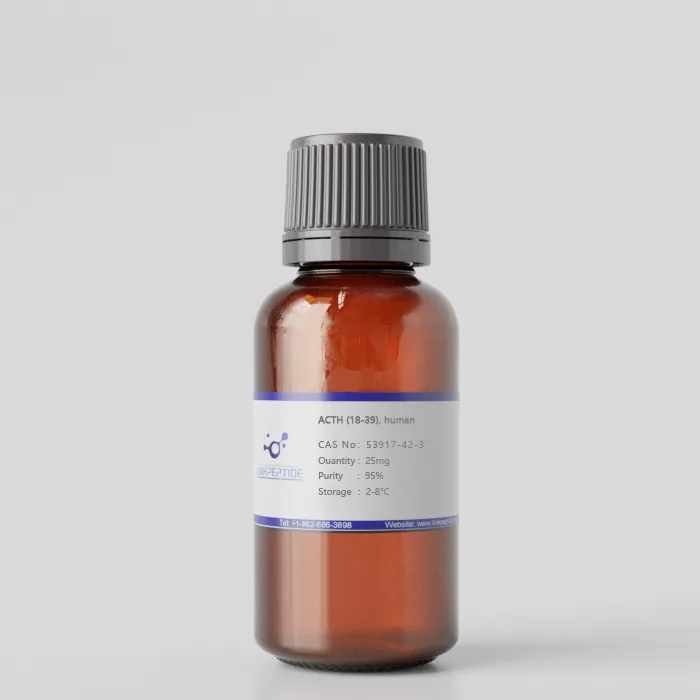
Product Name:ACTH (18-39), human
Form:TFA salt
Purity:95%
Storage:2-8 degree Celsius
Cas No:53917-42-3
Molar Mass:2465.7
Chemical Formula:C112H165N27O36
IUPAC Name:(4S)-4-[[(2S)-2-[[(2S)-2-[[(2S)-2-[[(2S)-2-[[(2S)-2-[[(2S)-2-[[2-[[(2S)-4-amino-2-[[(2S)-1-[(2S)-2-[[(2S)-2-[[(2S)-6-amino-2-[[(2S)-2-[[(2S)-1-[(2S)-2-amino-5-carbamimidamidopentanoyl]pyrrolidine-2-carbonyl]amino]-3-methylbutanoyl]amino]hexanoyl]amino]-3-methylbutanoyl]amino]-3-(4-hydroxyphenyl)propanoyl]pyrrolidine-2-carbonyl]amino]-4-oxobutanoyl]amino]acetyl]amino]propanoyl]amino]-4-carboxybutanoyl]amino]-3-carboxypropanoyl]amino]-4-carboxybutanoyl]amino]-3-hydroxypropanoyl]amino]propanoyl]amino]-5-[[(2S)-1-[[(2S)-1-[(2S)-2-[[(2S)-1-[[(2S)-4-carboxy-1-[[(1S)-1-carboxy-2-phenylethyl]amino]-1-oxobutan-2-yl]amino]-4-methyl-1-oxopentan-2-yl]carbamoyl]pyrrolidin-1-yl]-1-oxo-3-phenylpropan-2-yl]amino]-1-oxopropan-2-yl]amino]-5-oxopentanoic acid
SMILES:C[C@@H](C(=O)N[C@@H](CCC(=O)O)C(=O)N[C@@H](CC(=O)O)C(=O)N[C@@H](CCC(=O)O)C(=O)N[C@@H](CO)C(=O)N[C@@H](C)C(=O)N[C@@H](CCC(=O)O)C(=O)N[C@@H](C)C(=O)N[C@@H](CC1=CC=CC=C1)C(=O)N2CCC[C@H]2C(=O)N[C@@H](CC(C)C)C(=O)N[C@@H](CCC(=O)O)C(=O)N[C@@H](CC3=CC=CC=C3)C(=O)O)NC(=O)CNC(=O)[C@H](CC(=O)N)NC(=O)[C@@H]4CCCN4C(=O)[C@H](CC5=CC=C(C=C5)O)NC(=O)[C@H](C(C)C)NC(=O)[C@H](CCCCN)NC(=O)[C@H](C(C)C)NC(=O)[C@@H]6CCCN6C(=O)[C@H](CCCNC(=N)N)N
InChIKey:ZYDMZKPAPSZILB-WKNDHWIVSA-N
InChI:InChI=1S/C112H165N27O36/c1-56(2)48-72(100(163)125-70(37-41-86(148)149)97(160)133-77(111(174)175)51-63-24-14-11-15-25-63)129-103(166)79-28-20-46-138(79)109(172)75(49-62-22-12-10-13-23-62)131-93(156)61(9)121-95(158)68(35-39-84(144)145)123-92(155)60(8)122-102(165)78(55-140)134-98(161)71(38-42-87(150)151)126-101(164)74(53-88(152)153)128-96(159)69(36-40-85(146)147)124-91(154)59(7)120-83(143)54-119-94(157)73(52-82(115)142)130-104(167)80-29-21-47-139(80)110(173)76(50-64-31-33-65(141)34-32-64)132-107(170)89(57(3)4)135-99(162)67(27-16-17-43-113)127-106(169)90(58(5)6)136-105(168)81-30-19-45-137(81)108(171)66(114)26-18-44-118-112(116)117/h10-15,22-25,31-34,56-61,66-81,89-90,140-141H,16-21,26-30,35-55,113-114H2,1-9H3,(H2,115,142)(H,119,157)(H,120,143)(H,121,158)(H,122,165)(H,123,155)(H,124,154)(H,125,163)(H,126,164)(H,127,169)(H,128,159)(H,129,166)(H,130,167)(H,131,156)(H,132,170)(H,133,160)(H,134,161)(H,135,162)(H,136,168)(H,144,145)(H,146,147)(H,148,149)(H,150,151)(H,152,153)(H,174,175)(H4,116,117,118)/t59-,60-,61-,66-,67-,68-,69-,70-,71-,72-,73-,74-,75-,76-,77-,78-,79-,80-,81-,89-,90-/m0/s1
Sequence:Arg-Pro-Val-Lys-Val-Tyr-Pro-Asn-Gly-Ala-Glu-Asp-Glu-Ser-Ala-Glu-Ala-Phe-Pro-Leu-Glu-Phe
Application:
ACTH (18-39), human is a C-terminal fragment of adrenocorticotropic hormone (ACTH), consisting of the amino acid sequence Ser-Tyr-Ser-Met-Glu-His-Phe-Arg-Trp-Gly-Lys-Lys-Arg-Arg-Pro-Val-Lys-Val-Tyr-Pro-Asn-Gly-Val-Gly-Lys-Lys. While it lacks the N-terminal region required for adrenal stimulation, ACTH (18-39) has been investigated for its neuromodulatory, immunoregulatory, and metabolic roles. Studies suggest potential interactions with melanocortin receptors and neuropeptide systems, making it a useful tool in research on cognition, neuroprotection, and immune function. Due to its potential anti-inflammatory effects and receptor-specific interactions, ACTH (18-39) is widely used in studies related to neurodegenerative diseases, peptide metabolism, and stress regulation.
Current Research:
Introduction
ACTH (18-39) is a truncated ACTH fragment that retains the C-terminal region but lacks the N-terminal sequence essential for melanocortin 2 receptor (MC2R) activation and adrenal steroidogenesis. While it does not stimulate glucocorticoid release, research suggests that ACTH (18-39) may have distinct neuromodulatory and immunoregulatory effects, possibly mediated through melanocortin receptor interactions. This peptide is being explored for its potential role in neuroprotection, stress adaptation, and immune response regulation.
Neurobiological and Cognitive Research
While full-length ACTH (1-39) is primarily known for its role in adrenal function, studies on C-terminal fragments like ACTH (18-39) indicate potential neuromodulatory activity:
Possible interaction with melanocortin receptors (MC4R and MC5R), which are involved in neurotransmission and synaptic plasticity.
Influences on neurotransmitter systems, particularly dopaminergic and serotonergic pathways, which regulate mood, cognition, and stress response.
Potential application in neurodegenerative diseases, including Alzheimer’s and Parkinson’s, where peptide-based neuroprotection is an area of research interest.
These findings suggest ACTH (18-39) may have functional effects on memory, learning, and cognitive resilience, making it valuable in neurological studies.
Immunomodulatory and Anti-Inflammatory Effects
Melanocortin peptides, including ACTH fragments, have demonstrated immune-modulating effects. Research on ACTH (18-39) explores its role in:
Suppressing inflammatory cytokine production, potentially reducing levels of TNF-α, IL-6, and IL-1β.
Regulating immune responses in autoimmune diseases, such as multiple sclerosis, rheumatoid arthritis, and inflammatory bowel disease (IBD).
Neuroimmune interactions, particularly in conditions where chronic inflammation contributes to cognitive decline.
These findings highlight ACTH (18-39) as a potential target for neuroimmune and anti-inflammatory research.
Peptide Stability and Receptor Binding Studies
Since C-terminal ACTH fragments play a role in peptide stability and receptor interactions, ACTH (18-39) is commonly included in:
Melanocortin receptor binding assays, particularly MC4R and MC5R, which are linked to immune regulation and metabolic function.
Peptide degradation and clearance studies, contributing to pharmacokinetic research on peptide-based therapies.
Comparative research on ACTH metabolism, examining how C-terminal fragments influence hormonal signaling pathways.
Understanding peptide-receptor interactions can provide insights into new ACTH-derived drug designs for neurological and metabolic disorders.
Potential Therapeutic and Research Applications
Given its neuromodulatory, immune-regulatory, and receptor-interacting properties, ACTH (18-39) is being explored in:
Cognitive enhancement research, particularly in models of memory impairment and neurodegeneration.
Neuroimmune therapies, targeting neuroinflammation-related disorders such as Parkinson’s and Alzheimer’s disease.
Peptide-based drug development, focusing on modifications for enhanced stability and receptor selectivity.
Conclusion
ACTH (18-39), human, is a C-terminal ACTH fragment with potential applications in neuroprotection, immune modulation, and peptide pharmacology. While it does not activate adrenal steroidogenesis, its potential role in neurotransmitter regulation, inflammation control, and peptide-receptor interactions makes it a valuable research tool in neurology, immunology, and endocrinology. Ongoing studies continue to explore its biological significance and therapeutic potential in neurodegenerative diseases, stress adaptation, and immune system regulation.
Get a Quote
 LinkPeptide