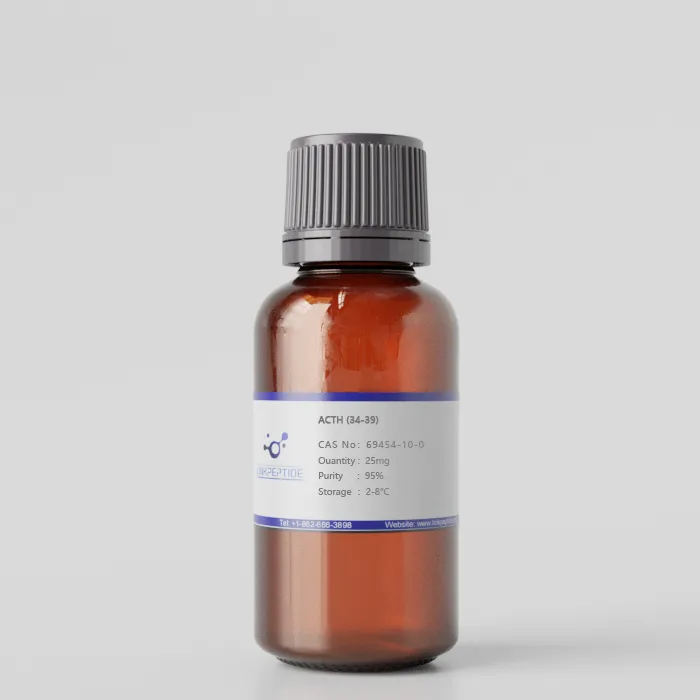
Product Name:ACTH (34-39)
Form:free base
Purity:95%
Storage:2-8 degree Celsius
Cas No:69454-10-0
Molar Mass:722.8
Chemical Formula:C37H50N6O9
IUPAC Name:(4S)-4-[[(2S)-2-[[(2S)-1-[(2S)-2-[[(2S)-2-aminopropanoyl]amino]-3-phenylpropanoyl]pyrrolidine-2-carbonyl]amino]-4-methylpentanoyl]amino]-5-[[(1S)-1-carboxy-2-phenylethyl]amino]-5-oxopentanoic acid
SMILES:C[C@@H](C(=O)N[C@@H](CC1=CC=CC=C1)C(=O)N2CCC[C@H]2C(=O)N[C@@H](CC(C)C)C(=O)N[C@@H](CCC(=O)O)C(=O)N[C@@H](CC3=CC=CC=C3)C(=O)O)N
InChIKey:FUSHTHSTTRFCPC-OBXVVNIGSA-N
InChI:InChI=1S/C37H50N6O9/c1-22(2)19-27(34(48)39-26(16-17-31(44)45)33(47)42-29(37(51)52)21-25-13-8-5-9-14-25)40-35(49)30-15-10-18-43(30)36(50)28(41-32(46)23(3)38)20-24-11-6-4-7-12-24/h4-9,11-14,22-23,26-30H,10,15-21,38H2,1-3H3,(H,39,48)(H,40,49)(H,41,46)(H,42,47)(H,44,45)(H,51,52)/t23-,26-,27-,28-,29-,30-/m0/s1
Sequence:Ala-Phe-Pro-Leu-Glu-Phe
Application:ACTH (34-39) is a short C-terminal fragment of adrenocorticotropic hormone (ACTH), consisting of the amino acid sequence Arg-Gly-Lys-Arg-Arg-Pro. Unlike full-length ACTH, this fragment lacks adrenal-stimulating activity but is studied for its potential roles in neuroregulation, peptide-receptor interactions, and immunomodulation. Research suggests that ACTH (34-39) may play a role in neurotransmission, cellular signaling, and inflammatory response regulation. It is commonly used in studies investigating melanocortin receptor interactions, peptide degradation pathways, and potential bioactive properties. Due to its structural significance, ACTH (34-39) is also valuable in biochemical and pharmacological research on hormonal and peptide-based therapies.
Current Research:Introduction ACTH (34-39) is a small peptide fragment derived from the C-terminal region of adrenocorticotropic hormone (ACTH). While most ACTH research focuses on its N-terminal bioactive region responsible for melanocortin receptor activation, the C-terminal sequences like ACTH (34-39) are of interest in studies on peptide stability, receptor specificity, and secondary physiological effects. This fragment may interact with cellular receptors and enzymatic pathways, influencing neuroregulation, immune response, and peptide metabolism. Neurobiological and Peptide Interaction Research ACTH (34-39) is not known to activate the melanocortin 2 receptor (MC2R), which is essential for adrenal steroidogenesis. However, some studies suggest that C-terminal ACTH fragments may have distinct neuromodulatory properties: Potential involvement in neurotransmitter regulation, particularly dopaminergic and serotonergic pathways. Possible effects on synaptic signaling, influencing neuronal communication and peptide-receptor interactions. Use in studies on peptide degradation, as the C-terminal sequence is a target for enzymatic cleavage affecting ACTH stability. While direct neurobiological effects remain under investigation, ACTH (34-39) is frequently included in research exploring ACTH-derived peptide fragments and their secondary bioactive roles. Peptide Stability and Metabolism Studies The C-terminal region of ACTH plays a crucial role in determining peptide stability, receptor binding specificity, and enzymatic degradation. Research involving ACTH (34-39) includes: Investigating ACTH metabolism and enzymatic breakdown by peptidases and proteases. Assessing peptide-receptor interactions beyond the classic melanocortin receptor system. Structural and pharmacological studies on peptide modifications for enhanced bioavailability and therapeutic potential. Immunological and Anti-Inflammatory Potential Although direct immune-modulating activity of ACTH (34-39) has not been widely characterized, other ACTH fragments have been shown to influence cytokine production, immune cell signaling, and inflammatory responses. Future research may explore whether this C-terminal sequence contributes to: Immune regulation via peptide-receptor interactions. Anti-inflammatory effects through cytokine modulation. Potential applications in autoimmune disease research. Potential Therapeutic and Research Applications Due to its structural role and potential bioactivity, ACTH (34-39) is used in: Peptide-receptor interaction studies to explore alternative ACTH signaling pathways. Investigations into ACTH metabolism, degradation, and enzymatic processing. Structural biology and peptide modification research, contributing to hormonal therapy development. Conclusion ACTH (34-39), human, is a C-terminal ACTH fragment with applications in neuroregulation, peptide metabolism, and immune research. While it does not directly stimulate adrenal steroidogenesis, its role in peptide stability, receptor interactions, and potential bioactivity makes it a valuable subject in biochemical and pharmacological studies. Ongoing research continues to explore its biological significance, structural contributions, and potential therapeutic applications in neurology, endocrinology, and immunology.
Get a Quote
 LinkPeptide