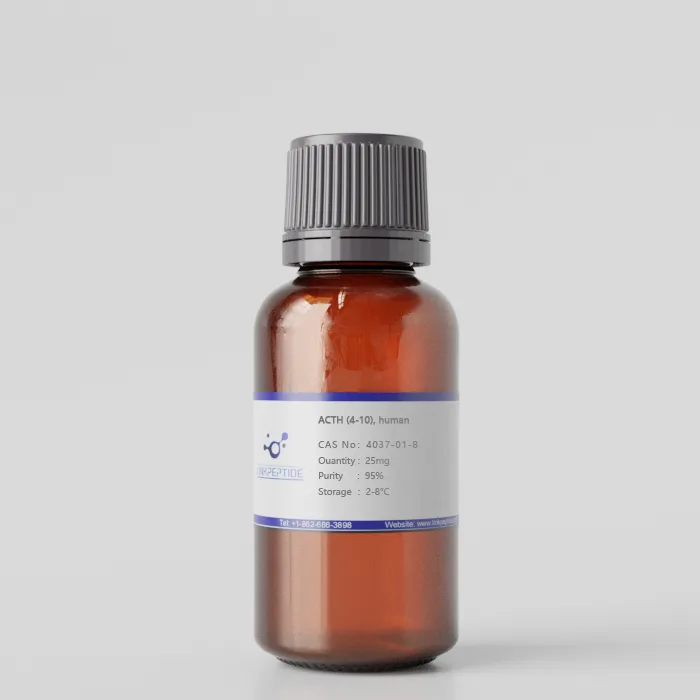
Product Name:ACTH (4-10), human
Form:Acetate salt
Purity:95%
Storage:2-8 degree Celsius
Cas No:4037-01-08
Molar Mass:962.09
Chemical Formula:C44H59N13O10S
IUPAC Name:(4S)-4-[[(2S)-2-amino-4-methylsulfanylbutanoyl]amino]-5-[[(2S)-1-[[(2S)-1-[[(2S)-1-[[(2S)-1-(carboxymethylamino)-3-(1H-indol-3-yl)-1-oxopropan-2-yl]amino]-5-(diaminomethylideneamino)-1-oxopentan-2-yl]amino]-1-oxo-3-phenylpropan-2-yl]amino]-3-(1H-imidazol-5-yl)-1-oxopropan-2-yl]amino]-5-oxopentanoic acid
SMILES:CSCC[C@@H](C(=O)N[C@@H](CCC(=O)O)C(=O)N[C@@H](CC1=CN=CN1)C(=O)N[C@@H](CC2=CC=CC=C2)C(=O)N[C@@H](CCCN=C(N)N)C(=O)N[C@@H](CC3=CNC4=CC=CC=C43)C(=O)NCC(=O)O)N
InChIKey:HAAUASBAIUJHAN-LXOXETEGSA-N
InChI:InChI=1S/C44H59N13O10S/c1-68-17-15-29(45)38(62)53-32(13-14-36(58)59)41(65)57-35(20-27-22-48-24-52-27)43(67)55-33(18-25-8-3-2-4-9-25)42(66)54-31(12-7-16-49-44(46)47)40(64)56-34(39(63)51-23-37(60)61)19-26-21-50-30-11-6-5-10-28(26)30/h2-6,8-11,21-22,24,29,31-35,50H,7,12-20,23,45H2,1H3,(H,48,52)(H,51,63)(H,53,62)(H,54,66)(H,55,67)(H,56,64)(H,57,65)(H,58,59)(H,60,61)(H4,46,47,49)/t29-,31-,32-,33-,34-,35-/m0/s1
Sequence:Met-Glu-His-Phe-Arg-Trp-Gly
Application:
ACTH (4-10), human is a bioactive peptide fragment of adrenocorticotropic hormone (ACTH), consisting of the sequence Met-Glu-His-Phe-Arg-Trp-Gly-Lys-Arg. While it does not stimulate adrenal corticosteroid release like full-length ACTH, ACTH (4-10) has been shown to influence cognition, stress regulation, and immune modulation. Research indicates its role in neurotransmitter regulation, memory enhancement, and anti-inflammatory responses, making it valuable in neuroscience, endocrinology, and immunology studies. ACTH (4-10) is widely used in learning and memory research, neuroprotection studies, and investigations into immune system modulation, with potential implications for Alzheimer’s disease, stress adaptation, and inflammatory conditions.
Current Research:
Introduction
ACTH fragments have been widely studied for their neuromodulatory and immunoregulatory properties. ACTH (4-10) is a short peptide sequence derived from adrenocorticotropic hormone, lacking the full-length hormone's adrenal-stimulating activity but retaining neuroactive and anti-inflammatory properties. This peptide has been studied for its cognitive-enhancing effects, neuroprotective potential, and immune-modulating capabilities, making it an important tool in neurological, psychiatric, and immunological research.
Cognitive and Memory-Enhancing Effects
Research suggests that ACTH (4-10) plays a role in learning and memory formation, likely due to its interaction with melanocortin receptors in the brain. Key findings include:
Enhancement of cognitive function in experimental models of learning impairment and neurodegeneration.
Neurotransmitter regulation, particularly its influence on dopaminergic, serotonergic, and cholinergic systems, which are critical for memory and cognitive processing.
Potential application in Alzheimer’s disease, where ACTH (4-10) may promote synaptic plasticity and neuronal survival.
Studies suggest that this peptide may serve as a cognitive enhancer, particularly in age-related cognitive decline and neurodegenerative diseases.
Stress Regulation and Neuropsychiatric Research
ACTH peptides, including ACTH (4-10), have been investigated for their role in stress adaptation and mood regulation. Findings indicate that:
ACTH (4-10) modulates the stress response, potentially reducing excessive cortisol secretion and protecting against HPA axis dysregulation.
It may exhibit anxiolytic and antidepressant-like effects, influencing mood disorders, anxiety, and PTSD.
Potential applications in neuropsychiatry include investigating its role in major depressive disorder (MDD) and chronic stress-related conditions.
By acting on neuropeptide signaling pathways, ACTH (4-10) may contribute to emotional resilience and neuroprotection.
Neuroprotection and Neuroinflammation Control
Studies have explored ACTH (4-10)’s potential in neuroprotection, particularly in conditions where inflammation and oxidative stress drive disease progression. Research highlights include:
Reducing neuroinflammatory markers, potentially benefiting conditions such as multiple sclerosis and Alzheimer’s disease.
Protecting neurons from oxidative stress, helping mitigate Parkinson’s disease-related neurodegeneration.
Enhancing neuronal plasticity, which could aid in brain injury recovery and neurorehabilitation.
Immunomodulatory and Anti-Inflammatory Effects
ACTH (4-10) has been shown to influence immune function through interactions with melanocortin receptors on immune cells. Research suggests it may:
Suppress pro-inflammatory cytokine production (e.g., TNF-α, IL-6), reducing systemic and neuroinflammation.
Modulate immune response in autoimmune diseases, including rheumatoid arthritis and multiple sclerosis.
Protect against excessive inflammatory responses, which are implicated in chronic inflammatory disorders and neurodegeneration.
Potential Therapeutic Applications
Due to its broad biological activity, ACTH (4-10) is being investigated for:
Cognitive-enhancing therapies, particularly for neurodegenerative and age-related memory impairments.
Treatment of stress-related disorders, including anxiety, depression, and PTSD.
Immunomodulatory therapies, targeting autoimmune and inflammatory diseases.
Conclusion
ACTH (4-10), human, is a neuroactive and immunomodulatory peptide fragment with applications in cognitive enhancement, stress adaptation, and immune regulation. Its ability to influence neurotransmission, reduce neuroinflammation, and modulate immune responses makes it a valuable research tool in neurology, psychiatry, and immunology. Ongoing studies continue to explore its therapeutic potential in neurodegenerative diseases, stress-related disorders, and inflammatory conditions.
Get a Quote
 LinkPeptide