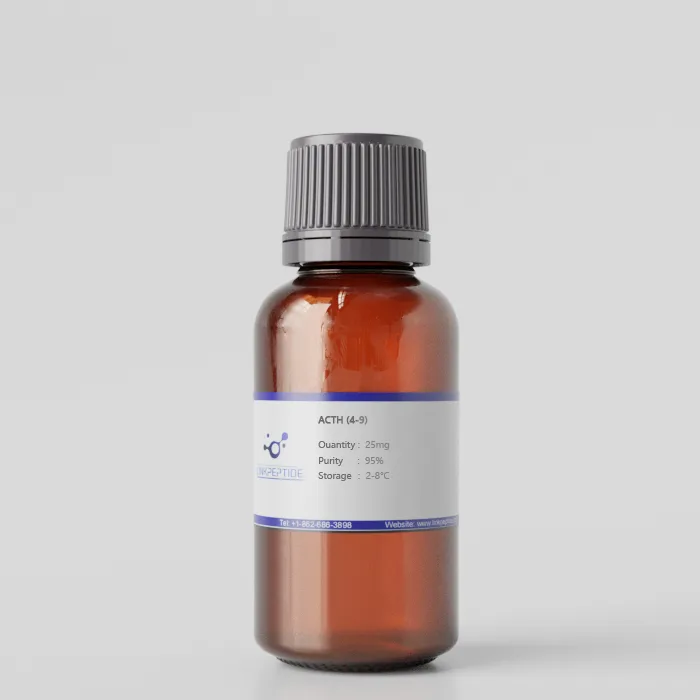
Product Name:ACTH (4-9)
Form:TFA salt
Purity:95%
Storage:2-8 degree Celsius
Molar Mass:905
Chemical Formula:C42H56N12O9S1
IUPAC Name:(4S)-4-[(2-amino-4-methylsulfanylbutanoyl)amino]-5-[[(2S)-1-[[(2S)-1-[[(2S)-1-[[(1S)-1-carboxy-2-(1H-indol-3-yl)ethyl]amino]-5-(diaminomethylideneamino)-1-oxopentan-2-yl]amino]-1-oxo-3-phenylpropan-2-yl]amino]-3-(1H-imidazol-5-yl)-1-oxopropan-2-yl]amino]-5-oxopentanoic acid
SMILES:CSCCC(C(=O)N[C@@H](CCC(=O)O)C(=O)N[C@@H](CC1=CN=CN1)C(=O)N[C@@H](CC2=CC=CC=C2)C(=O)N[C@@H](CCCN=C(N)N)C(=O)N[C@@H](CC3=CNC4=CC=CC=C43)C(=O)O)N
InChIKey:CLUQWSRYSHBBDD-DYXFYOPSSA-N
InChI:InChI=1S/C42H56N12O9S/c1-64-17-15-28(43)36(57)50-31(13-14-35(55)56)38(59)53-33(20-26-22-46-23-49-26)40(61)52-32(18-24-8-3-2-4-9-24)39(60)51-30(12-7-16-47-42(44)45)37(58)54-34(41(62)63)19-25-21-48-29-11-6-5-10-27(25)29/h2-6,8-11,21-23,28,30-34,48H,7,12-20,43H2,1H3,(H,46,49)(H,50,57)(H,51,60)(H,52,61)(H,53,59)(H,54,58)(H,55,56)(H,62,63)(H4,44,45,47)/t28,30-,31-,32-,33-,34-/m0/s1
Sequence:Met-Glu-His-Phe-Arg-Trp
Application:
ACTH (4-9) is a short bioactive fragment of adrenocorticotropic hormone (ACTH), consisting of the sequence Met-Glu-His-Phe-Arg-Trp-Gly. Although it lacks the full domain required for adrenal steroidogenesis, ACTH (4-9) is studied for its effects on neurotransmission, cognitive function, and immune regulation. Research suggests it plays a role in memory enhancement, stress response, and neuroprotection. It interacts with melanocortin receptors, influencing neuromodulation and inflammatory pathways. ACTH (4-9) is widely used in studies investigating cognition, mood disorders, neurodegeneration, and immune system regulation, with potential applications in Alzheimer’s disease, neuroinflammation, and stress adaptation research.
Current Research:
Introduction
ACTH fragments have attracted attention for their neurobiological and immunological functions, independent of their classical role in adrenal stimulation. ACTH (4-9) is a short peptide fragment that interacts with melanocortin receptors and other neuromodulatory systems, making it a subject of interest in research on cognitive function, neuroprotection, and inflammation control.
Neurocognitive and Memory-Enhancing Effects
Studies suggest that ACTH (4-9) modulates learning and memory, likely through its influence on synaptic plasticity and neurotransmitter regulation. Research highlights include:
Memory improvement: ACTH (4-9) has been shown to enhance cognitive function in experimental models of learning and memory deficits.
Neurotransmitter interactions: It may regulate dopaminergic and cholinergic systems, which are crucial for cognition and mood stabilization.
Potential in Alzheimer’s disease: Due to its neuroprotective properties, ACTH (4-9) is investigated for reducing cognitive decline and neurodegeneration.
Stress and Mood Regulation
ACTH-derived peptides are involved in stress response modulation. ACTH (4-9) has been studied for:
Regulating HPA axis activity, potentially modulating cortisol release and behavioral stress responses.
Mood-enhancing effects, suggesting potential applications in depression, anxiety, and PTSD research.
Neuroprotection and Neuroinflammation Control
ACTH (4-9) is being explored for its role in neuroprotection and anti-inflammatory pathways, particularly in diseases where chronic inflammation plays a role:
Neurodegenerative disorders: Studies suggest it may reduce oxidative stress and inflammation, making it relevant for Alzheimer’s, Parkinson’s, and multiple sclerosis.
Brain injury recovery: It may promote neuronal survival and repair mechanisms after injury or ischemic events.
Immunomodulatory and Anti-Inflammatory Effects
Melanocortin peptides, including ACTH (4-9), influence immune cell activity and inflammatory cytokine production. Key findings include:
Inhibition of pro-inflammatory cytokines such as TNF-α and IL-6, potentially reducing systemic inflammation.
Immune modulation in autoimmune diseases like rheumatoid arthritis and multiple sclerosis.
Neuroimmune interactions, relevant for conditions where immune dysfunction contributes to neurological disorders.
Potential Therapeutic Applications
Due to its effects on cognition, neuroprotection, and immune modulation, ACTH (4-9) is being investigated as a potential candidate for:
Cognitive-enhancing treatments, particularly for age-related memory decline and neurodegeneration.
Neuropsychiatric disorder research, including depression and PTSD.
Anti-inflammatory peptide therapies for autoimmune and neuroinflammatory diseases.
Conclusion
ACTH (4-9) is a neuroactive and immunomodulatory peptide fragment with broad applications in cognition, stress regulation, and immune research. Its potential in neurodegenerative and neuropsychiatric diseases, along with its ability to regulate neuroinflammation, makes it a valuable research tool in neurology, psychiatry, and immunology. Ongoing studies continue to explore its therapeutic potential in Alzheimer’s disease, stress-related disorders, and inflammatory conditions.
Get a Quote
 LinkPeptide