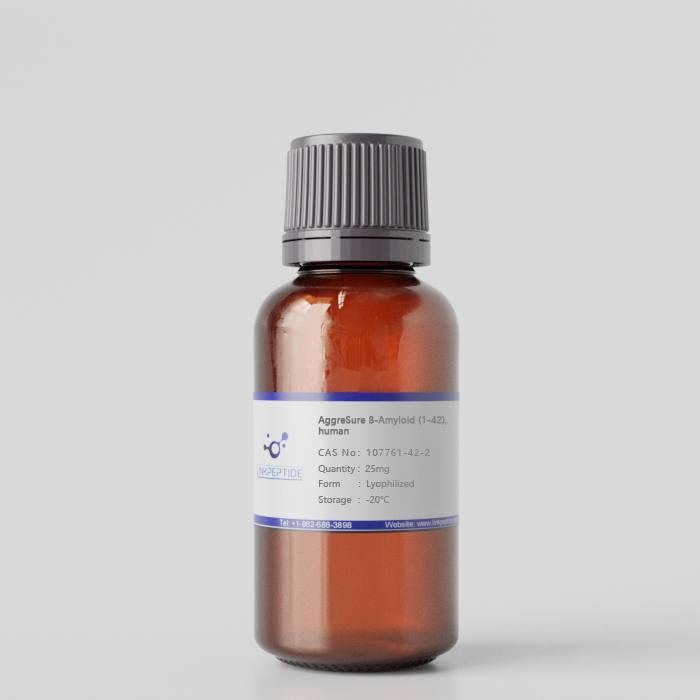
Product Name: AggreSure ß-Amyloid (1-42), human
Sequence One Letter Code: DAEFRHDSGYEVHHQKLVFFAEDVGSNKGAIIGLMVGGVVIA
Sequence Three Letter Code: H-Asp-Ala-Glu-Phe-Arg-His-Asp-Ser-Gly-Tyr-Glu-Val-His-His-Gln-Lys-Leu-Val-Phe-Phe-Ala-Glu-Asp-Val-Gly-Ser-Asn-Lys-Gly-Ala-Ile-Ile-Gly-Leu-Met-Val-Gly-Gly-Val-Val-Ile-Ala-OH
Cas No: 107761-42-2
Chemical Formula:C203H311N55O60S
Molecular Weight: 4514.4
Purity: 95%
Form: Lyophilized
Storage Conditions: Store at -20°C. Do not freeze-thaw reconstituted peptide.
Research Area: Cancer Disease Research
SMILES: CC[C@H](C)[C@@H](C(=O)N[C@@H]([C@@H](C)CC)C(=O)NCC(=O)N[C@@H](CC(C)C)C(=O)N[C@@H](CCSC)C(=O)N[C@@H](C(C)C)C(=O)NCC(=O)NCC(=O)N[C@@H](C(C)C)C(=O)N[C@@H](C(C)C)C(=O)N[C@@H]([C@@H](C)CC)C(=O)N[C@@H](C)C(=O)O)NC(=O)[C@H](C)NC(=O)CNC(=O)[C@H](CCCCN)NC(=O)[C@H](CC(=O)N)NC(=O)[C@H](CO)NC(=O)CNC(=O)[C@H](C(C)C)NC(=O)[C@H](CC(=O)O)NC(=O)[C@H](CCC(=O)O)NC(=O)[C@H](C)NC(=O)[C@H](CC1=CC=CC=C1)NC(=O)[C@H](CC2=CC=CC=C2)NC(=O)[C@H](C(C)C)NC(=O)[C@H](CC(C)C)NC(=O)[C@H](CCCCN)NC(=O)[C@H](CCC(=O)N)NC(=O)[C@H](CC3=CNC=N3)NC(=O)[C@H](CC4=CNC=N4)NC(=O)[C@H](C(C)C)NC(=O)[C@H](CCC(=O)O)NC(=O)[C@H](CC5=CC=C(C=C5)O)NC(=O)CNC(=O)[C@H](CO)NC(=O)[C@H](CC(=O)O)NC(=O)[C@H](CC6=CNC=N6)NC(=O)[C@H](CCCNC(=N)N)NC(=O)[C@H](CC7=CC=CC=C7)NC(=O)[C@H](CCC(=O)O)NC(=O)[C@H](C)NC(=O)[C@H](CC(=O)O)N
IUPAC: (4S)-5-[[(2S)-1-[[(2S)-1-[[(2S)-1-[[(2S)-1-[[(2S)-1-[[2-[[(2S)-1-[[(2S)-1-[[(2S)-1-[[(2S)-1-[[(2S)-1-[[(2S)-5-amino-1-[[(2S)-6-amino-1-[[(2S)-1-[[(2S)-1-[[(2S)-1-[[(2S)-1-[[(2S)-1-[[(2S)-1-[[(2S)-1-[[(2S)-1-[[2-[[(2S)-1-[[(2S)-4-amino-1-[[(2S)-6-amino-1-[[2-[[(2S)-1-[[(2S,3S)-1-[[(2S,3S)-1-[[2-[[(2S)-1-[[(2S)-1-[[(2S)-1-[[2-[[2-[[(2S)-1-[[(2S)-1-[[(2S,3S)-1-[[(1S)-1-carboxyethyl]amino]-3-methyl-1-oxopentan-2-yl]amino]-3-methyl-1-oxobutan-2-yl]amino]-3-methyl-1-oxobutan-2-yl]amino]-2-oxoethyl]amino]-2-oxoethyl]amino]-3-methyl-1-oxobutan-2-yl]amino]-4-methylsulfanyl-1-oxobutan-2-yl]amino]-4-methyl-1-oxopentan-2-yl]amino]-2-oxoethyl]amino]-3-methyl-1-oxopentan-2-yl]amino]-3-methyl-1-oxopentan-2-yl]amino]-1-oxopropan-2-yl]amino]-2-oxoethyl]amino]-1-oxohexan-2-yl]amino]-1,4-dioxobutan-2-yl]amino]-3-hydroxy-1-oxopropan-2-yl]amino]-2-oxoethyl]amino]-3-methyl-1-oxobutan-2-yl]amino]-3-carboxy-1-oxopropan-2-yl]amino]-4-carboxy-1-oxobutan-2-yl]amino]-1-oxopropan-2-yl]amino]-1-oxo-3-phenylpropan-2-yl]amino]-1-oxo-3-phenylpropan-2-yl]amino]-3-methyl-1-oxobutan-2-yl]amino]-4-methyl-1-oxopentan-2-yl]amino]-1-oxohexan-2-yl]amino]-1,5-dioxopentan-2-yl]amino]-3-(1H-imidazol-4-yl)-1-oxopropan-2-yl]amino]-3-(1H-imidazol-4-yl)-1-oxopropan-2-yl]amino]-3-methyl-1-oxobutan-2-yl]amino]-4-carboxy-1-oxobutan-2-yl]amino]-3-(4-hydroxyphenyl)-1-oxopropan-2-yl]amino]-2-oxoethyl]amino]-3-hydroxy-1-oxopropan-2-yl]amino]-3-carboxy-1-oxopropan-2-yl]amino]-3-(1H-imidazol-4-yl)-1-oxopropan-2-yl]amino]-5-carbamimidamido-1-oxopentan-2-yl]amino]-1-oxo-3-phenylpropan-2-yl]amino]-4-[[(2S)-2-[[(2S)-2-amino-3-carboxypropanoyl]amino]propanoyl]amino]-5-oxopentanoic acid
INCHIKEY: DZHSAHHDTRWUTF-SIQRNXPUSA-N
INCHI:
InChI=1S/C203H311N55O60S/c1-28-106(20)164(195(310)220-91-149(267)228-130(71-98(4)5)181(296)238-129(66-70-319-27)179(294)251-158(100(8)9)193(308)218-87-146(264)215-88-151(269)250-160(102(12)13)198(313)255-163(105(18)19)199(314)258-165(107(21)29-2)200(315)227-112(26)202(317)318)257-201(316)166(108(22)30-3)256-169(284)109(23)224-147(265)89-216-171(286)122(51-40-42-67-204)233-188(303)139(81-145(208)263)244-192(307)143(94-260)230-150(268)92-219-194(309)159(101(10)11)252-191(306)141(83-157(280)281)245-177(292)127(60-64-153(272)273)232-168(283)111(25)226-180(295)133(73-113-45-34-31-35-46-113)241-184(299)135(75-115-49-38-33-39-50-115)247-196(311)162(104(16)17)254-190(305)131(72-99(6)7)239-173(288)123(52-41-43-68-205)234-175(290)125(58-62-144(207)262)236-185(300)136(77-117-84-211-95-221-117)243-187(302)138(79-119-86-213-97-223-119)248-197(312)161(103(14)15)253-178(293)128(61-65-154(274)275)237-182(297)132(76-116-54-56-120(261)57-55-116)229-148(266)90-217-172(287)142(93-259)249-189(304)140(82-156(278)279)246-186(301)137(78-118-85-212-96-222-118)242-174(289)124(53-44-69-214-203(209)210)235-183(298)134(74-114-47-36-32-37-48-114)240-176(291)126(59-63-152(270)271)231-167(282)110(24)225-170(285)121(206)80-155(276)277/h31-39,45-50,54-57,84-86,95-112,121-143,158-166,259-261H,28-30,40-44,51-53,58-83,87-94,204-206H2,1-27H3,(H2,207,262)(H2,208,263)(H,211,221)(H,212,222)(H,213,223)(H,215,264)(H,216,286)(H,217,287)(H,218,308)(H,219,309)(H,220,310)(H,224,265)(H,225,285)(H,226,295)(H,227,315)(H,228,267)(H,229,266)(H,230,268)(H,231,282)(H,232,283)(H,233,303)(H,234,290)(H,235,298)(H,236,300)(H,237,297)(H,238,296)(H,239,288)(H,240,291)(H,241,299)(H,242,289)(H,243,302)(H,244,307)(H,245,292)(H,246,301)(H,247,311)(H,248,312)(H,249,304)(H,250,269)(H,251,294)(H,252,306)(H,253,293)(H,254,305)(H,255,313)(H,256,284)(H,257,316)(H,258,314)(H,270,271)(H,272,273)(H,274,275)(H,276,277)(H,278,279)(H,280,281)(H,317,318)(H4,209,210,214)/t106-,107-,108-,109-,110-,111-,112-,121-,122-,123-,124-,125-,126-,127-,128-,129-,130-,131-,132-,133-,134-,135-,136-,137-,138-,139-,140-,141-,142-,143-,158-,159-,160-,161-,162-,163-,164-,165-,166-/m0/s1
Source / Species: human
Conjugation: Unconjugated
Code Nacres: NA.26
Application: AggreSure™ β-Amyloid (1–42), human is a pretreated synthetic peptide corresponding to the full-length Aβ(1–42) sequence implicated in Alzheimer’s disease pathology. This preparation is specifically processed and quality-tested to ensure reproducible aggregation behavior, with validation performed using the SensoLyte® ThT Aβ42 Aggregation Assay. Aβ(1–42) forms oligomers and fibrillar aggregates that model amyloid plaque formation, neurotoxicity, and protein misfolding mechanisms in neurodegenerative research. This product supports aggregation kinetics studies, inhibitor screening, and therapeutic development targeting amyloid formation. Designed for experimental consistency, AggreSure™ Aβ(1–42) enables reliable in vitro modeling of Alzheimer’s disease–related amyloidogenesis and neurodegeneration pathways.
Current Research: Aggregation of β-amyloid (Aβ) peptides, particularly Aβ(1–42), remains a central focus in Alzheimer’s disease (AD) research due to its strong propensity to form neurotoxic oligomers and fibrillar assemblies. Compared with Aβ(1–40), the 42-residue isoform exhibits increased hydrophobicity and enhanced aggregation kinetics, favoring formation of soluble oligomers widely considered primary mediators of synaptic dysfunction and neuronal toxicity. As a result, reproducible preparation of Aβ(1–42) is critical for generating reliable experimental models. AggreSure™ β-Amyloid (1–42) is specifically pretreated and quality-validated to ensure consistent aggregation behavior, minimizing batch-to-batch variability that commonly affects amyloid studies. Validation using the SensoLyte® ThT Aβ42 Aggregation Assay confirms predictable fibrillogenesis profiles, enabling standardized kinetic analyses. Such reproducibility is particularly important in time-course aggregation assays, where lag phase duration, elongation rate, and plateau formation are key experimental parameters. Current research increasingly distinguishes between monomeric, oligomeric, and fibrillar Aβ species, as each form exhibits distinct structural and toxicological properties. Controlled aggregation of Aβ(1–42) enables investigation of early oligomer formation, membrane interaction, calcium dysregulation, and synaptic impairment. AggreSure™ Aβ(1–42) supports studies examining conformational transitions, β-sheet formation, and nucleation-dependent polymerization mechanisms using biophysical techniques such as ThT fluorescence, circular dichroism spectroscopy, electron microscopy, and atomic force microscopy. In drug discovery, standardized Aβ(1–42) preparations are essential for screening small molecules, antibodies, and peptide inhibitors targeting amyloid formation or promoting aggregate clearance. Reproducible aggregation kinetics allow accurate comparison of compound efficacy across experimental platforms. Additionally, therapeutic strategies aimed at destabilizing oligomers or preventing fibril elongation rely on consistent baseline aggregation profiles to evaluate inhibitory potency. Beyond aggregation studies, Aβ(1–42) is widely applied in cell-based assays modeling AD-related neurotoxicity. Aggregated preparations are used to assess mitochondrial dysfunction, oxidative stress, inflammatory activation of microglia, and synaptic protein loss. Reliable peptide quality is critical for correlating structural species with biological outcomes and for reducing experimental variability in neurodegeneration models. Advances in structural biology and computational modeling further underscore the importance of defined amyloid preparations. Molecular simulations and structural analyses of oligomeric assemblies depend on well-characterized starting materials to interpret conformational landscapes and toxic interfaces. In parallel, biomarker research exploring Aβ aggregation states in cerebrospinal fluid and plasma benefits from in vitro standards that reflect physiologically relevant aggregation behavior. Collectively, current Alzheimer’s disease research emphasizes the need for experimentally consistent Aβ(1–42) preparations to ensure reproducibility across aggregation, toxicity, and therapeutic screening studies. AggreSure™ β-Amyloid (1–42), human provides a validated and reliable platform for investigating amyloidogenesis, structure–toxicity relationships, and the development of interventions targeting protein misfolding and neurodegeneration pathways.
Get a Quote
 LinkPeptide