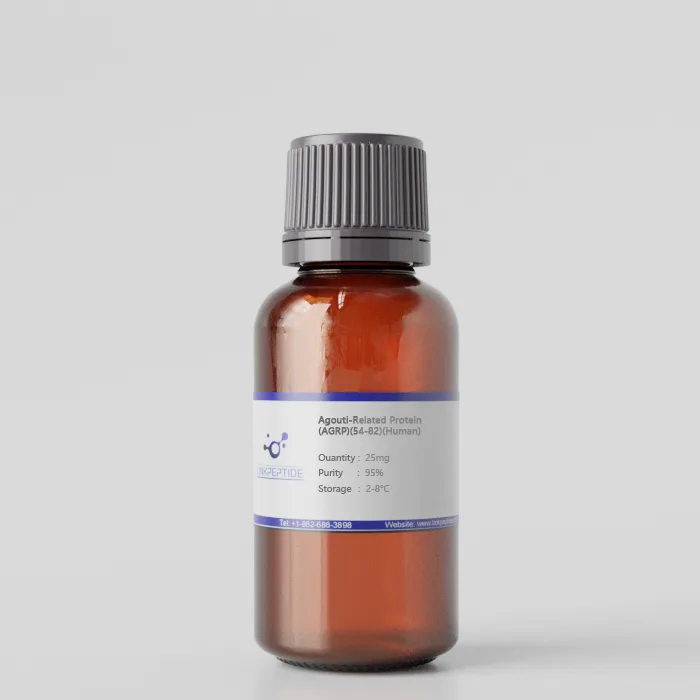
Product Name:Agouti-Related Protein (AGRP)(54-82)(Human)
Form:TFA salt
Purity:95%
Storage:2-8 degree Celsius
Molar Mass:3282.5
Chemical Formula:C137H225N39O54
Sequence:Thr-Thr-Ala-Glu-Gln-Ala-Glu-Glu-Asp-Leu-Leu-Gln-Glu-Ala-Gln-Ala-Leu-Ala-Glu-Val-Leu-Asp-Leu-Gln-Asp-Arg-Glu-Pro-Arg
Application:Agouti-Related Protein (AGRP)(54-82) (Human) is a bioactive peptide fragment of AGRP, a key neuropeptide antagonist of melanocortin receptors (MC3R and MC4R) involved in energy homeostasis, appetite regulation, and metabolism. AGRP(54-82) functions as an inverse agonist, inhibiting melanocortin signaling in the hypothalamic appetite control system, leading to increased food intake and weight gain. It plays a crucial role in obesity, metabolic disorders, and neuroendocrine research. This peptide is widely used in studies on appetite regulation, energy balance, and potential therapeutic interventions targeting melanocortin pathways for obesity, cachexia, and metabolic syndrome.
Current Research:
Agouti-Related Protein (AGRP)(54-82) is a functional peptide fragment of AGRP, a neuropeptide that plays a major role in appetite regulation, metabolic homeostasis, and energy expenditure. AGRP is primarily produced in the arcuate nucleus of the hypothalamus and acts as a competitive antagonist and inverse agonist at melanocortin receptors MC3R and MC4R, counteracting the effects of α-MSH (alpha-melanocyte-stimulating hormone).
Increased appetite (hyperphagia) by suppressing melanocortin-induced satiety signals.
Reduced energy expenditure, contributing to long-term metabolic regulation.
Neuroendocrine adaptations, ensuring energy conservation under fasting or caloric restriction.
Research shows that AGRP levels are upregulated during fasting, promoting hunger and energy storage, while MC4R activation suppresses food intake. AGRP(54-82) is widely used in studies on obesity, cachexia, and metabolic disorders to evaluate appetite-modulating mechanisms.
Obesity, where AGRP overexpression contributes to excessive food intake and weight gain.
Anorexia and cachexia, where AGRP suppression leads to reduced appetite and weight loss.
Metabolic syndrome, where AGRP-mediated effects on MC4R influence insulin sensitivity and lipid metabolism.
Studies using AGRP(54-82) have explored MC4R-targeted drugs for obesity treatments, including MC4R agonists that counteract AGRP-induced hyperphagia.
Corticotropin-releasing hormone (CRH) pathways, linking stress and appetite regulation.
Leptin and ghrelin signaling, where leptin inhibits AGRP expression, while ghrelin stimulates it.
Research suggests that AGRP antagonists may have therapeutic potential in treating stress-induced overeating and metabolic dysregulation.
MC4R-targeted obesity treatments to counteract AGRP-induced hyperphagia.
Cachexia therapies, where AGRP modulation may prevent excessive weight loss in cancer and chronic illness.
Metabolic disease research, evaluating AGRP’s role in insulin resistance and lipid metabolism disorders.
Conclusion
Agouti-Related Protein (AGRP)(54-82) (Human) is a critical peptide for understanding appetite regulation, obesity, and metabolic disorders. Its role in melanocortin receptor signaling makes it a key target in neuroendocrine, metabolic, and pharmaceutical research, with ongoing studies exploring its therapeutic potential for appetite modulation and metabolic disease management.
Get a Quote
 LinkPeptide