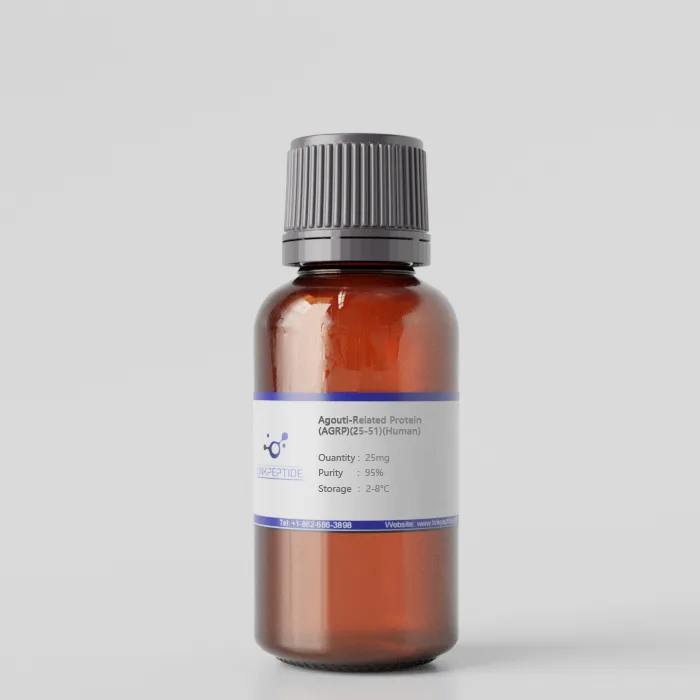
Product Name:Agouti-Related Protein (AGRP)(25-51)(Human)
Form:TFA salt
Purity:95%
Storage:2-8 degree Celsius
Molar Mass:2894.5
Chemical Formula:C130H221N37O35S1
Sequence:Leu-Ala-Pro-Met-Glu-Gly-Ile-Arg-Arg-Pro-Asp-Gln-Ala-Leu-Leu-Pro-Glu-Leu-Pro-Gly-Leu-Gly-Leu-Arg-Ala-Pro-Leu
Application:Agouti-Related Protein (AGRP)(25-51) (Human) is a peptide fragment derived from AGRP, a key neuropeptide involved in appetite regulation, energy balance, and metabolic control. AGRP functions as an inverse agonist and competitive antagonist of melanocortin receptors (MC3R and MC4R), counteracting α-MSH (alpha-melanocyte-stimulating hormone) to promote food intake and weight gain. The AGRP(25-51) fragment retains functional properties important in neuropeptide signaling and metabolic research. It is widely studied in obesity, cachexia, and metabolic syndrome research, with applications in understanding appetite regulation, hypothalamic signaling, and melanocortin receptor-targeted drug development.
Current Research:
Agouti-Related Protein (AGRP)(25-51) is a biologically active fragment of AGRP, a neuropeptide secreted by neurons in the arcuate nucleus of the hypothalamus that plays a major role in appetite control, energy homeostasis, and metabolic regulation. AGRP exerts its effects by acting as an inverse agonist and antagonist at melanocortin receptors MC3R and MC4R, counteracting the anorexigenic (appetite-suppressing) effects of α-MSH.
Increased feeding behavior by inhibiting MC4R activity.
Reduction in energy expenditure, promoting energy conservation during fasting or starvation.
Enhanced ghrelin-induced hunger response, suggesting a role in neuroendocrine control.
Research indicates that AGRP(25-51) plays a critical role in neurotransmission related to feeding cues and may serve as a potential target for treating metabolic disorders and eating behaviors.
Obesity, where AGRP overexpression leads to hyperphagia (excessive food intake) and weight gain.
Cachexia and anorexia, where decreased AGRP levels contribute to reduced appetite and weight loss.
Metabolic syndrome, with AGRP-mediated effects on glucose homeostasis, insulin sensitivity, and lipid metabolism.
Studies have focused on MC4R-targeted therapies aimed at counteracting AGRP-induced appetite stimulation to develop anti-obesity treatments.
Leptin, which suppresses AGRP expression, reducing hunger.
Ghrelin, which stimulates AGRP production, increasing food intake.
Corticotropin-releasing hormone (CRH), linking stress responses to appetite regulation.
These interactions suggest that AGRP(25-51) plays a role in stress-induced eating behaviors and metabolic adaptation to nutritional deficiencies.
Obesity treatments, targeting MC4R to suppress AGRP’s effects.
Cachexia and anorexia therapy, where AGRP modulation could prevent excessive weight loss in cancer and chronic disease patients.
Neuropeptide-based drug development, focusing on melanocortin receptor modulation for metabolic diseases.
Conclusion
Agouti-Related Protein (AGRP)(25-51) (Human) is a critical peptide fragment for studying appetite control, energy regulation, and metabolic disorders. Its role in melanocortin receptor signaling makes it a valuable research tool in obesity, cachexia, and neuroendocrine function studies, contributing to therapeutic advancements in metabolic disease management.
Get a Quote
 LinkPeptide