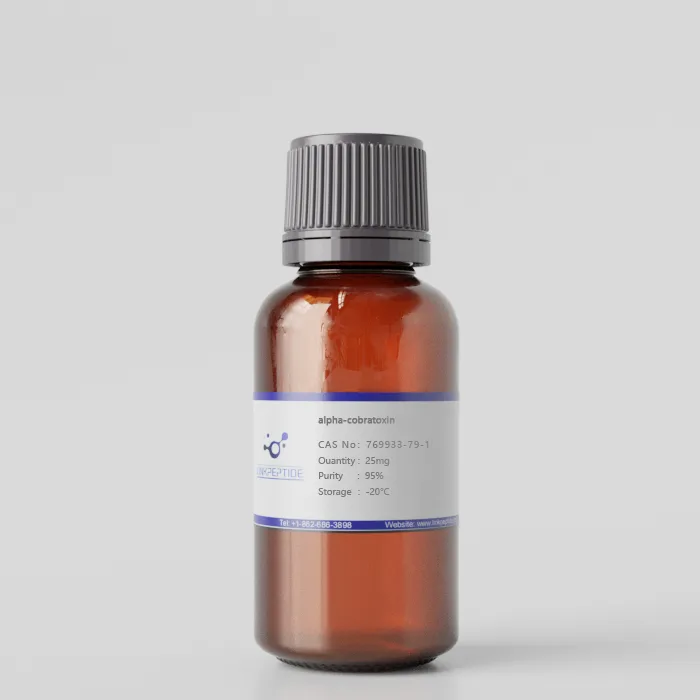
Product Name:alpha-cobratoxin
CAS No:769933-79-1
Purity:95%
Molar Mass:7820.93
Chemical Formula:C332H520N98O101S10
Storage:Store at -20 degrees Celsius
Sequence:IRCFITPDITSKDCPNGHVCYTKTWCDAFCSIRGKRVDLGCAATCPTVKTGVDIQCCSTDNCNPFPTRKRP
Application:Alpha-cobratoxin, derived from the venom of the cobra Naja kaouthia, is a potent neurotoxin that selectively binds to nicotinic acetylcholine receptors (nAChRs). By blocking these receptors, particularly the muscle-type nAChRs with the ??1 subunit, alpha-cobratoxin prevents acetylcholine from activating them, leading to neuromuscular paralysis. This highly specific action makes it a valuable tool in research focused on understanding nAChR function, receptor-ligand interactions, and neuromuscular transmission. It is also used to explore therapeutic interventions for diseases associated with cholinergic signaling, such as myasthenia gravis and neurodegenerative disorders. Alpha-cobratoxin plays a key role in advancing neurotoxin research.
Current Research:
??-Cobratoxin is a potent neurotoxin found in the venom of certain cobra species, including the Thailand cobra (Naja kaouthia), the Indochinese spitting cobra (Naja siamensis), and the Chinese cobra (Naja atra). These cobras inhabit tropical and subtropical regions across Africa and Asia.
Structural Characteristics
Belonging to the three-finger toxin family, ??-cobratoxin comprises approximately 71 amino acids and features a compact structure stabilized by multiple disulfide bonds. This configuration is essential for its high affinity and specificity toward nicotinic acetylcholine receptors (nAChRs).
Mechanism of Action
??-Cobratoxin functions as a competitive antagonist of nAChRs, particularly those at the neuromuscular junction. By binding to these receptors, it prevents acetylcholine from attaching, thereby inhibiting synaptic transmission. This blockade leads to muscle paralysis and can result in respiratory failure if not promptly addressed.
Toxicity Profile
The median lethal dose (LD??) of ??-cobratoxin varies depending on the route of administration and the animal model used. In mice, the LD?? is approximately 4 ??g/kg when administered intravenously. Envenomation in humans can cause symptoms ranging from localized pain and swelling to systemic effects such as drowsiness, hypotension, and, in severe cases, paralysis leading to respiratory failure.
Research Applications
Due to its specificity for nAChRs, ??-cobratoxin is a valuable tool in neuropharmacological research:
Receptor Characterization: It aids in studying the structural and functional properties of nAChRs, enhancing our understanding of synaptic transmission mechanisms.
Drug Development: Insights into its interaction with nAChRs contribute to the design of novel therapeutics for neuromuscular disorders and conditions involving dysfunctional cholinergic signaling.
Therapeutic Potential
Beyond its toxic effects, ??-cobratoxin has been investigated for potential therapeutic applications. Studies have explored its analgesic properties in rodent pain models, suggesting that it may modulate pain pathways. However, its clinical use requires careful consideration due to its potent neurotoxicity.
Conclusion
??-Cobratoxin is a potent neurotoxin that selectively inhibits nAChRs, providing significant insights into neuromuscular transmission and potential therapeutic avenues for related disorders. Its applications extend from fundamental research to the development of novel pharmacological agents.
Reference:
Get a Quote
 LinkPeptide