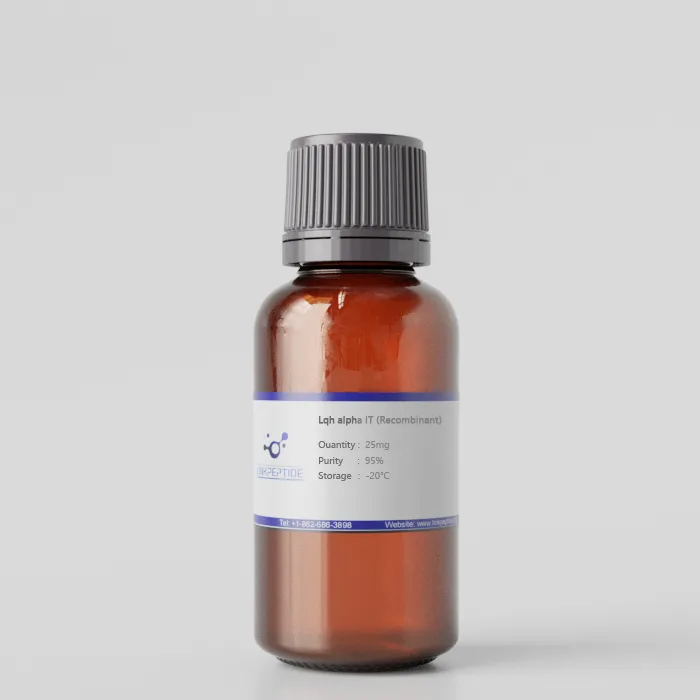
Product Name:Lqh alpha IT (Recombinant)
Synonyms:CHARYBDOTOXIN
Purity:95%
Molar Mass:4296
Chemical Formula:C176H277N57O55S7
Storage:Store at -20 degrees Celsius
Sequence:XFTNVSCTTSKECWSVCQRLHNTSRGKCMNKKCRCYS
Target:Nav
Application:
Lqh αIT (Recombinant) is a neurotoxin derived from the venom of the deathstalker scorpion (Leiurus quinquestriatus hebraeus) and is specifically engineered to target insect voltage-gated sodium channels (Nav). By binding to these channels, it prolongs their inactivation phase, leading to sustained depolarization and paralysis in insects. This recombinant toxin is widely used in research to investigate sodium channel function, neurotoxicity mechanisms, and to develop novel insecticides. Its high specificity and effectiveness make Lqh αIT an essential tool for studying sodium channel dynamics and exploring potential applications in pest control and neurobiological research.
Current Research:
LqhαIT, also known as alpha-insect toxin LqhαIT, is a 66-amino acid peptide derived from the venom of the scorpion Leiurus quinquestriatus hebraeus. This recombinant toxin is classified as an alpha-insect toxin due to its specific action on voltage-gated sodium (Nav) channels in insects. It functions by binding to receptor site-3 on these channels, inhibiting the inactivation process and thereby prolonging the action potential. This mechanism leads to sustained neuronal firing, ultimately causing paralysis in affected insects.
The structural integrity of LqhαIT is maintained by four disulfide bridges, which stabilize its three-dimensional conformation. This stability is crucial for its interaction with sodium channels. Recombinant production of LqhαIT in Escherichia coli has facilitated detailed studies of its structure and function. Notably, the solution structure of recombinant LqhαIT was determined using proton two-dimensional nuclear magnetic resonance spectroscopy (2D NMR), providing insights into its conformational features.
Biologically, LqhαIT exhibits high toxicity to insects, making it a valuable tool for studying insect Nav channels. It also shows significant toxicity in mammalian models when administered subcutaneously, though its effects are markedly reduced when delivered intracerebroventricularly. This differential toxicity underscores its potential for selective targeting in pest control applications.
In research settings, LqhαIT serves as a marker for receptor site-3 on both insect and mammalian sodium channels. Its ability to modulate sodium channel activity has made it instrumental in elucidating the physiological roles of these channels and in the development of insecticides that exploit this mechanism.
In summary, LqhαIT is a potent scorpion alpha-insect toxin that prolongs action potentials by inhibiting sodium current inactivation. Its specificity and efficacy in targeting sodium channels render it a significant subject of study in neurophysiology and a potential candidate for developing novel insecticidal agents.
Reference:
Get a Quote
 LinkPeptide

![[Nphe1]Nociceptin(1-13)NH2](https://www.linkpeptide.com/wp-content/uploads/2024/10/Nphe1Nociceptin1-13NH2-jpg-3.webp "[Nphe1]Nociceptin(1-13)NH2")
![LEIUROTOXIN I [R7]-](https://www.linkpeptide.com/wp-content/uploads/2024/10/LEIUROTOXIN-I-R7-jpg-2.webp "LEIUROTOXIN I [R7]-")