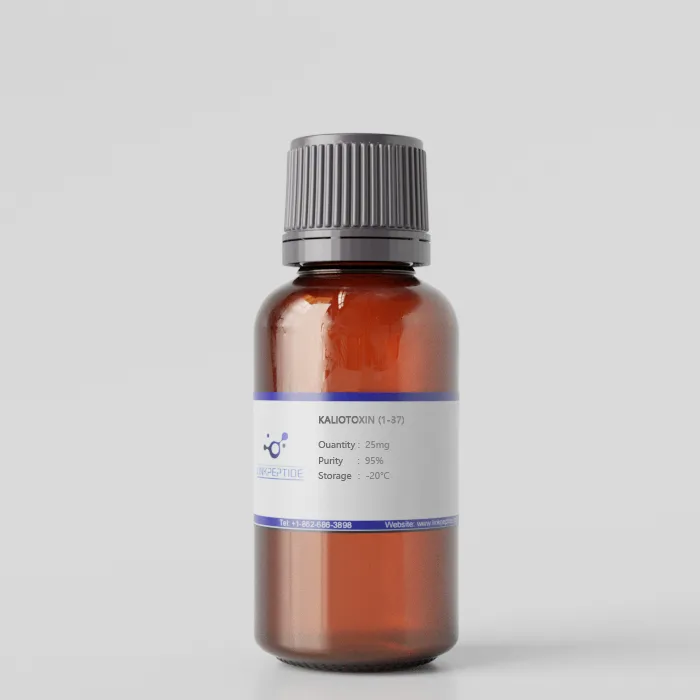
Product Name:KALIOTOXIN (1-37)
Purity:95%
Molar Mass:4018.82
Chemical Formula:C165H271N53O48S8
Storage:Store at -20 degrees Celsius
Sequence:GVEINVKCSGSPQCLKPCKDAGMRFGKCMNRKCHCTP
Application:
Kaliotoxin (1-37) is a potent peptide derived from the venom of the scorpion Androctonus mauritanicus. This toxin specifically targets voltage-gated potassium channels, particularly Kv1.1 and Kv1.3, and inhibits their activity. Its ability to block these channels makes Kaliotoxin (1-37) a valuable tool in neurophysiological research, especially in the study of potassium channel function and its role in various neurological disorders. Additionally, it is used in immunological studies due to its effects on immune cells that rely on potassium channels. With its high purity and stability, Kaliotoxin (1-37) is essential for advanced research in neurobiology and immunology.
Current Research:
Kaliotoxin (1-37) is a 37-amino acid peptide toxin isolated from the venom of the scorpion Androctonus mauritanicus. This short-chain toxin is a member of the alpha-KTx family, which specifically targets voltage-gated potassium (Kv) channels. Kaliotoxin (1-37) plays a pivotal role in neurophysiology research due to its high specificity and potent inhibitory activity.
Mechanism of Action
Kaliotoxin (1-37) selectively binds to Kv1.1 and Kv1.3 channels in neuronal and immune cells. By blocking these channels, it inhibits potassium ion conductance, which disrupts the cell's resting membrane potential and action potential repolarization. This action has significant effects on neuronal excitability, signal transmission, and T-cell activation, making it a critical tool for studying these processes.
Applications in Research
Neurophysiology: Kaliotoxin (1-37) is widely used to study Kv channel function in regulating neuronal signaling and excitability. Its specificity enables detailed examination of Kv1.1 and Kv1.3 channel contributions to synaptic transmission and nerve impulse propagation.
Immunology: In T-cell research, Kv1.3 channels are critical for calcium signaling and activation. Kaliotoxin (1-37) provides insights into immune cell regulation, offering potential applications in autoimmune disease research and immunomodulation.
Drug Development: The toxin serves as a template for designing Kv channel inhibitors with therapeutic potential, particularly in conditions like multiple sclerosis, rheumatoid arthritis, and chronic pain, where Kv1.3 channels are implicated.
Structural Insights
The structure of Kaliotoxin (1-37) is stabilized by disulfide bridges, forming a compact and rigid conformation. This stability enhances its binding affinity and selectivity for Kv channels, ensuring effective blockade in experimental systems.
Conclusion
Kaliotoxin (1-37) is a powerful and precise tool for exploring the roles of potassium channels in neuronal and immune cell physiology. Its contributions to neurobiology and immunology research underline its significance as a model peptide for channel-targeted therapeutic development.
Reference:
Get a Quote
 LinkPeptide

![LEIUROTOXIN I [R7]-](https://www.linkpeptide.com/wp-content/uploads/2024/10/LEIUROTOXIN-I-R7-jpg-2.webp "LEIUROTOXIN I [R7]-")