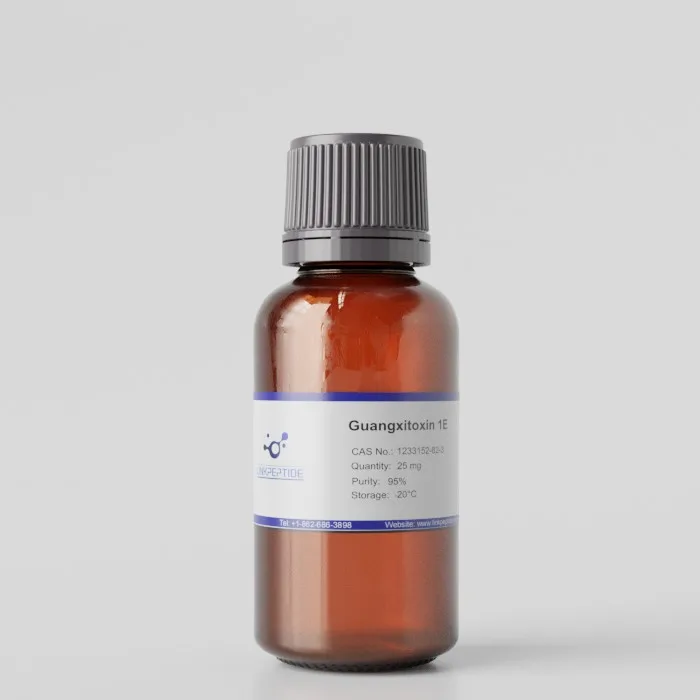
Product Name: Guangxitoxin 1E
CAS No: 1233152-82-3
Purity: 95%
Molar Mass: 3948.6
Chemical Formula: C178H248N44O45S7
Storage: Store at -20 degrees Celsius
Sequence: EGECGGFWWKCGSGKPACCPKYVCSPKWGLCNFPMP
Target: KV2.1 and KV2.2 channels
Application:
Guangxitoxin 1E is a peptide toxin derived from the venom of the Chinese tarantula, Plesiophrictus guangxiensis. It acts as a potent inhibitor of voltage-gated potassium channels (Kv2.1), affecting neuronal excitability and synaptic transmission. By blocking these channels, Guangxitoxin 1E can modulate action potential duration and neurotransmitter release, making it a valuable tool in neurophysiological studies. This peptide is useful in research focused on understanding potassium channel functions, neurodegenerative diseases, and the development of new therapeutic strategies for conditions like epilepsy and chronic pain. Its specific action on Kv2.1 channels highlights its importance in both basic and applied neuroscience.
Current Research:
Guangxitoxin-1E (GxTx-1E) is a peptide toxin derived from the venom of the tarantula Plesiophrictus guangxiensis. It functions as a potent gating modifier of voltage-gated potassium (Kv) channels, particularly Kv2.1 and Kv2.2, with high affinity. This specificity has made GxTx-1E a valuable tool in neurophysiological research and a potential candidate for therapeutic applications.
Mechanism of Action
GxTx-1E binds to the voltage-sensing domains of Kv2.1 and Kv2.2 channels, altering their gating properties. This interaction shifts the voltage dependence of channel activation toward more depolarized potentials, effectively inhibiting channel opening at physiological membrane voltages. The toxin stabilizes the closed state of the channel, thereby reducing potassium ion conductance and modulating neuronal excitability.
Applications in Research
Neurophysiology: GxTx-1E is utilized to study the functional roles of Kv2 channels in neuronal excitability and signaling. By selectively inhibiting these channels, researchers can dissect their contributions to action potential dynamics and synaptic transmission.
Pancreatic β-Cell Function: Kv2.1 channels are expressed in pancreatic β-cells, where they influence insulin secretion. GxTx-1E has been shown to enhance glucose-stimulated insulin secretion by broadening action potentials and increasing calcium influx, providing insights into the regulation of insulin release.
Cardiac Electrophysiology: Investigations into the role of Kv2 channels in cardiac tissues have employed GxTx-1E to understand their impact on cardiac action potentials and arrhythmogenesis.
Therapeutic Potential
The ability of GxTx-1E to modulate Kv2 channel activity suggests potential therapeutic applications in conditions where altered neuronal excitability is implicated, such as epilepsy and neuropathic pain. Additionally, its effects on insulin secretion indicate possible relevance in diabetes research. However, further studies are necessary to evaluate its safety and efficacy in clinical settings.
Conclusion
Guangxitoxin-1E serves as a potent and selective inhibitor of Kv2.1 and Kv2.2 channels, offering valuable insights into their physiological and pathological roles. Its application in various research domains continues to advance our understanding of potassium channel function and holds promise for the development of novel therapeutic strategies.
Reference:
Get a Quote
 LinkPeptide