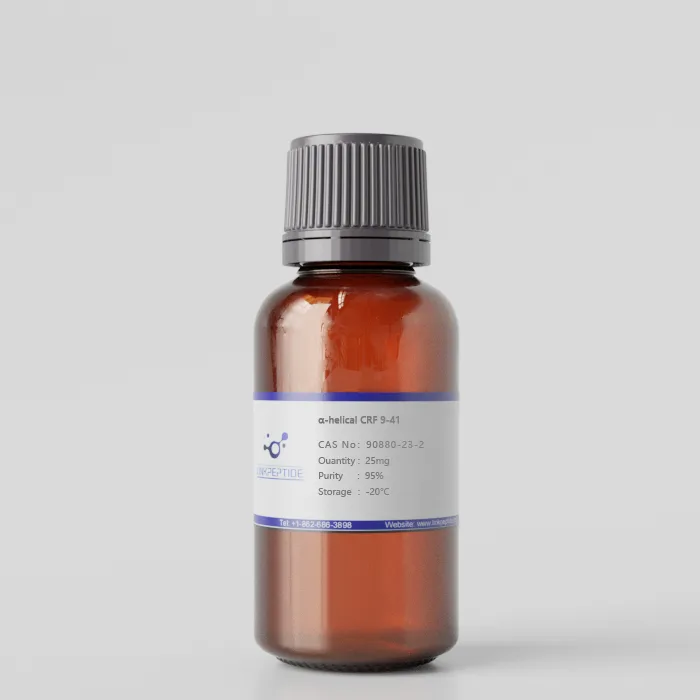
Product Name:α-helical CRF 9-41
CAS No:90880-23-2
Purity:95%
Molar Mass:3826.4
Chemical Formula:C166H274N46O53S2
Storage:Store at -20 degrees Celsius
Sequence:DLTFHLLREMLEMAKAEQEAEQAALNRLLLEEA
Application:
α-Helical CRF 9-41 is a synthetic analog of corticotropin-releasing factor (CRF), designed as a competitive antagonist that blocks the activity of CRF by binding to its receptors. This analog is modified to adopt an α-helical structure, enhancing its stability and binding affinity. Spanning amino acids 9 to 41 of the native CRF sequence, it effectively inhibits the stress-related responses mediated by CRF, including the release of adrenocorticotropic hormone (ACTH). α-Helical CRF 9-41 is widely used in research to study the role of CRF in stress, anxiety, and related disorders, offering insights into potential therapeutic strategies for stress-related conditions.
Current Research:
α-Helical CRF(9-41) is a synthetic peptide analog of corticotropin-releasing factor (CRF), encompassing amino acids 9 to 41 of the native CRF sequence. This analog is engineered to adopt an α-helical conformation, enhancing its stability and receptor-binding properties.
Receptor Interaction and Pharmacological Profile:
CRF₂ Receptor Antagonism: α-Helical CRF(9-41) functions as a competitive antagonist at CRF₂ receptors, with a binding affinity (K_B) of approximately 100 nM.
CRF₁ Receptor Partial Agonism: At CRF₁ receptors, it exhibits partial agonistic activity, characterized by an effective concentration (EC₅₀) of 140 nM.
Biological Implications:
The dual activity of α-Helical CRF(9-41) allows it to modulate the CRF signaling pathway intricately. By antagonizing CRF₂ receptors, it can inhibit CRF-mediated responses, such as stress-induced adrenocorticotropic hormone (ACTH) release. Conversely, its partial agonism at CRF₁ receptors enables it to partially activate these receptors, potentially modulating stress and anxiety-related behaviors.
Research Applications:
α-Helical CRF(9-41) serves as a valuable tool in neuroendocrinological research, particularly in studies exploring the CRF system's role in stress, anxiety, and depression. Its ability to differentially modulate CRF receptor subtypes makes it instrumental in dissecting the distinct functions of CRF₁ and CRF₂ receptors.
Storage and Handling:
For optimal stability, α-Helical CRF(9-41) should be stored desiccated at -20°C. Proper storage conditions are crucial to maintain its bioactivity for experimental applications.
Conclusion:
α-Helical CRF(9-41) is a potent modulator of the CRF signaling pathway, offering significant insights into the physiological and pathological processes mediated by CRF receptors. Its unique pharmacological profile continues to support advancements in understanding stress-related disorders and the development of targeted therapeutics.
Reference:
Get a Quote
 LinkPeptide