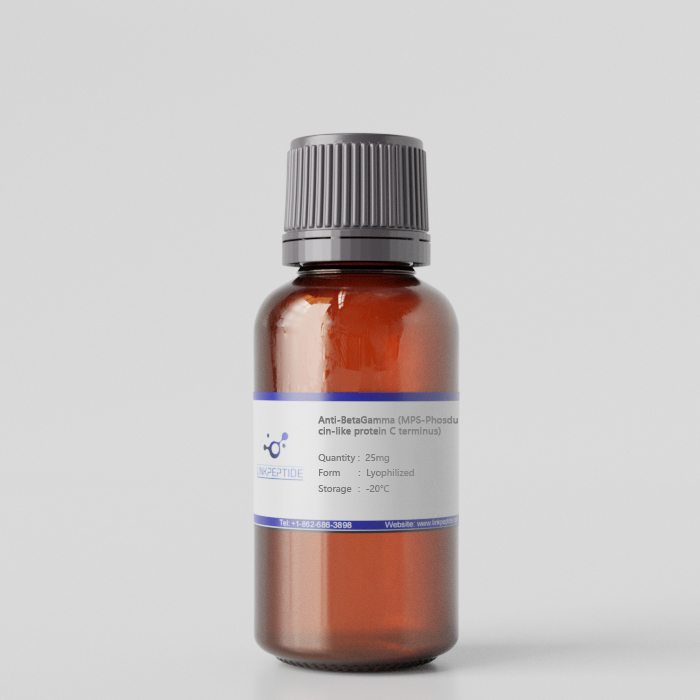
Product Name: Anti-BetaGamma (MPS-Phosducin-like protein C terminus)
Sequence One Letter Code: AAVALLPAVLLALLAVTDQLGEDFFAVDLEAFLQEFGLLPEKE
Sequence Three Letter Code: H-Ala-Ala-Val-Ala-Leu-Leu-Pro-Ala-Val-Leu-Leu-Ala-Leu-Leu-Ala-Val-Thr-Asp-Gln-Leu-Gly-Glu-Asp-Phe-Phe-Ala-Val-Asp-Leu-Glu-Ala-Phe-Leu-Gln-Glu-Phe-Gly-Leu-Leu-Pro-Glu-Lys-Glu-OH
Chemical Formula:C217H340N46O63
Molecular Weight: 4601.7
Purity: 95%
Form: Lyophilized
Storage Conditions: - 20 °C
Research Area: Peptide Series
Source / Species: mouse, rat
Conjugation: Unconjugated
Code Nacres: NA.26
Application: Anti-BetaGamma Peptide is a membrane-permeable peptide derived from the C-terminal region of phosducin-like protein, a regulator of heterotrimeric G-protein signaling. It selectively binds Gβγ subunits, disrupting their interaction with downstream effectors and inhibiting Gβγ-mediated signaling pathways. The peptide has been shown to suppress Go GTPase activity and reduce β-adrenergic receptor kinase–mediated phosphorylation of rhodopsin. By modulating G-protein signaling dynamics, it serves as a valuable tool for studying receptor desensitization, intracellular signaling pathways, and G-protein–coupled receptor function. It is widely used in pharmacological and signal transduction research.
Current Research: Anti-BetaGamma Peptide is a membrane-permeable synthetic peptide derived from the C-terminal region of phosducin-like protein (PhLP), a known regulator of heterotrimeric G-protein signaling. This peptide is specifically designed to bind Gβγ subunits, thereby disrupting their interaction with downstream effectors and modulating signaling cascades initiated by G protein–coupled receptors (GPCRs). Due to its selectivity and functional impact, Anti-BetaGamma Peptide is widely used as a molecular tool for dissecting Gβγ-dependent signaling pathways in pharmacological and cellular research. Gβγ Subunits in G-Protein Signaling Heterotrimeric G proteins consist of three subunits: Gα, Gβ, and Gγ. Upon activation of GPCRs: Gα exchanges GDP for GTP and dissociates from the Gβγ dimer Both Gα and Gβγ subunits independently regulate downstream effectors The Gβγ complex plays a crucial role in modulating: Ion channels Kinases such as β-adrenergic receptor kinase (βARK/GRK2) Phospholipase C (PLC) signaling Vesicular trafficking and cellular responses Targeting Gβγ provides a strategy to selectively influence signaling pathways without directly interfering with Gα activity. Mechanism of Action Anti-BetaGamma Peptide functions by binding directly to Gβγ subunits, preventing their interaction with effector proteins. This competitive inhibition results in: Disruption of Gβγ-mediated signaling cascades Reduction of downstream effector activation Selective modulation of GPCR signaling outputs Importantly, this approach allows researchers to isolate and study the specific contributions of Gβγ signaling within complex cellular pathways. Effects on G-Protein and Receptor Signaling Experimental studies have demonstrated that Anti-BetaGamma Peptide can: Suppress Go GTPase activity, indicating interference with G-protein cycling Reduce β-adrenergic receptor kinase (GRK2/βARK)-mediated phosphorylation of rhodopsin, highlighting its role in receptor regulation Inhibit receptor desensitization mechanisms, which are often mediated by Gβγ-dependent recruitment of kinases These effects make the peptide particularly valuable for studying signal attenuation and receptor regulation. Applications in GPCR and Signal Transduction Research Anti-BetaGamma Peptide is extensively used in studies focused on GPCR signaling dynamics and intracellular pathways. Its ability to selectively inhibit Gβγ interactions enables detailed mechanistic investigations. Common applications include: Dissection of Gβγ-dependent signaling pathways Studies of GPCR desensitization and resensitization Analysis of kinase recruitment and receptor phosphorylation Investigation of ion channel regulation by Gβγ Pharmacological studies targeting GPCR signaling components These applications are critical for understanding how cells process and regulate external signals. Role in Receptor Desensitization One important function of Gβγ subunits is the recruitment of G protein–coupled receptor kinases (GRKs), which phosphorylate activated receptors and initiate desensitization. By interfering with this process, Anti-BetaGamma Peptide allows researchers to: Examine the mechanisms of receptor downregulation Differentiate between Gα- and Gβγ-mediated effects Study temporal aspects of GPCR signaling This is particularly relevant in systems where receptor responsiveness changes dynamically over time. Advantages as a Research Tool Anti-BetaGamma Peptide offers several advantages for experimental use: Membrane permeability, enabling intracellular targeting Selective binding to Gβγ, minimizing off-target effects Reversible modulation of signaling pathways Compatibility with cellular and biochemical assays These properties make it a versatile reagent for both in vitro and cell-based studies. A Powerful Tool for Studying G-Protein Signaling Anti-BetaGamma Peptide provides a targeted approach to investigating the role of Gβγ subunits in GPCR-mediated signaling networks. By selectively disrupting Gβγ–effector interactions, it enables precise analysis of signaling pathways that are otherwise difficult to isolate. Its application continues to advance understanding of receptor regulation, intracellular signaling dynamics, and pharmacological modulation of GPCR systems, making it an essential tool in modern signal transduction research.
Get a Quote
 LinkPeptide