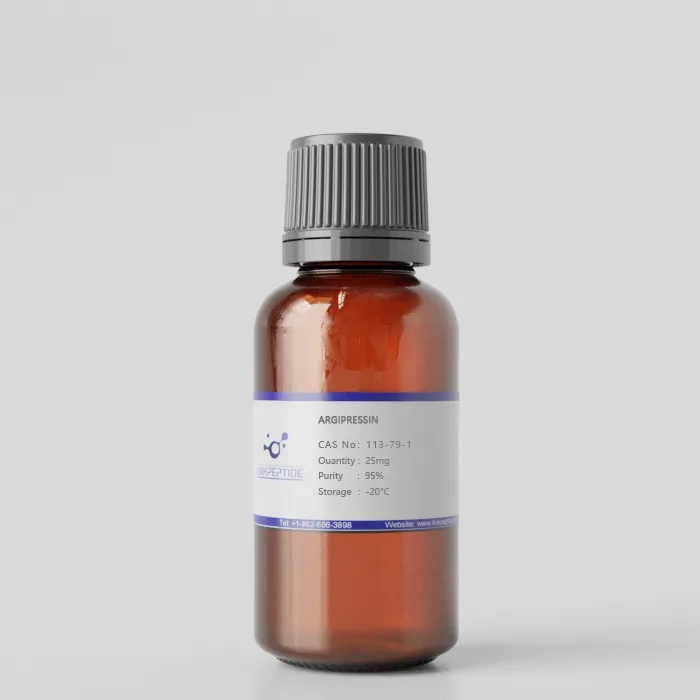
Product Name:ARGIPRESSIN
Form:Acetate salt
Purity:95%
Storage:-20oC
Cas No:113-79-1
Molar Mass:1084.2
Chemical Formula:C46H65N15O12S2
Synonyms:Arginine vasopressin
IUPAC Name:(2S)-1-[(4R,7S,10S,13S,16S,19R)-19-amino-7-(2-amino-2-oxoethyl)-10-(3-amino-3-oxopropyl)-13-benzyl-16-[(4-hydroxyphenyl)methyl]-6,9,12,15,18-pentaoxo-1,2-dithia-5,8,11,14,17-pentazacycloicosane-4-carbonyl]-N-[(2S)-1-[(2-amino-2-oxoethyl)amino]-5-(diaminomethylideneamino)-1-oxopentan-2-yl]pyrrolidine-2-carboxamide
SMILES:C1C[C@H](N(C1)C(=O)[C@@H]2CSSC[C@@H](C(=O)N[C@H](C(=O)N[C@H](C(=O)N[C@H](C(=O)N[C@H](C(=O)N2)CC(=O)N)CCC(=O)N)CC3=CC=CC=C3)CC4=CC=C(C=C4)O)N)C(=O)N[C@@H](CCCN=C(N)N)C(=O)NCC(=O)N
InChIKey:KBZOIRJILGZLEJ-LGYYRGKSSA-N
InChI:InChI=1S/C46H65N15O12S2/c47-27-22-74-75-23-33(45(73)61-17-5-9-34(61)44(72)56-28(8-4-16-53-46(51)52)39(67)54-21-37(50)65)60-43(71)32(20-36(49)64)59-40(68)29(14-15-35(48)63)55-41(69)31(18-24-6-2-1-3-7-24)58-42(70)30(57-38(27)66)19-25-10-12-26(62)13-11-25/h1-3,6-7,10-13,27-34,62H,4-5,8-9,14-23,47H2,(H2,48,63)(H2,49,64)(H2,50,65)(H,54,67)(H,55,69)(H,56,72)(H,57,66)(H,58,70)(H,59,68)(H,60,71)(H4,51,52,53)/t27-,28-,29-,30-,31-,32-,33-,34-/m0/s1
Sequence:CYFQNCPRG
Application:Argipressin, also known as arginine vasopressin (AVP), is a synthetic form of the natural antidiuretic hormone (ADH) that regulates water balance, blood pressure, and vascular tone. It acts on V1 receptors to induce vasoconstriction and on V2 receptors in the kidneys to promote water retention. Argipressin is used in vasodilatory shock, diabetes insipidus, and gastrointestinal (GI) bleeding, particularly in cases of esophageal variceal hemorrhage. Current research explores its role in septic shock, heart failure, and kidney protection, making it a promising candidate in critical care medicine and hemodynamic management.
Current Research:Argipressin (arginine vasopressin, AVP) is a key hormone involved in fluid homeostasis, vasoconstriction, and cardiovascular regulation. As a therapeutic agent, it is widely used in critical care, nephrology, and gastroenterology, with ongoing research exploring its broader applications in shock management, kidney protection, and metabolic disorders. Hemodynamic Support in Vasodilatory Shock and Critical Care Argipressin is a potent vasoconstrictor, making it a valuable agent in shock states. Septic shock treatment: It is often used in catecholamine-resistant hypotension, either alone or in combination with norepinephrine to maintain vascular tone and organ perfusion. Cardiac arrest and advanced life support (ALS): Some studies suggest that Argipressin may offer superior vasopressor effects compared to epinephrine in cardiac arrest resuscitation protocols. Post-cardiotomy shock: Research is evaluating its efficacy in managing post-surgical hypotension following cardiac surgery. Renal Protection and Nephrology Applications Argipressin plays a crucial role in fluid balance and kidney function, with emerging research in renal failure and critical illness-associated kidney dysfunction. Acute kidney injury (AKI) and hepatorenal syndrome (HRS): Studies indicate that Argipressin can improve renal perfusion and urine output, making it a potential therapy for kidney injury in cirrhotic and critically ill patients. Diabetes insipidus (DI) management: It is a first-line treatment for central diabetes insipidus, effectively reducing excessive urine output and preventing dehydration. Gastrointestinal Bleeding and Portal Hypertension Argipressin is used in variceal bleeding management, particularly in patients with cirrhosis and portal hypertension. Esophageal variceal hemorrhage: By constricting splanchnic blood vessels, it reduces portal venous pressure, helping control acute GI bleeding episodes. Adjunct to endoscopic therapy: It is often combined with endoscopic variceal ligation (EVL) or sclerotherapy to enhance bleeding control. Emerging Research Areas Heart failure and vasopressor support: Research explores its role in low-output heart failure, particularly in patients requiring cardiac support. Endocrine and metabolic disorders: Some studies suggest that Argipressin may influence glucose metabolism and lipid regulation, making it a potential target in metabolic syndrome research. Neurological applications: Preliminary studies indicate that vasopressin analogs may have cognitive and neuroprotective effects, particularly in conditions like Alzheimer??s disease and brain ischemia. With ongoing research, Argipressin continues to be a key therapeutic agent in shock resuscitation, renal medicine, and gastrointestinal bleeding, with potential expanding applications in cardiology, endocrinology, and neurology.
Get a Quote
 LinkPeptide