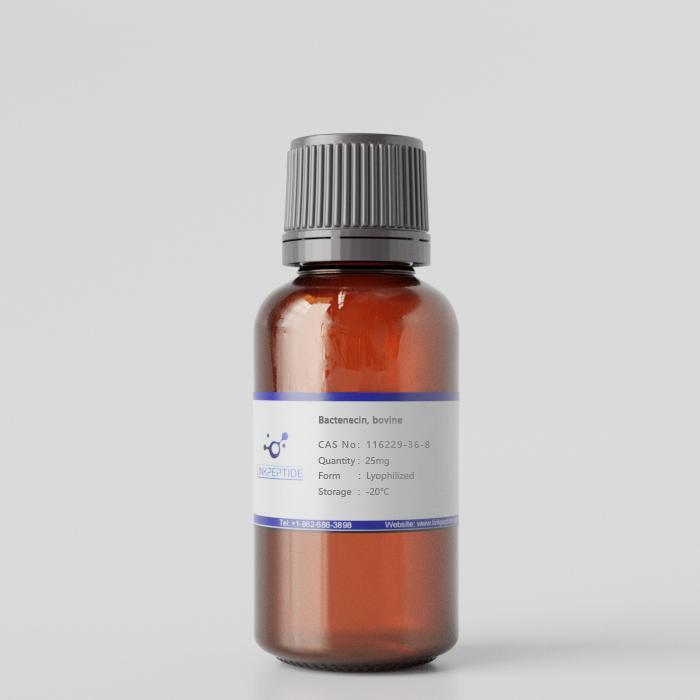
Product Name: Bactenecin, bovine
Sequence One Letter Code: RLCRIVVIRVCR (Disulfide bridge: 3-11)
Sequence Three Letter Code: H-Arg-Leu-Cys-Arg-Ile-Val-Val-Ile-Arg-Val-Cys-Arg-OH (Disulfide bridge: 3-11)
Cas No: 116229-36-8
Chemical Formula:C63H118N24O13S2
Molecular Weight: 1484
Purity: 95%
Form: Lyophilized
Storage Conditions: - 20 °C
Research Area: Inflammation Modulation
SMILES: CCC(C)C1C(=O)NC(C(=O)NC(C(=O)NC(C(=O)NC(C(=O)NC(C(=O)NC(CSSCC(C(=O)NC(C(=O)N1)CCCN=C(N)N)NC(=O)C(CC(C)C)NC(=O)C(CCCN=C(N)N)N)C(=O)NC(CCCN=C(N)N)C(=O)O)C(C)C)CCCN=C(N)N)C(C)CC)C(C)C)C(C)C
IUPAC: 2-[[28-[[2-[[2-amino-5-(diaminomethylideneamino)pentanoyl]amino]-4-methylpentanoyl]amino]-13,22-di(butan-2-yl)-10,25-bis[3-(diaminomethylideneamino)propyl]-6,9,12,15,18,21,24,27-octaoxo-7,16,19-tri(propan-2-yl)-1,2-dithia-5,8,11,14,17,20,23,26-octazacyclononacosane-4-carbonyl]amino]-5-(diaminomethylideneamino)pentanoic acid
INCHIKEY: RHISNKCGUDDGEG-UHFFFAOYSA-N
INCHI:
InChI=1S/C63H118N24O13S2/c1-13-34(11)46-57(97)78-38(21-17-25-75-62(69)70)49(89)83-43(31(5)6)54(94)82-42(53(93)79-39(59(99)100)22-18-26-76-63(71)72)29-102-101-28-41(81-51(91)40(27-30(3)4)80-48(88)36(64)19-15-23-73-60(65)66)52(92)77-37(20-16-24-74-61(67)68)50(90)86-47(35(12)14-2)58(98)85-44(32(7)8)55(95)84-45(33(9)10)56(96)87-46/h30-47H,13-29,64H2,1-12H3,(H,77,92)(H,78,97)(H,79,93)(H,80,88)(H,81,91)(H,82,94)(H,83,89)(H,84,95)(H,85,98)(H,86,90)(H,87,96)(H,99,100)(H4,65,66,73)(H4,67,68,74)(H4,69,70,75)(H4,71,72,76)
Source / Species: Bovine
Conjugation: Unconjugated
Code Nacres: NA.26
Application: Bactenecin, bovine is a 12–amino acid cationic antimicrobial peptide belonging to the cathelicidin family and originally isolated from bovine neutrophils. Its amphipathic and positively charged structure enables strong interaction with negatively charged microbial membranes, leading to membrane permeabilization and cell death. Bactenecin exhibits activity against a broad spectrum of bacteria and contributes to innate immune defense mechanisms. Due to its compact structure and potent antimicrobial profile, this peptide is widely used to investigate peptide–membrane interactions, antimicrobial mechanisms, and structure–activity relationships within the cathelicidin family. It also supports research into the development of peptide-based antimicrobial agents and host defense modulators.
Current Research: Bactenecin, bovine is a 12–amino acid cationic antimicrobial peptide belonging to the cathelicidin family and originally isolated from bovine neutrophils. As part of the innate immune defense repertoire, bactenecin is stored in neutrophil granules and released upon activation during infection or inflammatory stimulation. Its compact structure, high positive charge, and amphipathic character enable efficient interaction with microbial membranes, contributing to rapid bactericidal activity. Structural Characteristics Bactenecin is distinguished by its short length and highly cationic composition, enriched in arginine and other positively charged residues. This positive charge facilitates electrostatic attraction to negatively charged bacterial membranes composed of phosphatidylglycerol, cardiolipin, and lipopolysaccharides. The peptide adopts a conformation that supports membrane interaction and insertion, enabling disruption of bilayer integrity. Its small size and defined sequence make it particularly suitable for structural and mechanistic studies of antimicrobial peptides. Antimicrobial Mechanism of Action The primary mode of action of bactenecin involves membrane targeting. After electrostatic binding to the microbial surface, the peptide inserts into the lipid bilayer and disrupts membrane structure. This can result in: Increased membrane permeability Formation of transient or stable pores Leakage of intracellular contents Loss of membrane potential These effects rapidly compromise bacterial viability. The membrane-directed mechanism reduces dependence on specific intracellular targets and contributes to broad-spectrum antimicrobial activity. Spectrum of Activity Bactenecin exhibits activity against a range of Gram-positive and Gram-negative bacteria in experimental systems. Its potency and rapid action underscore its role as an early-line defense molecule in innate immunity. Because microbial membranes differ structurally from mammalian cell membranes, cationic antimicrobial peptides like bactenecin demonstrate selective toxicity toward pathogens under appropriate experimental conditions. Role in Innate Immunity As a member of the cathelicidin family, bactenecin is produced as part of a larger precursor protein that is proteolytically processed to generate the active peptide. Cathelicidins are conserved across mammalian species and contribute to frontline host defense by combining direct antimicrobial effects with immune modulation. In addition to membrane disruption, antimicrobial peptides may influence cytokine production, chemotaxis, and inflammatory signaling, broadening their functional significance in host defense. Applications in Research Bactenecin, bovine is widely used in: Peptide–membrane interaction studies Liposome permeabilization assays Antimicrobial activity testing Structure–activity relationship (SAR) analyses Comparative studies within the cathelicidin family Its short length and defined sequence facilitate mutational analysis aimed at determining how charge distribution, hydrophobicity, and residue positioning affect antimicrobial potency. Peptide Engineering and Drug Development Because of its potent antimicrobial properties and structural simplicity, bactenecin serves as a model scaffold for the design of peptide-based antimicrobial agents. Modifications to improve stability, reduce cytotoxicity, or enhance spectrum of activity are often evaluated using bactenecin as a template. Such studies contribute to ongoing efforts to develop alternatives to conventional antibiotics, particularly in the context of increasing antimicrobial resistance. Experimental Advantages Short, well-defined cationic sequence Strong membrane-targeting activity Suitable for biochemical and microbiological assays Ideal scaffold for structure–function studies Relevant model within the cathelicidin family Research Significance Bactenecin, bovine provides a compact and potent model for investigating antimicrobial peptide biology. Its defined amphipathic structure and membrane-disruptive mechanism support detailed analysis of host defense strategies and peptide–lipid interactions. As antimicrobial resistance continues to pose significant challenges, bactenecin remains an important tool in research focused on innate immunity and peptide-based therapeutic development.
Get a Quote
 LinkPeptide