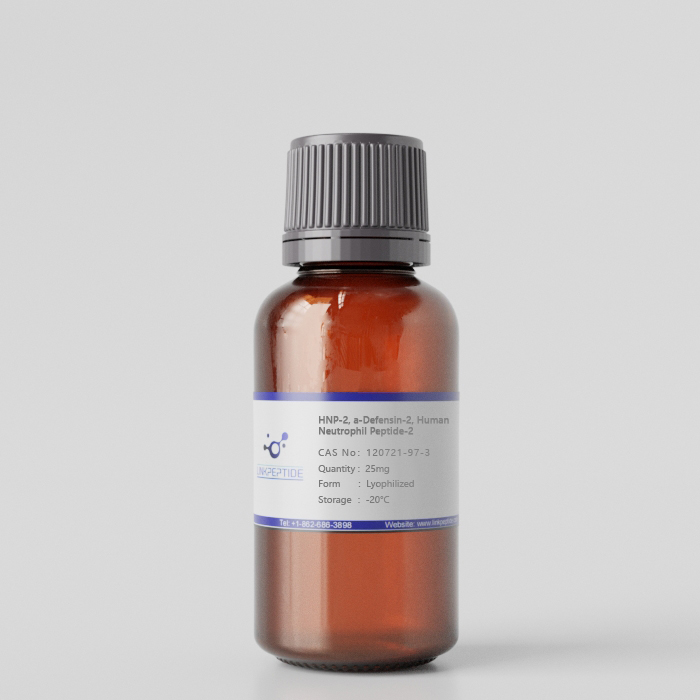
Product Name: HNP-2, a-Defensin-2, Human Neutrophil Peptide-2
Sequence One Letter Code: CYCRIPACIAGERRYGTCIYQGRLWAFCC (Disulfide bridge: 1-29, 3-18, 8-28)
Sequence Three Letter Code: H-Cys-Tyr-Cys-Arg-Ile-Pro-Ala-Cys-Ile-Ala-Gly-Glu-Arg-Arg-Tyr-Gly-Thr-Cys-Ile-Tyr-Gln-Gly-Arg-Leu-Trp-Ala-Phe-Cys-Cys-OH (Disulfide bridge: 1-29, 3-18, 8-28)
Cas No: 120721-97-3
Chemical Formula:C147H217N43O37S6
Molecular Weight: 3371.1
Purity: 95%
Form: Lyophilized
Storage Conditions: - 20 °C
Research Area: Infection Disease Research
SMILES: CC[C@H](C)[C@H]1C(=O)N[C@H](C(=O)NCC(=O)N[C@H](C(=O)N[C@H](C(=O)N[C@H](C(=O)N[C@H](C(=O)NCC(=O)N[C@H](C(=O)N[C@H]2CSSC[C@H]3C(=O)N[C@H](C(=O)N[C@H](C(=O)N4CCC[C@H]4C(=O)N[C@H](C(=O)N[C@@H](CSSC[C@@H](C(=O)N[C@@H](CSSC[C@@H](C(=O)N[C@H](C(=O)N3)CC5=CC=C(C=C5)O)N)C(=O)O)NC(=O)[C@@H](NC(=O)[C@@H](NC(=O)[C@@H](NC(=O)[C@@H](NC(=O)[C@@H](NC(=O)CNC(=O)[C@@H](NC(=O)[C@@H](NC(=O)[C@@H](NC2=O)[C@@H](C)CC)CC6=CC=C(C=C6)O)CCC(=O)N)CCCNC(=N)N)CC(C)C)CC7=CNC8=CC=CC=C87)C)CC9=CC=CC=C9)C(=O)N1)C)[C@@H](C)CC)CCCNC(=N)N)[C@@H](C)O)CC1=CC=C(C=C1)O)CCCNC(=N)N)CCCNC(=N)N)CCC(=O)O)C
IUPAC: (1R,4S,7S,13S,16S,19R,22S,25S,31S,34S,37S,40S,46S,49R,52S,55S,58S,64S,67S,70S,73S,76S,79R,82R,87R,90S)-87-amino-58-(3-amino-3-oxopropyl)-76-benzyl-7,22,52-tris[(2S)-butan-2-yl]-4,34,37,64-tetrakis(3-carbamimidamidopropyl)-31-(2-carboxyethyl)-46-[(1R)-1-hydroxyethyl]-40,55,90-tris[(4-hydroxyphenyl)methyl]-70-(1H-indol-3-ylmethyl)-16,25,73-trimethyl-67-(2-methylpropyl)-2,5,8,14,17,20,23,26,29,32,35,38,41,44,47,50,53,56,59,62,65,68,71,74,77,80,88,91-octacosaoxo-84,85,94,95,98,99-hexathia-3,6,9,15,18,21,24,27,30,33,36,39,42,45,48,51,54,57,60,63,66,69,72,75,78,81,89,92-octacosazatetracyclo[47.43.4.419,79.09,13]hectane-82-carboxylic acid
INCHIKEY: GRZXCHIIZXMEPJ-HTLKCAKFSA-N
INCHI:
InChI=1S/C147H217N43O37S6/c1-13-73(6)114-139(222)168-76(9)118(201)163-63-110(196)170-96(48-50-113(199)200)127(210)172-92(31-22-52-159-145(152)153)125(208)171-93(32-23-53-160-146(154)155)126(209)178-98(58-81-35-41-85(192)42-36-81)123(206)165-65-112(198)186-117(79(12)191)141(224)184-106-70-232-229-67-103-134(217)173-94(33-24-54-161-147(156)157)128(211)189-116(75(8)15-3)142(225)190-55-25-34-108(190)138(221)167-78(11)120(203)181-105(136(219)187-114)69-231-230-68-104(135(218)185-107(143(226)227)71-233-228-66-89(148)121(204)176-100(133(216)182-103)59-82-37-43-86(193)44-38-82)183-132(215)99(57-80-26-17-16-18-27-80)175-119(202)77(10)166-129(212)102(61-84-62-162-90-29-20-19-28-88(84)90)179-130(213)97(56-72(4)5)177-124(207)91(30-21-51-158-144(150)151)169-111(197)64-164-122(205)95(47-49-109(149)195)174-131(214)101(60-83-39-45-87(194)46-40-83)180-140(223)115(74(7)14-2)188-137(106)220/h16-20,26-29,35-46,62,72-79,89,91-108,114-117,162,191-194H,13-15,21-25,30-34,47-61,63-71,148H2,1-12H3,(H2,149,195)(H,163,201)(H,164,205)(H,165,206)(H,166,212)(H,167,221)(H,168,222)(H,169,197)(H,170,196)(H,171,208)(H,172,210)(H,173,217)(H,174,214)(H,175,202)(H,176,204)(H,177,207)(H,178,209)(H,179,213)(H,180,223)(H,181,203)(H,182,216)(H,183,215)(H,184,224)(H,185,218)(H,186,198)(H,187,219)(H,188,220)(H,189,211)(H,199,200)(H,226,227)(H4,150,151,158)(H4,152,153,159)(H4,154,155,160)(H4,156,157,161)/t73-,74-,75-,76-,77-,78-,79+,89-,91-,92-,93-,94-,95-,96-,97-,98-,99-,100-,101-,102-,103-,104-,105-,106-,107-,108-,114-,115-,116-,117-/m0/s1
Source / Species: human
Conjugation: Unconjugated
Code Nacres: NA.26
Application: HNP-2 (α-Defensin-2) is a 29-amino acid cationic peptide belonging to the α-defensin family of innate immune effectors. Stored in azurophilic granules of human neutrophils, HNP-2 is rapidly released upon activation and contributes to frontline antimicrobial defense. The peptide disrupts microbial membranes through electrostatic interactions and pore formation, exhibiting activity against Gram-positive and Gram-negative bacteria, fungi, and select viruses. Beyond direct microbicidal action, HNP-2 modulates inflammatory signaling, chemotaxis, and cytokine production. Its defined disulfide-bonded structure makes it a useful model for studying defensin folding and structure–function relationships. HNP-2 is widely employed in immunology and infection research to investigate host defense mechanisms and innate immune regulation.
Current Research: HNP-2 (α-Defensin-2) is a 29–amino acid cationic antimicrobial peptide belonging to the human α-defensin family, a key component of innate immune defense. It is stored in azurophilic granules of neutrophils and released rapidly upon activation during infection or inflammatory stimulation. As part of the frontline host defense system, HNP-2 exhibits broad-spectrum antimicrobial activity and contributes to immune modulation at sites of tissue injury and microbial invasion. Structure and Biochemical Characteristics HNP-2 shares the conserved structural features characteristic of α-defensins, including six cysteine residues that form three intramolecular disulfide bonds. These disulfide linkages stabilize a compact β-sheet–rich structure critical for antimicrobial activity and proteolytic resistance. The peptide’s strong cationic charge facilitates electrostatic interactions with negatively charged microbial membranes, while its amphipathic character supports membrane insertion and disruption. Because of its defined disulfide-bonded architecture, HNP-2 serves as a valuable model for investigating defensin folding pathways, oxidative disulfide bond formation, and structure–function relationships. Comparative studies between oxidized and reduced forms provide insight into the structural determinants required for antimicrobial efficacy. Antimicrobial Mechanism of Action HNP-2 exerts direct microbicidal effects through membrane targeting mechanisms. Its positive charge promotes binding to anionic phospholipids and lipopolysaccharides on bacterial cell surfaces. Following membrane association, HNP-2 can induce membrane permeabilization, pore formation, and destabilization of lipid bilayers, leading to microbial cell death. The peptide demonstrates activity against: Gram-positive bacteria Gram-negative bacteria Fungal pathogens Select enveloped viruses Its ability to disrupt diverse microbial membranes highlights its role as a broad-spectrum innate immune effector. Immunomodulatory Functions In addition to direct antimicrobial action, HNP-2 participates in immune regulation. It modulates cytokine production, influences dendritic cell maturation, and affects chemotactic responses of immune cells. HNP-2 can function as a chemoattractant for monocytes and T lymphocytes, linking innate and adaptive immune responses. Recent studies emphasize defensins as multifunctional signaling molecules capable of shaping inflammatory microenvironments. HNP-2 has been implicated in modulating NF-κB signaling pathways, influencing IL-8 production, and regulating epithelial barrier responses during infection. Role in Infection and Inflammation Research HNP-2 is widely used in immunology and infection biology to investigate host–pathogen interactions and innate immune mechanisms. Experimental applications include: Antimicrobial activity assays Membrane permeabilization and liposome disruption studies Cytokine induction assays in epithelial or immune cells Chemotaxis and immune cell migration models Structure–function and mutagenesis analyses In inflammatory disease research, altered defensin levels have been associated with conditions such as sepsis, inflammatory bowel disease, and chronic lung infections. Synthetic HNP-2 supports mechanistic exploration of how defensin signaling influences inflammatory progression. Structural Biology and Peptide Engineering Because α-defensins represent prototypical cysteine-rich antimicrobial peptides, HNP-2 is frequently employed as a reference scaffold for engineering peptide analogs with enhanced stability, altered selectivity, or improved therapeutic potential. Structural studies using NMR and crystallography have clarified how disulfide pairing governs conformational stability and biological activity. The defined 29-residue sequence provides a reproducible platform for analyzing the impact of sequence modifications on antimicrobial potency and immunomodulatory function. Experimental Advantages Broad-spectrum antimicrobial activity Stable disulfide-bonded structure Dual antimicrobial and immunomodulatory functions Suitable for biochemical, microbiological, and cell-based assays Model system for defensin folding and structure–activity studies Research Significance HNP-2 (α-Defensin-2) occupies a central role in studies of innate immune defense and host–pathogen interactions. By combining potent microbicidal activity with immune signaling functions, it represents a multifunctional peptide critical for understanding early immune responses. Its well-characterized structure and mechanism make it a foundational tool in infection research, antimicrobial peptide development, and innate immunity investigations.
Get a Quote
 LinkPeptide