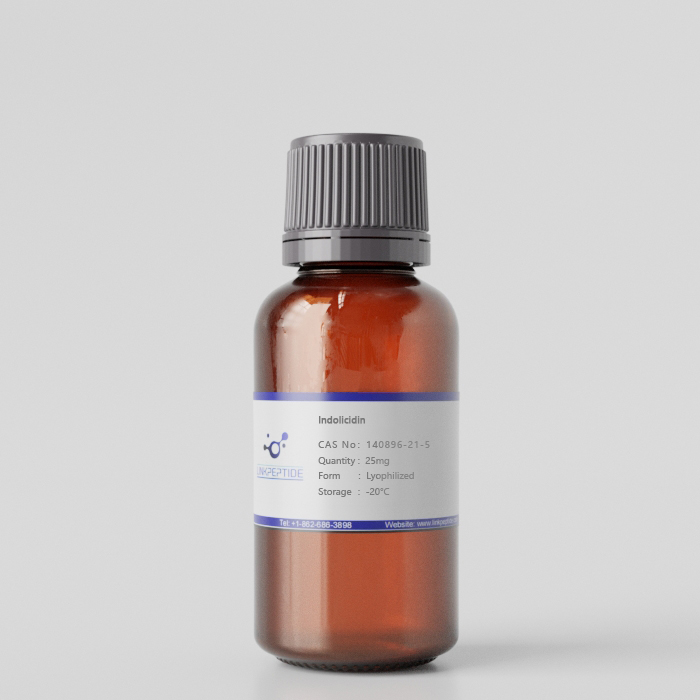
Product Name: Indolicidin
Sequence One Letter Code: ILPWKWPWWPWRR-NH2
Sequence Three Letter Code: H-Ile-Leu-Pro-Trp-Lys-Trp-Pro-Trp-Trp-Pro-Trp-Arg-Arg-NH2
Cas No: 140896-21-5
Chemical Formula:C100H132N26O13
Molecular Weight: 1906.4 Purity: 95% Form: Lyophilized
Storage Conditions: - 20 °C
Research Area: Antiviral
SMILES: CC[C@H](C)[C@@H](C(=O)N[C@@H](CC(C)C)C(=O)N1CCC[C@H]1C(=O)N[C@@H](CC2=CNC3=CC=CC=C32)C(=O)N[C@@H](CCCCN)C(=O)N[C@@H](CC4=CNC5=CC=CC=C54)C(=O)N6CCC[C@H]6C(=O)N[C@H](CC7=CNC8=CC=CC=C87)C(=O)N[C@@H](CC9=CNC1=CC=CC=C19)C(=O)N1CCC[C@H]1C(=O)N[C@@H](CC1=CNC2=CC=CC=C21)C(=O)N[C@@H](CCCNC(=N)N)C(=O)N[C@@H](CCCNC(=N)N)C(=O)N)N
IUPAC: (2S)-1-[(2S)-2-[[(2S)-6-amino-2-[[(2S)-2-[[(2S)-1-[(2S)-2-[[(2S,3S)-2-amino-3-methylpentanoyl]amino]-4-methylpentanoyl]pyrrolidine-2-carbonyl]amino]-3-(1H-indol-3-yl)propanoyl]amino]hexanoyl]amino]-3-(1H-indol-3-yl)propanoyl]-N-[(2R)-1-[[(2S)-1-[(2S)-2-[[(2S)-1-[[(2S)-1-[[(2S)-1-amino-5-carbamimidamido-1-oxopentan-2-yl]amino]-5-carbamimidamido-1-oxopentan-2-yl]amino]-3-(1H-indol-3-yl)-1-oxopropan-2-yl]carbamoyl]pyrrolidin-1-yl]-3-(1H-indol-3-yl)-1-oxopropan-2-yl]amino]-3-(1H-indol-3-yl)-1-oxopropan-2-yl]pyrrolidine-2-carboxamide
INCHIKEY: USSYUMHVHQSYNA-PYODXXEMSA-N
INCHI:
InChI=1S/C100H132N26O13/c1-5-57(4)85(102)95(136)123-79(45-56(2)3)96(137)124-42-20-36-82(124)92(133)118-76(46-58-51-110-68-28-11-6-23-63(58)68)89(130)116-74(33-16-17-39-101)88(129)121-80(49-61-54-113-71-31-14-9-26-66(61)71)97(138)125-43-21-38-84(125)94(135)120-78(48-60-53-112-70-30-13-8-25-65(60)70)91(132)122-81(50-62-55-114-72-32-15-10-27-67(62)72)98(139)126-44-22-37-83(126)93(134)119-77(47-59-52-111-69-29-12-7-24-64(59)69)90(131)117-75(35-19-41-109-100(106)107)87(128)115-73(86(103)127)34-18-40-108-99(104)105/h6-15,23-32,51-57,73-85,110-114H,5,16-22,33-50,101-102H2,1-4H3,(H2,103,127)(H,115,128)(H,116,130)(H,117,131)(H,118,133)(H,119,134)(H,120,135)(H,121,129)(H,122,132)(H,123,136)(H4,104,105,108)(H4,106,107,109)/t57-,73-,74-,75-,76-,77-,78+,79-,80-,81-,82-,83-,84-,85-/m0/s1
Source / Species: Bovine
Conjugation: Unconjugated
Code Nacres: NA.26
Application: Indolicidin is a 13-amino acid cationic antimicrobial peptide of the cathelicidin family, originally isolated from bovine neutrophils. Rich in tryptophan residues and C-terminally amidated, it exhibits broad-spectrum antimicrobial activity against Gram-positive and Gram-negative bacteria, fungi, protozoa, and HIV-1 in vitro. Unlike many antimicrobial peptides that act solely through membrane disruption, indolicidin also interacts with intracellular targets, reflecting a multifaceted mechanism of action. It is widely used in infection biology and immunology research to study innate defense mechanisms, peptide–membrane interactions, and antimicrobial structure–function relationships.
Current Research: Indolicidin is a 13–amino acid cationic antimicrobial peptide (AMP) belonging to the cathelicidin family, originally isolated from bovine neutrophils. Structurally distinctive, indolicidin is enriched in tryptophan and proline residues and is C-terminally amidated, features that contribute to its amphipathic character and potent biological activity. Unlike many linear α-helical AMPs, indolicidin adopts a flexible conformation that enables versatile interactions with microbial membranes and intracellular targets. Indolicidin exhibits broad-spectrum antimicrobial activity in vitro, including activity against Gram-positive bacteria, Gram-negative bacteria, fungi, protozoa, and HIV-1, making it a valuable model peptide for studying innate immune defense mechanisms. Structural and Biophysical Features The peptide’s high tryptophan content facilitates strong interactions with lipid bilayers through aromatic side-chain insertion into membrane interfaces. Proline residues contribute to conformational flexibility, allowing indolicidin to adapt structurally upon binding to membranes or nucleic acids. Key structural characteristics include: Net positive charge promoting electrostatic attraction to negatively charged microbial membranes Hydrophobic–cationic balance supporting membrane association C-terminal amidation enhancing stability and activity These features collectively underpin its antimicrobial potency and multifunctional behavior. Mechanism of Action Indolicidin demonstrates a multifaceted mechanism of antimicrobial activity, distinguishing it from classical pore-forming peptides. 1. Membrane Interaction and Disruption Indolicidin associates with microbial membranes through electrostatic and hydrophobic interactions. Rather than forming stable transmembrane pores in a canonical manner, it induces membrane perturbation, increasing permeability and compromising barrier integrity. 2. Intracellular Targeting Beyond membrane effects, indolicidin penetrates microbial cells and interacts with intracellular components. Reported mechanisms include: DNA and RNA binding Inhibition of DNA synthesis Interference with enzymatic processes Induction of oxidative stress This dual membrane–intracellular activity contributes to its broad-spectrum antimicrobial profile. Applications in Infection Biology and Immunology 1. Antimicrobial Mechanism Studies Indolicidin is frequently used to investigate: Peptide–membrane biophysics Liposome leakage and model membrane systems Structure–activity relationships of tryptophan-rich AMPs Synergistic effects with conventional antibiotics 2. Host–Pathogen Interaction Research As a cathelicidin-derived peptide, indolicidin serves as a model for studying innate immune effector mechanisms in neutrophils and other immune cells. It helps elucidate how endogenous AMPs contribute to microbial clearance. 3. Antiviral and Antiprotozoal Investigations In vitro studies have demonstrated inhibitory activity against HIV-1 and certain protozoa, supporting its use in exploratory research on peptide-based antiviral strategies. 4. Peptide Engineering and Therapeutic Design Due to its compact size and potent activity, indolicidin is commonly used as a template for: Designing stabilized analogs Modifying charge and hydrophobicity profiles Developing antimicrobial coatings or biomaterial integrations Experimental Considerations Indolicidin activity is influenced by ionic strength, serum components, and microbial membrane composition. Dose–response studies are recommended when comparing antimicrobial potency across strains or assay conditions. In membrane interaction studies, defined lipid systems can clarify structure–function relationships.
Get a Quote
 LinkPeptide