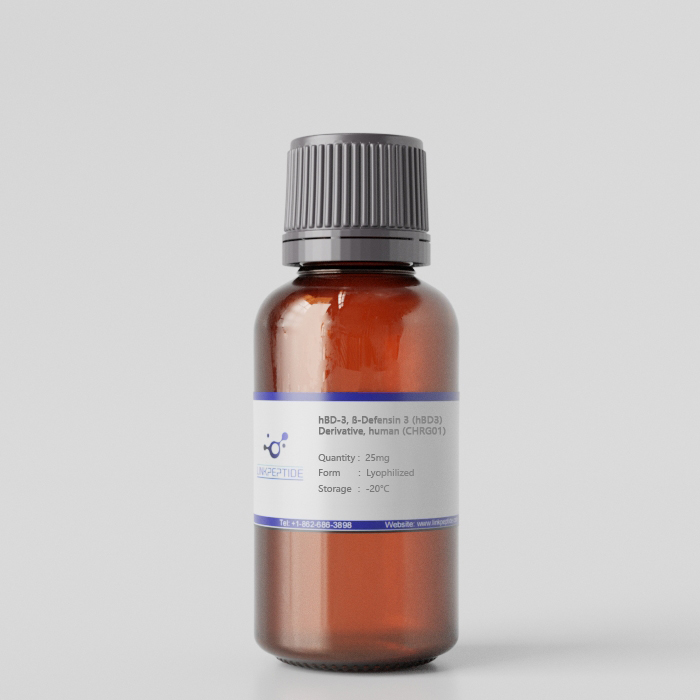
Product Name: hBD-3, ß-Defensin 3 (hBD3) Derivative, human (CHRG01)
Sequence One Letter Code: KSSTRGRKSSRRKK
Sequence Three Letter Code: H-Lys-Ser-Ser-Thr-Arg-Gly-Arg-Lys-Ser-Ser-Arg-Arg-Lys-Lys-OH
Chemical Formula:C66H128N30O20
Molecular Weight: 1662
Purity: 95%
Form: Lyophilized
Storage Conditions: - 20 °C
Research Area: Infection Disease Research
Source / Species: human
Conjugation: Unconjugated
Code Nacres: NA.26
Application: CHRG01 is a synthetic peptide derived from residues 54–67 of human β-defensin 3 (hBD-3), in which all cysteine residues are substituted with serine to prevent disulfide bond formation. Despite elimination of native disulfide bridges, CHRG01 retains electrostatic-dependent antimicrobial activity characteristic of hBD-3. This modification enables investigation of defensin structure–function relationships independent of disulfide-stabilized folding. The peptide is useful for studying membrane interactions, antimicrobial mechanisms, and host–pathogen dynamics. CHRG01 is widely applied in research on innate immunity, defensin biology, and antimicrobial resistance, providing a simplified model for analyzing cationic host defense peptide activity.
Current Research: The growing threat of antimicrobial resistance has intensified research into host defense peptides (HDPs) as potential alternatives to traditional antibiotics. Among these molecules, human β-defensin 3 (hBD-3) is one of the most potent antimicrobial peptides in the innate immune system. Known for its broad-spectrum activity against bacteria, fungi, and some viruses, hBD-3 plays an important role in mucosal immunity and epithelial defense. However, the structural complexity of defensins—particularly their multiple disulfide bonds—can complicate mechanistic studies. To address this challenge, researchers have developed simplified peptide derivatives such as CHRG01, which allow investigation of defensin function without the constraints of disulfide-stabilized folding. Human β-Defensin 3 and Innate Immunity Human β-defensins belong to a family of cationic antimicrobial peptides expressed primarily by epithelial cells. These peptides contribute to the first line of defense against microbial invasion by directly disrupting microbial membranes and by modulating immune responses. Among the known defensins, hBD-3 is especially notable for its strong antimicrobial potency and salt-resistant activity, allowing it to function effectively in physiological environments where other antimicrobial peptides lose activity. Structurally, hBD-3 contains three disulfide bonds formed by six cysteine residues, which stabilize its folded conformation. These disulfide bridges are traditionally believed to contribute to peptide stability, structural integrity, and functional activity. However, growing evidence suggests that electrostatic interactions between positively charged residues and negatively charged microbial membranes play a central role in defensin antimicrobial activity. Disentangling the contributions of structure and charge has therefore become an important area of defensin research. Design and Structural Simplification of CHRG01 CHRG01 is a synthetic peptide derived from residues 54–67 of human β-defensin 3, representing a truncated segment of the native peptide. In this derivative, all cysteine residues have been replaced with serine, preventing the formation of disulfide bonds. This substitution removes the structural constraints imposed by the native defensin fold while preserving the peptide’s overall charge distribution. The rationale behind this design is to create a minimalistic model peptide that retains the electrostatic features responsible for antimicrobial activity while eliminating structural elements that could complicate mechanistic interpretation. By preventing disulfide bond formation, CHRG01 remains more flexible and does not adopt the compact, disulfide-stabilized structure typical of defensins. This allows researchers to investigate whether antimicrobial function arises primarily from cationic charge interactions rather than rigid tertiary structure. Interestingly, despite the absence of native disulfide bridges, CHRG01 retains electrostatic-dependent antimicrobial activity, demonstrating that certain functional properties of defensins can be preserved even in simplified peptide forms. This observation provides important insight into how defensins interact with microbial membranes. Investigating Membrane Interactions and Antimicrobial Mechanisms One of the most widely studied aspects of defensin biology is their ability to disrupt microbial membranes. Like many cationic antimicrobial peptides, defensins interact preferentially with negatively charged phospholipids found in bacterial membranes, while largely sparing neutral mammalian cell membranes. Because CHRG01 lacks rigid structural constraints, it serves as a useful probe for examining membrane interaction dynamics. Researchers often employ this peptide in experiments involving: Liposome membrane disruption assays Bacterial membrane permeability studies Fluorescence-based membrane binding analysis Biophysical characterization of peptide–lipid interactions Such studies help clarify how electrostatic attraction, amphipathicity, and peptide flexibility influence antimicrobial activity. CHRG01 therefore contributes to a broader understanding of how host defense peptides recognize and destabilize microbial membranes. Applications in Host–Pathogen Interaction Studies Beyond direct antimicrobial activity, defensins also play roles in immune signaling and host–pathogen interactions. They can recruit immune cells, modulate inflammatory pathways, and influence microbial colonization. Simplified peptides such as CHRG01 allow researchers to evaluate which biological effects depend on peptide structure versus charge-mediated interactions. For example, CHRG01 has been used to examine how defensin-derived peptides interact with microbial surfaces, influence biofilm formation, or alter bacterial susceptibility to immune responses. Because it isolates the cationic antimicrobial component of defensin function, the peptide provides a valuable experimental model for dissecting the biological roles of host defense peptides. A Tool for Defensin Biology and Antimicrobial Research As interest grows in peptide-based antimicrobial therapeutics, model peptides like CHRG01 offer important experimental advantages. Their simplified structure facilitates chemical synthesis, reduces structural complexity, and enables systematic modification to explore structure–activity relationships. Consequently, CHRG01 is widely applied in research focused on innate immunity, defensin biology, and antimicrobial resistance mechanisms. By providing a streamlined system for studying cationic host defense peptide activity, it helps researchers better understand the fundamental principles underlying defensin-mediated antimicrobial defense. Continued investigation of peptides like CHRG01 may also inform the design of next-generation antimicrobial agents inspired by natural immune peptides. As antibiotic resistance continues to challenge modern medicine, these insights could contribute to the development of novel therapeutic strategies that harness the mechanisms of innate immunity.
Get a Quote
 LinkPeptide