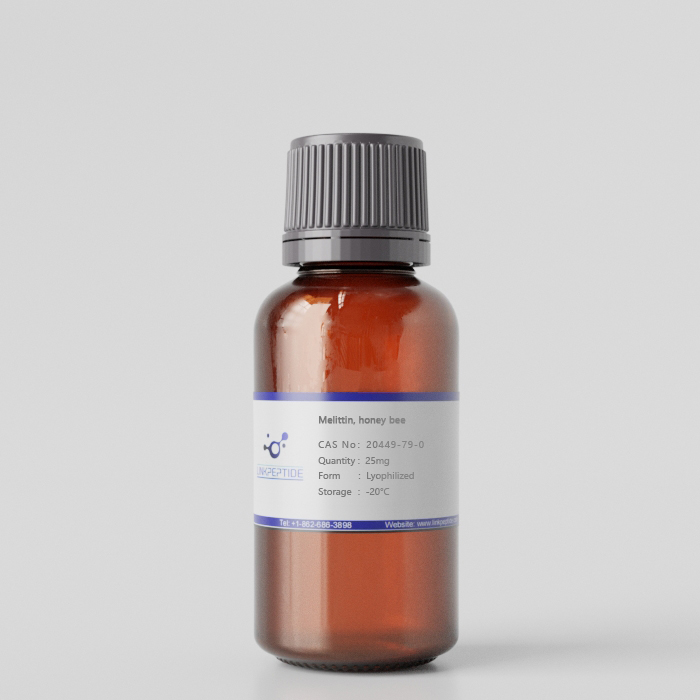
Product Name: Melittin, honey bee
Sequence One Letter Code: GIGAVLKVLTTGLPALISWIKRKRQQ-NH2
Sequence Three Letter Code: H-Gly-Ile-Gly-Ala-Val-Leu-Lys-Val-Leu-Thr-Thr-Gly-Leu-Pro-Ala-Leu-Ile-Ser-Trp-Ile-Lys-Arg-Lys-Arg-Gln-Gln-NH2
Cas No: 20449-79-0
Chemical Formula:C131H229N39O31
Molecular Weight: 2846.7
Purity: 95%
Form: Lyophilized
Storage Conditions: - 20 °C
Research Area: Inflammation and Immunology Research
SMILES: CCC(C)C(C(=O)NCC(=O)NC(C)C(=O)NC(C(C)C)C(=O)NC(CC(C)C)C(=O)NC(CCCCN)C(=O)NC(C(C)C)C(=O)NC(CC(C)C)C(=O)NC(C(C)O)C(=O)NC(C(C)O)C(=O)NCC(=O)NC(CC(C)C)C(=O)N1CCCC1C(=O)NC(C)C(=O)NC(CC(C)C)C(=O)NC(C(C)CC)C(=O)NC(CO)C(=O)NC(CC2=CNC3=CC=CC=C32)C(=O)NC(C(C)CC)C(=O)NC(CCCCN)C(=O)NC(CCCNC(=N)N)C(=O)NC(CCCCN)C(=O)NC(CCCNC(=N)N)C(=O)NC(CCC(=O)N)C(=O)NC(CCC(=O)N)C(=O)N)NC(=O)CN
IUPAC: 2-[[5-amino-2-[[2-[[6-amino-2-[[2-[[6-amino-2-[[2-[[2-[[2-[[2-[[2-[2-[[1-[2-[[2-[[2-[[2-[[2-[[2-[[6-amino-2-[[2-[[2-[2-[[2-[[2-[(2-aminoacetyl)amino]-3-methylpentanoyl]amino]acetyl]amino]propanoylamino]-3-methylbutanoyl]amino]-4-methylpentanoyl]amino]hexanoyl]amino]-3-methylbutanoyl]amino]-4-methylpentanoyl]amino]-3-hydroxybutanoyl]amino]-3-hydroxybutanoyl]amino]acetyl]amino]-4-methylpentanoyl]pyrrolidine-2-carbonyl]amino]propanoylamino]-4-methylpentanoyl]amino]-3-methylpentanoyl]amino]-3-hydroxypropanoyl]amino]-3-(1H-indol-3-yl)propanoyl]amino]-3-methylpentanoyl]amino]hexanoyl]amino]-5-carbamimidamidopentanoyl]amino]hexanoyl]amino]-5-carbamimidamidopentanoyl]amino]-5-oxopentanoyl]amino]pentanediamide
INCHIKEY: VDXZNPDIRNWWCW-UHFFFAOYSA-N
INCHI:
InChI=1S/C131H229N39O31/c1-23-71(16)102(163-97(176)60-135)122(194)146-62-98(177)148-74(19)109(181)164-100(69(12)13)124(196)160-88(55-65(4)5)116(188)155-84(41-30-33-51-134)115(187)165-101(70(14)15)125(197)161-90(57-67(8)9)118(190)168-106(77(22)173)128(200)169-105(76(21)172)123(195)147-63-99(178)150-92(58-68(10)11)129(201)170-54-36-44-94(170)121(193)149-75(20)108(180)158-89(56-66(6)7)117(189)166-104(73(18)25-3)127(199)162-93(64-171)120(192)159-91(59-78-61-145-80-38-27-26-37-79(78)80)119(191)167-103(72(17)24-2)126(198)157-83(40-29-32-50-133)111(183)154-85(42-34-52-143-130(139)140)112(184)152-82(39-28-31-49-132)110(182)153-86(43-35-53-144-131(141)142)113(185)156-87(46-48-96(137)175)114(186)151-81(107(138)179)45-47-95(136)174/h26-27,37-38,61,65-77,81-94,100-106,145,171-173H,23-25,28-36,39-60,62-64,132-135H2,1-22H3,(H2,136,174)(H2,137,175)(H2,138,179)(H,146,194)(H,147,195)(H,148,177)(H,149,193)(H,150,178)(H,151,186)(H,152,184)(H,153,182)(H,154,183)(H,155,188)(H,156,185)(H,157,198)(H,158,180)(H,159,192)(H,160,196)(H,161,197)(H,162,199)(H,163,176)(H,164,181)(H,165,187)(H,166,189)(H,167,191)(H,168,190)(H,169,200)(H4,139,140,143)(H4,141,142,144)
Source / Species: honey bee
Conjugation: Unconjugated
Code Nacres: NA.26
Application: Melittin is a 26-amino acid amphipathic peptide derived from honey bee venom and is known for its potent membrane-disruptive properties. It interacts strongly with lipid bilayers, leading to pore formation, membrane destabilization, and cell lysis. Melittin elicits both humoral and cellular immune responses, with antibodies recognizing its C-terminal region and T cells targeting its hydrophobic core. In addition to its cytolytic activity, melittin exhibits antimicrobial and anti-inflammatory effects and has demonstrated inhibitory activity against Borrelia burgdorferi. Due to its well-characterized structure and mechanism, melittin is widely used to study membrane permeabilization, peptide–lipid interactions, and immune responses to venom-derived peptides. It also supports research exploring the therapeutic potential of cytolytic peptides in infection, inflammation, and targeted drug delivery.
Current Research: Melittin is a 26-amino acid amphipathic peptide and the principal cytolytic component of honey bee (Apis mellifera) venom. It represents one of the most extensively studied membrane-active peptides due to its potent ability to disrupt lipid bilayers and induce cell lysis. Structurally, melittin adopts an α-helical conformation in membrane-mimetic environments, with a clear segregation of hydrophobic and positively charged residues that confer strong amphipathicity. This structural organization underlies its high affinity for lipid membranes and its capacity to form pores, making it a benchmark molecule for studying peptide–lipid interactions and membrane permeabilization mechanisms. Melittin interacts preferentially with phospholipid bilayers through electrostatic attraction to negatively charged lipid headgroups and hydrophobic insertion into the membrane core. Upon membrane binding, it can aggregate and form transient or stable pores, resulting in increased permeability and eventual membrane destabilization. Experimental systems using liposomes, supported lipid bilayers, and electrophysiological measurements have demonstrated concentration-dependent pore formation and membrane thinning. These properties have made melittin a standard model for analyzing how amphipathic helices perturb membrane structure and integrity. Beyond its cytolytic action, melittin exhibits broad antimicrobial activity. It is effective against Gram-positive and Gram-negative bacteria, as well as certain fungi and enveloped viruses. Notably, melittin has demonstrated inhibitory effects against Borrelia burgdorferi, the causative agent of Lyme disease. Its antimicrobial mechanism involves membrane disruption and rapid loss of cellular homeostasis, distinguishing it from antibiotics that target specific enzymatic pathways. As such, melittin serves as a prototype for developing membrane-targeting antimicrobial agents. Melittin also elicits strong immune responses. In venom exposure, it contributes to both humoral and cellular immune activation. Antibody recognition predominantly targets epitopes within the C-terminal region, while T cell responses are often directed toward the peptide’s hydrophobic core. These immunogenic properties make melittin a useful antigenic model for studying immune recognition of venom-derived peptides, antigen processing, and epitope mapping. Its defined sequence enables precise characterization of antibody binding sites and T cell activation determinants. Interestingly, melittin exhibits context-dependent anti-inflammatory effects. Although it can promote inflammation through membrane damage at high concentrations, controlled application has been shown to modulate inflammatory signaling pathways, including inhibition of phospholipase A2 and downstream eicosanoid production. These dual properties have prompted investigation into its potential as a therapeutic agent when appropriately formulated or targeted. In membrane biophysics, melittin remains a foundational tool for exploring peptide-induced membrane curvature, lipid domain reorganization, and bilayer elasticity. Circular dichroism spectroscopy, fluorescence assays, and calorimetric studies consistently use melittin as a reference amphipathic helix. Its well-defined mechanism provides a comparative standard for evaluating newly designed cytolytic or antimicrobial peptides. The peptide has also attracted attention in drug delivery research. Because of its potent membrane-disruptive activity, engineered or attenuated melittin derivatives are being investigated as components of targeted delivery systems. Conjugation to nanoparticles or tumor-targeting ligands aims to harness its cytolytic capacity selectively while minimizing systemic toxicity. Such strategies are under exploration in oncology and infectious disease contexts. In summary, melittin is a 26-residue amphipathic peptide derived from honey bee venom with potent membrane-disruptive, antimicrobial, and immunomodulatory properties. Its well-characterized α-helical structure and pore-forming mechanism have established it as a model system for studying membrane permeabilization and peptide–lipid interactions. Beyond fundamental research, melittin continues to inform therapeutic development efforts targeting infection, inflammation, and selective cytolytic delivery strategies.
Get a Quote
 LinkPeptide