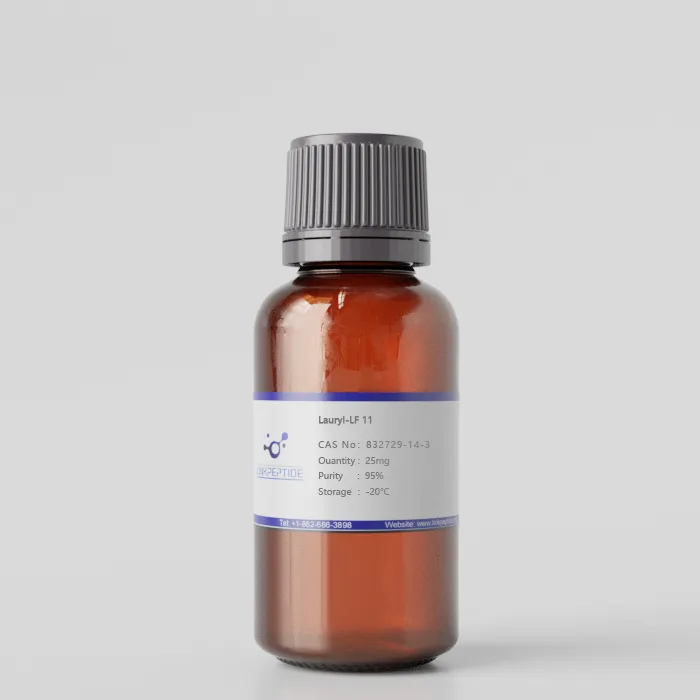
Product Name:Lauryl-LF 11
CAS No:832729-14-3
Purity:95%
Molar Mass:1712.11
Chemical Formula:C81H134N26O15
Storage:Store at -20 degrees Celsius
Sequence:FQWQRNIRKVR
Application:
Lauryl-LF 11 is a modified version of the antimicrobial peptide LF 11, where a lauryl (a fatty acid) group is attached to enhance its membrane-binding and antimicrobial properties. This modification improves its ability to interact with and disrupt microbial cell membranes, increasing its potency against bacteria, fungi, and possibly even viruses. Lauryl-LF 11 is particularly valuable in research related to antimicrobial resistance, as it is designed to overcome the limitations of conventional antibiotics. The lauryl modification also enhances its stability and bioavailability, making it a promising candidate for the development of novel antimicrobial therapies.
Current Research:
Lauryl-LF 11 (CAS: 832729-14-3) is an N-terminally acylated analog of the peptide LF 11, derived from human lactoferricin. This modification involves the addition of a lauryl (C12) fatty acid chain to the N-terminus, enhancing its amphipathic nature and biological activity.
Biological Activity
Lauryl-LF 11 exhibits enhanced antibacterial properties compared to its parent peptide, LF 11. The laurylation significantly improves its ability to bind to lipopolysaccharides (LPS) on the outer membrane of Gram-negative bacteria, facilitating membrane disruption and bacterial cell death. This modification also increases its efficacy against Gram-positive bacteria, broadening its antimicrobial spectrum.
Endotoxin Neutralization
The increased LPS-binding affinity of Lauryl-LF 11 enables it to effectively neutralize endotoxins, reducing inflammatory responses associated with endotoxin exposure. This property is particularly beneficial in preventing or mitigating conditions like sepsis, where endotoxin-induced inflammation is a critical concern.
Research Applications
Lauryl-LF 11 serves as a valuable tool in studying antimicrobial mechanisms and host-pathogen interactions. Its enhanced properties make it a promising candidate for developing new therapeutic agents aimed at treating bacterial infections and neutralizing endotoxins.
Reference:
Get a Quote
 LinkPeptide