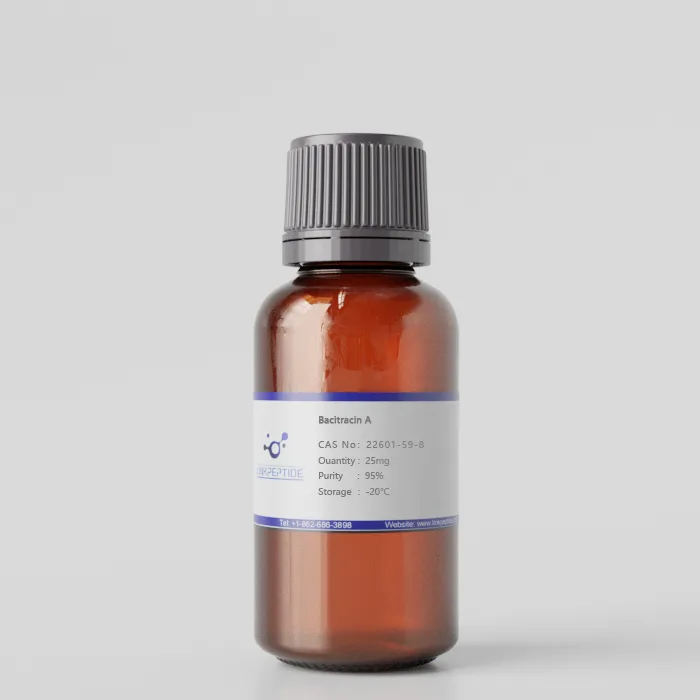
Product Name:Bacitracin A
Synonyms:Baciguent
CAS No:22601-59-8
Purity:95%
Molar Mass:1422.7
Chemical Formula:C66H103N17O16S
Storage:Store at -20 degrees Celsius
Application:
Bacitracin A is a prominent peptide antibiotic primarily used for its potent activity against Gram-positive bacteria. Isolated from Bacillus licheniformis, Bacitracin A disrupts bacterial cell wall synthesis by inhibiting the dephosphorylation of bactoprenol, a critical lipid carrier in the peptidoglycan biosynthesis pathway. This mechanism makes Bacitracin A effective against a broad range of bacterial pathogens, particularly in treating skin and eye infections. Due to its effectiveness, it is frequently utilized in topical formulations. Bacitracin A is also valuable in research for studying bacterial resistance mechanisms and for its role in investigating cell wall biosynthesis, offering insights into antibiotic development and microbial physiology.
Current Research:
Bacitracin A, a cyclic polypeptide antibiotic derived from Bacillus subtilis and Bacillus licheniformis, is the primary active component of the bacitracin complex. It exhibits potent antibacterial activity, primarily against Gram-positive bacteria, through its unique mechanism of action. Bacitracin A interferes with bacterial cell wall synthesis by inhibiting the dephosphorylation of undecaprenyl pyrophosphate (UPP), a lipid carrier crucial for peptidoglycan precursor transport. This inhibition disrupts cell wall integrity, leading to bacterial cell lysis.
Research Applications
Antibacterial Studies:
Bacitracin A is widely used in microbiology to study bacterial cell wall synthesis and mechanisms of antibiotic resistance. Its activity against Gram-positive bacteria, including Staphylococcus aureus and Streptococcus species, makes it a valuable tool for identifying resistance patterns and evaluating new antimicrobial agents.
Membrane Transport Mechanisms:
Research on Bacitracin A has provided insights into lipid carrier recycling and its regulation within bacterial membranes. Its ability to inhibit UPP regeneration has been pivotal in understanding the dynamics of bacterial cell wall biosynthesis.
Biomedical Research:
Beyond microbiology, Bacitracin A is employed in tissue culture studies to prevent contamination and to explore its potential effects on eukaryotic cells. Additionally, its interaction with metal ions, such as zinc, enhances its antimicrobial properties, making it a subject of interest in developing improved formulations.
Drug Development:
Structural studies of Bacitracin A have inspired the design of peptide-based antibiotics targeting resistant bacterial strains. Its unique mechanism of action offers a framework for developing new agents that circumvent common resistance mechanisms.
In summary, Bacitracin A is an essential tool in antibiotic research, offering insights into bacterial physiology, antimicrobial resistance, and the development of novel therapeutics.
Reference:
Get a Quote
 LinkPeptide